Vercel AI SDK Releases workflow-harness 1.0.129 Patch Update

Vercel AI SDK releases workflow-harness 1.0.129 patch, syncing dependencies with @ai-sdk/harness.
Vercel AI SDK has released `@ai-sdk/workflow-harness@1.0.129`, a patch update focused on version alignment with `@ai-sdk/harness` and syncing two upstream commits — with no breaking changes. The `workflow-harness` package handles multi-step AI workflow testing and orchestration, forming part of the production-grade runtime validation infrastructure alongside `harness`. Published via GitHub Actions with GPG signing for supply chain security, this marks the 129th patch release, reflecting the project's commitment to frequent, safe iteration.
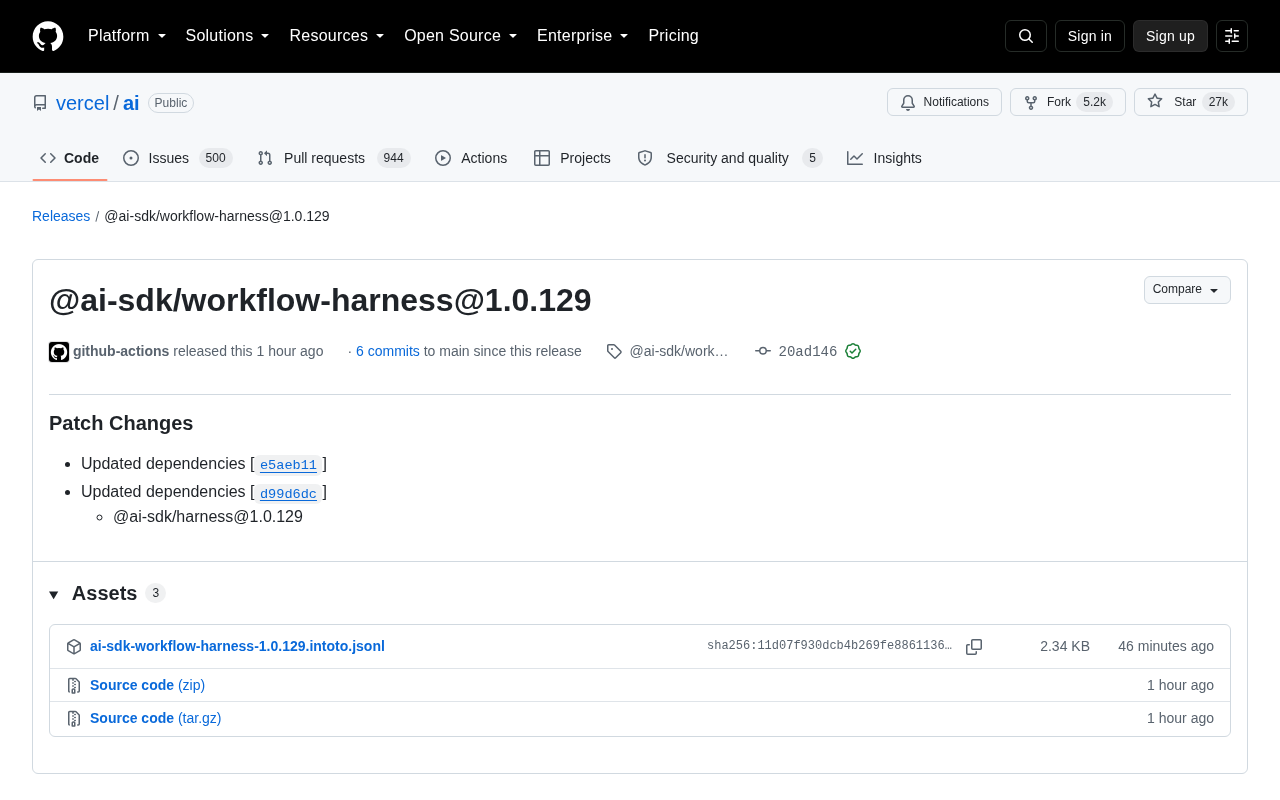
Vercel's AI SDK ecosystem has released @ai-sdk/workflow-harness@1.0.129. As a highly popular open-source project maintained by the team (with over 27k GitHub stars and 5.2k forks), this is a patch-level update focused primarily on syncing internal dependencies.
Update Overview
According to the official release notes, the core changes in version 1.0.129 center on dependency updates — specifically syncing two upstream commits (e5aeb11 and d99d6dc) and aligning with @ai-sdk/harness@1.0.129. Updates of this nature typically introduce no breaking changes; instead, they ensure consistency and stability across the toolchain's versioning.
This release was published via an automated GitHub Actions workflow and signed using GitHub's verified GPG key (ID: B5690EEEBB952194), reflecting the project's commitment to supply chain security in its release process.
What Is workflow-harness?
workflow-harness is a component within the Vercel AI SDK ecosystem. Based on its name, it's designed to support the testing, orchestration, or execution of workflows. In software engineering, a "harness" typically refers to a tool that provides a runtime environment, driving logic, or validation scaffolding for a specific module.
As AI application development grows increasingly complex, organizing LLM calls, tool executions, and multi-step reasoning into controllable workflows has become a critical requirement for building production-grade AI applications. While components like this don't directly face end users, they form an essential foundation for reliable operation of higher-level applications.
The Vercel AI SDK (the ai package and its @ai-sdk/* sub-packages) is a unified interface layer from Vercel that allows developers to call multiple model providers — OpenAI, Anthropic, Google, and others — through a consistent API. The entire SDK is managed as a monorepo and includes the core runtime, model adapters, front-end hooks for React/Vue, and auxiliary packages like harness and workflow-harness for testing and orchestration. harness can be thought of as the underlying test execution framework, while workflow-harness builds on top of it to add runtime and validation capabilities specifically for multi-step AI workflows. Together, they provide the infrastructure developers need to simulate, replay, and verify AI call chains in local or CI environments.
Why Patch Updates Matter
For developers, the value of patch releases is often underestimated. These seemingly minor dependency sync updates actually serve several important purposes:
Maintaining Dependency Tree Consistency
In a monorepo where multiple packages depend on each other, keeping version numbers aligned prevents compatibility issues caused by version drift. The fact that workflow-harness and harness share the same 1.0.129 version number is a direct result of this version governance strategy.
A monorepo is an engineering approach where multiple related projects or packages are maintained within a single repository, as opposed to the polyrepo model where each package lives in its own repo. The advantages of a monorepo include cross-package code sharing, unified CI pipelines, and atomic commits (a single commit can span multiple packages). The challenge, however, is increased version management complexity — when package A depends on package B and B releases a new version, if A doesn't update in time, "version drift" can occur, leading to runtime incompatibilities or type errors. Vercel AI SDK uses the Changesets tool to automate coordinated version releases, ensuring all sub-packages affected by a change increment their versions in sync. The matching version numbers between
workflow-harnessandharnessare a direct result of this mechanism.
Automated CI Practices
This release was completed automatically via GitHub Actions, forming a complete automated pipeline from code merge to version publication to signature verification. This approach reduces the risk of human error during releases and makes high-frequency minor version iterations feasible — the version number 1.0.129 alone speaks to the project's rapid release cadence.
GPG (GNU Privacy Guard) signature verification is an important tool for open-source supply chain security. Publishers sign commits or release tags with a private key, and anyone downloading the package can use the corresponding public key to verify that the release was genuinely published by an authorized party and hasn't been tampered with. In the npm ecosystem, combining GitHub Actions' OIDC (OpenID Connect) token mechanism with GPG signatures creates a trusted pipeline from code merge to package publication, effectively guarding against "supply chain poisoning" attacks — a type of attack that has caused serious damage in several high-profile open-source package incidents in recent years. A version number as high as
1.0.129means the project has gone through 129 patch releases since1.0.0, with high-frequency automated publishing keeping each change small and rollback costs low.
Recommendations for Developers
If you're building applications with the Vercel AI SDK, it's worth tracking these patch updates and syncing them promptly — especially if you rely on harness-related capabilities. While patch updates are generally safe, it's still good practice to validate workflow behavior in a test environment before deploying to production.
It's worth noting that the official release notes for this update are fairly brief, listing only the dependency changes without disclosing specific feature improvements or bug fix details. Developers looking for deeper context on what changed can consult the associated commit records and the corresponding changelog for @ai-sdk/harness.
Related articles

Chain of Thought Isn't Just for AI: How Humans Can Use CoT to Improve Thinking Quality
Chain of Thought isn't just a prompt trick for large models. Starting from a Hacker News discussion, this article analyzes why CoT works for human thinking too, breaks down actionable ways to transfer it, and highlights the key differences between human CoT and machine CoT.
Cloudflare Teams Up with OpenAI: Closi…
Cloudflare Teams Up with OpenAI: Closing the Loop from Vulnerability Discovery to Defense with AI
Cloudflare uses OpenAI Daybreak to investigate security vulnerabilities and generate reviewable remediation plans, while developers use Codex to boost coding efficiency and quality.

Orca Multi-Agent Orchestration in Practice: A Guide to Parallel Collaboration with Claude and Codex
Orca is Stable AI's free open-source agent workbench supporting 34 agents like Claude Code and Codex in parallel. Learn its Git worktree isolation, multi-model orchestration, and mobile management.