Vercel AI SDK Releases workflow-harness 1.0.130 Patch Update

Vercel AI SDK releases workflow-harness 1.0.130 patch update, primarily syncing internal dependencies with low upgrade risk.
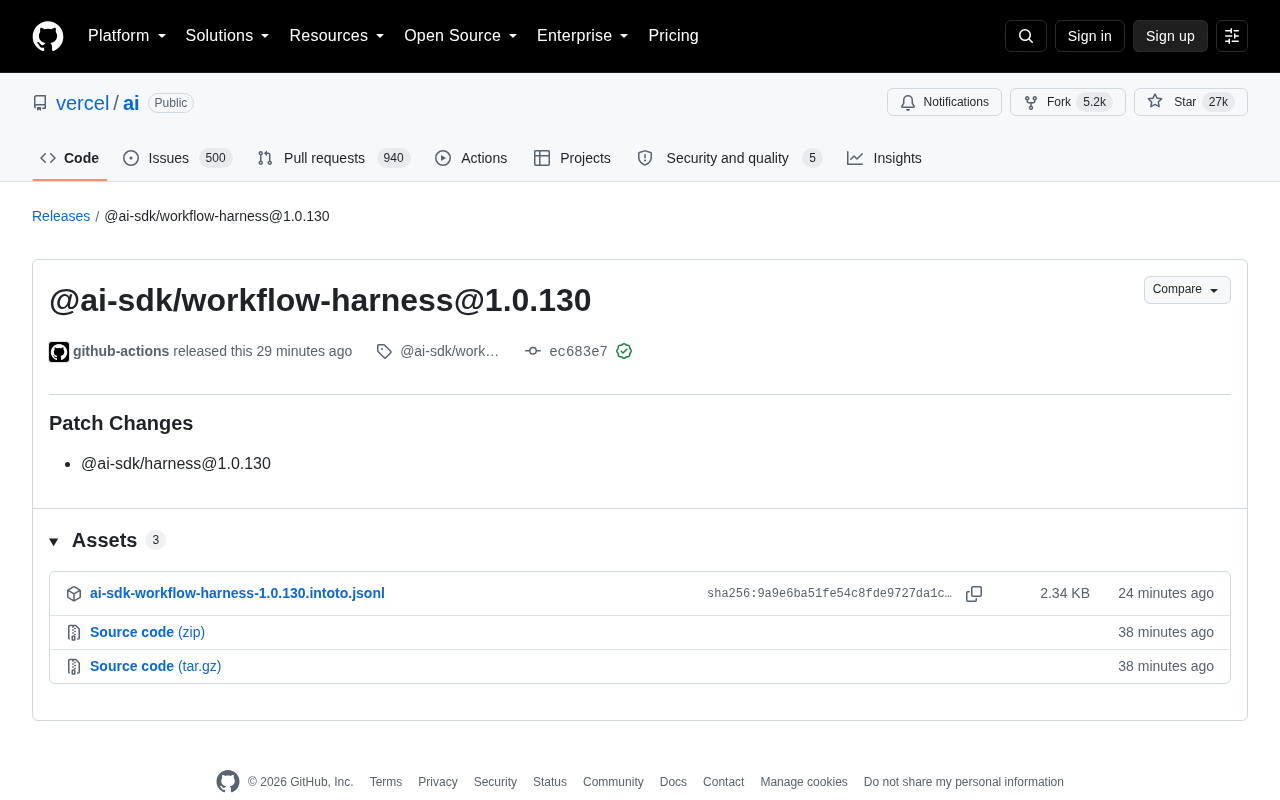
Vercel AI SDK published `@ai-sdk/[email protected]` via GitHub Actions — a patch-level update that syncs the internal `@ai-sdk/harness` dependency to the same version. As a foundational package handling workflow runtime support within the AI SDK ecosystem, its frequent small-version releases reflect the active maintenance of the Vercel AI repository (~27k stars). Since patch updates typically carry no breaking changes, developers are encouraged to incorporate this into their regular dependency update workflow, leveraging Dependabot or Renovate for automated handling with CI validation.
Vercel's popular open-source AI SDK project recently published @ai-sdk/[email protected] via GitHub Actions. This is a patch-level update that syncs the dependency on @ai-sdk/[email protected]. While the version bump may seem routine, keeping up with each iteration still provides useful context for developers building AI applications on top of this toolchain.
About This Release
This release was automated through GitHub Actions, with commits carrying a verified GPG signature (key ID: B5690EEEBB952194) — confirming it as a trusted, official source. According to the release notes, this is a Patch Changes update, and the primary change is upgrading the internal dependency @ai-sdk/harness to the matching version 1.0.130.
Patch versions typically indicate that the update focuses on bug fixes, dependency synchronization, or minor internal adjustments — not breaking changes or significant new features. For teams already using this package, the upgrade risk is low and it's safe to follow along.
What Is workflow-harness?
workflow-harness is a component within the Vercel AI SDK ecosystem. The AI SDK is a TypeScript toolkit for building AI-powered applications, widely used in scenarios like chatbots, text generation, and structured data output.
Judging by the naming, the harness family of packages primarily serves the testing, orchestration, and runtime support of workflows. These packages typically operate as internal or auxiliary tools, ensuring the stability of the core SDK across various workflow scenarios. The frequent small-version iterations of these foundational packages reflect just how actively the project is maintained.
In software engineering, a "test harness" refers to infrastructure code used to automate test execution, collect results, and manage test environments. In the context of the AI SDK, the @ai-sdk/harness family acts as a runtime scaffold — providing unified calling conventions, error capturing, and state management interfaces for AI workflow execution, so that higher-level business code doesn't need to worry about the underlying orchestration details. This design pattern is common in large SDKs: abstracting shared runtime support logic into standalone packages, which are then composed by scenario-specific packages (like workflow-harness). This approach simplifies individual maintenance and reduces coupling between modules.
What the Release Cadence Says About Project Health
The Vercel AI repository currently has around 27k stars and 5.2k forks, making it one of the most closely watched AI application development frameworks today. Reaching patch version 1.0.130 signals that the project maintains a high-frequency iteration cadence — dense small-version releases typically indicate a responsive maintenance team and disciplined dependency management.
For developers evaluating frameworks, this level of activity is a strong positive signal. It means issues are more likely to get fixed quickly, and the ecosystem can stay current with upstream LLM API changes.
What Should Developers Do?
For projects already using the AI SDK, here are a few recommendations:
- Keep an eye on version alignment between
@ai-sdk/harnessand@ai-sdk/workflow-harnessto avoid build issues caused by dependency mismatches; - Patch versions can be folded into your regular dependency update workflow — validate with CI tests before merging;
- If you're using automated dependency management tools like Dependabot or Renovate, patch updates like this can typically be handled automatically.
It's worth noting that the release notes for this update are fairly minimal, only indicating a dependency sync without disclosing specific fix details. For a deeper look at what changed, refer to the corresponding commit (ec683e7) and the repository's full changelog.
Dependabot and Renovate are the two dominant automated dependency management tools today. Dependabot is natively integrated with GitHub and periodically scans your repository to create Pull Requests for dependency updates. Renovate offers more flexible configuration strategies, supporting grouping and merging of updates based on semantic version ranges, release time windows, and more. For patch-level updates like @ai-sdk/workflow-harness, you can set automerge: true (scoped to patch only) in your tool configuration, letting the CI pipeline handle auto-merging once tests pass. This minimizes manual review overhead while keeping your dependencies continuously fresh.
Related articles

ChatGPT Space Launches: Team Collaboration and New Pages Features Explained
ChatGPT Space is OpenAI's new team collaboration feature with Pages, real-time collaboration, and Slack/Google Drive sync. We break down its privacy design, multi-platform integration, and the full workflow from conversation to document.

Migrating Apache Spark UDFs to GPU Acceleration with AI Agents
NVIDIA developer blog explains how AI Agents rewrite Apache Spark UDFs for GPU acceleration, covering migration criteria, agent rewriting and verification workflows, plus pitfalls like result consistency and CPU-GPU transfer overhead.

Zed Editor v0.40.4-rc2 Released: Usage Credits Now Available Without Upgrading
Zed editor releases v0.40.4-rc2, allowing users to use usage credits for AI features without upgrading to a paid plan, lowering the trial barrier.