Vercel AI SDK Sandbox Package Releases Version 1.0.151 Update

@ai-sdk/sandbox-vercel releases patch 1.0.151, syncs harness dependency, a low-risk automated update.
@ai-sdk/sandbox-vercel has released patch version 1.0.151, automatically built by GitHub Actions with signature verification, ensuring trusted artifact origin. The core of this update is two dependency synchronizations, upgrading @ai-sdk/harness to 1.0.151 as well, to maintain runtime consistency between the sandbox package and underlying modules in the monorepo. As a patch-level iteration, it involves no breaking changes or new features, making upgrade risk low. Developers using loose version ranges can update normally, while projects also using harness are advised to upgrade both to avoid version mismatch. The sandbox package serves as security isolation infrastructure in AI programming and AI Agent code execution scenarios, and its importance continues to rise with the proliferation of code generation applications.
Version Release Overview
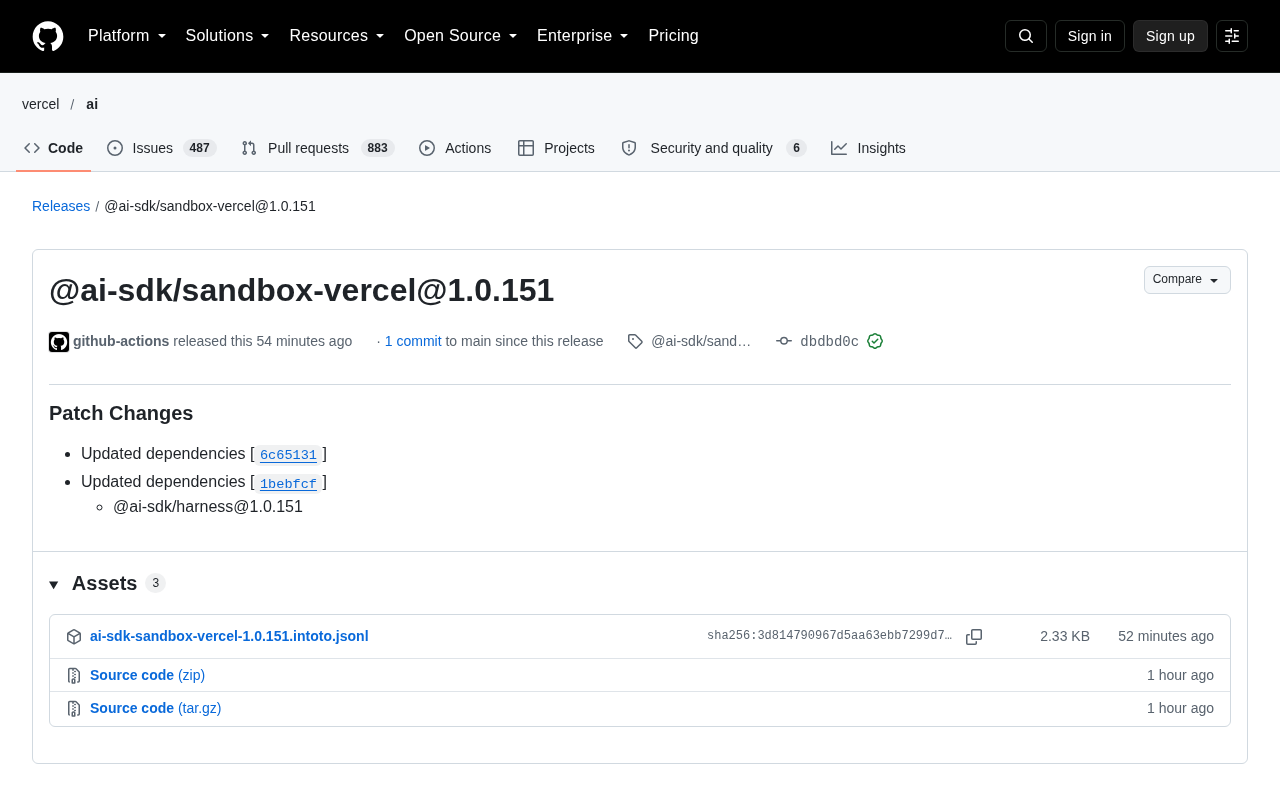
The sandbox toolkit @ai-sdk/sandbox-vercel in the Vercel AI SDK ecosystem has released version 1.0.151. This version was pushed through the GitHub Actions automated release pipeline, with commit dbdbd0c, and comes with a GitHub verification signature to ensure the integrity and trusted origin of the build artifacts.
From the version number perspective, this is a patch-level iteration, meaning this update primarily focuses on dependency synchronization and internal fixes, rather than introducing breaking changes or entirely new features.
Specific Changes in This Update
Dependency Version Synchronization
The core content of this release consists of two dependency updates, corresponding to commits 6c65131 and 1bebfcf. Among them, @ai-sdk/harness was also updated to 1.0.151, keeping it consistent with the sandbox package.
This "linked version bump" pattern is quite common in monorepo-architected SDK projects. When the underlying harness module undergoes changes, the upper-layer sandbox integration package needs to synchronize its dependency version to ensure runtime behavior consistency.
Automated Release Pipeline
This version was automatically published by the github-actions bot, with only 1 commit from the commit to the main branch. The automated release chain reduces the risk of human error and indicates that the project's CI/CD pipeline is quite mature.
GitHub Actions is a continuous integration and continuous delivery (CI/CD) platform provided by GitHub that allows developers to define workflows in code repositories, automatically executing a series of tasks when specific events (such as pushes to the main branch, tag creation, or Release publishing) are triggered. In this project, the release process is configured to execute automatically: from code commit, build, and test to ultimately publishing the package to the npm registry, all completed by the bot account github-actions. The core value of this approach lies in eliminating inconsistencies caused by manual operations and ensuring that every release artifact is reproducible.
Additionally, the "GitHub verification signature" mentioned in the article refers to the cryptographic attestation that GitHub attaches to build artifacts generated by Actions workflows. Through commands like gh attestation verify, users can verify that a certain npm package was indeed built from a specified repository and commit, rather than being a tampered third-party version. This is an important practice in software supply chain security, and is increasingly valued especially in enterprise-level dependency management.
Practical Impact on Developers
Upgrade Recommendations
For developers currently using @ai-sdk/sandbox-vercel, this is a low-risk patch update. If your project has relatively loose dependency locking (such as using ^1.0.0), performing a regular package manager update will get you this version.
If you also use @ai-sdk/harness in your project, it is recommended to upgrade both to 1.0.151 together to avoid sandbox execution anomalies caused by version mismatch.
Positioning of Sandbox Capabilities
@ai-sdk/sandbox-vercel is a toolchain component of the Vercel AI SDK, mainly used to execute AI-generated code or commands in a controlled environment. It plays an infrastructure role in "AI programming" and "AI application" scenarios—allowing model-output code to be safely run and verified without contaminating the host environment.
With the proliferation of AI Agents and code generation applications, the importance of such sandbox integration packages continues to rise.
Monorepo (single repository) is a project architecture pattern that manages multiple related packages in the same code repository, as opposed to the traditional independent repository per package (polyrepo). In a monorepo, @ai-sdk/harness and @ai-sdk/sandbox-vercel, although functionally different, share the same set of build tools, testing frameworks, and release processes.
The key impact of this architecture is version linkage: when the underlying harness package undergoes changes and releases a new version, the sandbox package that depends on it needs to synchronously update its dependency declaration in package.json to ensure that a matching version is pulled during installation. This is precisely the core content of this 1.0.151 release—two dependency synchronization commits.
The advantage of monorepo lies in low cross-package refactoring costs, transparent dependency relationships, and unified release cadence; the challenge is that it requires tools like Changesets, Lerna, or Turborepo to manage version numbers and release processes, otherwise version mismatches easily occur. Vercel AI SDK has evidently solved this problem through its automated toolchain.
Ecosystem Perspective
Vercel's AI SDK system is rapidly expanding, forming a complete matrix from the core SDK to peripheral packages like harness and sandbox. The high-frequency minor version iterations reflect two things: first, upstream dependencies change frequently; second, the team adheres to rapid delivery.
For enterprise-level users, it is recommended to establish a dependency version monitoring mechanism, evaluating whether to follow patch version releases rather than blindly upgrading, with particular attention to the version correspondence between harness and sandbox.
Related articles

JobRunner MCP Server: AI Agents Can Now Fix Failed Java Jobs
JobRunner launches an open-source MCP server enabling AI agents to view cluster status, diagnose failures, and recover Java jobs—incident response from any cloud coding environment or existing agent.

MLAI Digital Launches 9 Security Agents: MCP Server Safeguards the Full Lifecycle of Agentic AI
MLAI Digital launches Security MCP Server with nine built-in specialized security agents covering vulnerability discovery, attack simulation, prompt injection detection, API and infrastructure assessment, and accelerated remediation—embedding security validation across the full Agentic AI lifecycle from development to production.

Running Isaac Lab on H100 GPUs: Exploring Better Approaches
Exploring optimization methods for running Isaac Lab on NVIDIA H100 GPUs, including MIG configuration, mixed precision, TensorRT acceleration, and community experience to improve robotics simulation and reinforcement learning efficiency.