Vercel AI SDK: Say Goodbye to Spinning-Wheel Waits in AI Chat with Streaming Responses

Vercel AI SDK improves AI chat with streaming and typed tool calls, but weigh paid gateway and frequent breaking upgrades.
The article introduces Vercel AI SDK, an Apache-licensed TypeScript AI toolkit with over 27,000 GitHub stars. Its core mechanism streams model replies from server to browser React chat hook for instant rendering. It covers three layers: streaming chat, Zod schema typed output validation, and tool calling. It also notes three costs: paid Vercel AI Gateway, three breaking major versions in a year, and lack of team-level gateway; consider LiteLLM for that.
A user asks your AI chat app a question, and all they see is a spinning animation—one second, two seconds, ten seconds—and then the entire answer suddenly pops up. This experience is driving users away. The solution proposed in the video is the Vercel AI SDK: an open-source TypeScript toolkit that makes model replies arrive as they're written, like a phone call, rather than waiting for the whole thing to be finished, like sending a letter.
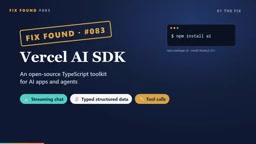
What It Actually Is: An Apache-Licensed TypeScript AI Toolkit
The Vercel AI SDK has a clear positioning—an AI application development kit for TypeScript developers, with over 27,000 GitHub stars and an Apache license. Its core mechanism works on two ends: the server continuously pushes the model's reply to the browser as a stream; the browser-side React chat hook is responsible for instantly appending each small chunk of content to the screen and accurately determining when the answer ends.
Model compatibility covers major providers such as OpenAI, Anthropic, and Google. This means developers don't have to write a separate integration for each vendor, and switching models requires little change to upper-layer code.
Three Functional Layers Worth Noting
1. Streaming Chat: The Primary Fast-Track
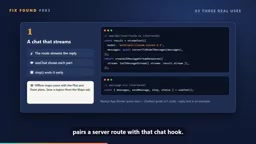
The official quick start pairs a server-side route with the React chat hook—this is the most typical integration approach. Developers only need to define a server-side route responsible for calling the model and returning a stream, and use the hook on the frontend to consume the stream and render it, producing a "generate-as-you-display" effect. For teams with existing Next.js projects, this path has the lowest retrofitting cost.
Streaming refers to the server not waiting for the LLM to generate a complete answer but instead pushing each token to the client immediately via HTTP chunked transfer or Server-Sent Events as soon as it's produced, with the frontend rendering it incrementally. Compared to the traditional "request-wait-complete return," streaming reduces time to first byte (TTFB) from several seconds to hundreds of milliseconds, significantly improving the perceived wait. The AI SDK encapsulates the streaming interface differences of various providers on the server side into a unified ReadableStream, while the React hook is responsible for consuming that stream, maintaining message state, and identifying end markers—so developers don't have to hand-write chunk parsing and concatenation logic.
2. Typed Data: More Than Just Text
A common pain point in AI applications is that the structure the model returns is uncontrollable. The SDK's approach is to let you describe the expected data structure with a Zod schema, and when the model's output doesn't match the schema, the SDK throws an error directly. This moves "discovering the format is wrong at runtime" earlier into an explicit validation step, which is especially valuable for scenarios where model output feeds into downstream business logic.
Zod is a TypeScript-first runtime schema validation library. Developers declare object structures, types, and constraints using a chained API, then automatically infer static types via z.infer. It fills the gap where TypeScript types are erased after compilation and cannot validate runtime data. In AI scenarios, model output is essentially an uncontrollable string; a Zod schema can both serve as part of the prompt to constrain the model to generate according to the structure and perform runtime validation after receiving the result—throwing an error on validation failure to prevent dirty data from flowing downstream. The AI SDK connects Zod with the model's structured output capabilities (such as JSON mode and tool-calling parameters), making "declare schema → generate → validate" a single pipeline.
3. Tool Calling: Letting Models Solve Problems Step by Step
Each tool consists of three parts: a description, an input schema, and an execution function. The model can call these tools step by step until it reaches a final answer. This is a foundational capability for building agent-like applications and a key link in the current shift of AI applications from "chatting" to "getting work done."
Tool Calling / Function Calling is a protocol capability of large models: developers provide the model with a set of tool names, natural language descriptions, and parameter schemas. During inference, if the model determines it needs external capabilities, it returns a structured call request (tool name + parameters), which the host program actually executes before passing the result back to the model; the model then continues reasoning, looping until it gives a final answer. This allows models to break beyond the boundary of "only generating text"—they can query databases, call APIs, and perform calculations. The AI SDK abstracts this multi-turn loop into a unified interface, shielding differences in message formats and calling protocols across providers. Developers only need to define the three tool elements, and the SDK handles the loop orchestration.
Three Costs You Should Know in Advance
The video doesn't shy away from the problems here—it lays out the pitfalls plainly.
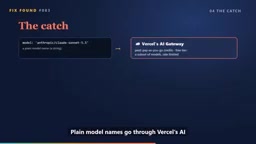
First, model calls aren't free. If you use ordinary model names directly, requests go through Vercel's AI Gateway—a paid service with only a limited free quota. Bypassing it is easy: switch to the provider's own package and key to connect directly to OpenAI or Anthropic. The library itself is open source and free, but token costs still have to be paid—the only difference is whether you pay the gateway or the provider.
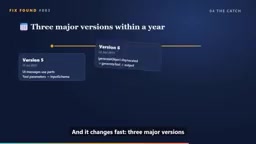
Second, versions change quickly. Three major versions were released within a year, each with breaking changes. For production projects that prioritize stability, this is a real maintenance burden—pinning versions and following migration guides are necessary work.
Third, it's not a team-level gateway. If what you need is a unified gateway with per-team key and budget allocation, the video explicitly recommends turning to LiteLLM rather than forcing this SDK to do the job.
Who Should Use It, Who Should Steer Clear
The target user is "the TypeScript developer adding AI features to their own app," regardless of whether the app is deployed on Vercel. The test is actually simple: if you're struggling with the waiting experience in AI chat, or you need type-safe model output and tool calling, this SDK is worth a try—just follow the Next.js quick start in the docs: install the package, configure the gateway or provider key, and start the dev server.
Conversely, if what you want is shared key and budget management across multiple teams, or you can't afford frequent breaking upgrades, it may not be the best fit. At the end of the video, the question is thrown to the audience: what should be fixed next? That open posture itself also shows that this tool is still evolving rapidly.
Additional Background
LiteLLM is an open-source LLM gateway/proxy layer that sits between applications and various model providers, exposing a unified OpenAI-compatible interface externally while handling key management, per-team or per-user quota and budget control, rate limiting, failure retries, cost tracking, and log auditing internally. Its positioning is complementary to the AI SDK rather than competitive: the AI SDK addresses application-side streaming rendering, typed output, and tool-calling orchestration; LiteLLM addresses organization-side unified access and governance. When the need escalates from "a single app connecting to a model" to "multiple teams sharing model resources with cost accounting," the gateway layer is the correct level of abstraction.
Related articles

Last Week Tonight Exposé: The Dangerous Ties Between Politicians and White Supremacy
Last Week Tonight investigates Georgia Senate candidate Mike Collins and Florida candidate Marshall Rawson, exposing their multiple ties to white supremacists and the Republican Party's silent response.
AI Buzz Weekly: GPT-6.5 Leak, New Claude Model, and MiniMax's Cost-Effectiveness
This week's AI buzz roundup: suspected GPT-6.5 leak, Microsoft configs showing GPT-6.1 Tera, Anthropic's new model that can identify entire classes of bugs, disappointing early Gemini 4 Carbon results, and MiniMax M3.1 Flash beating Claude Opus 5 and GPT-5.6 Sol in benchmarks at extremely low cost.

AI Briefing: Gemini 4 Carbon Released, Ant Open-Sources Ling-3.1
AI Briefing: Google releases Gemini 4 Carbon qubit model, claiming to surpass Opus 5.5 with half-price tokens; Ant open-sources Ling-3.1-1019 for real-task Personal Agents; domestic AI drug discovery succeeds in 18 of 19 projects, hitting all 6 GPCR targets; zero-revenue company valued at $20B raises another $1B; Sichuan convenience store robot sales fail.