Vercel AI SDK Svelte 4.0.277 Release Update Breakdown
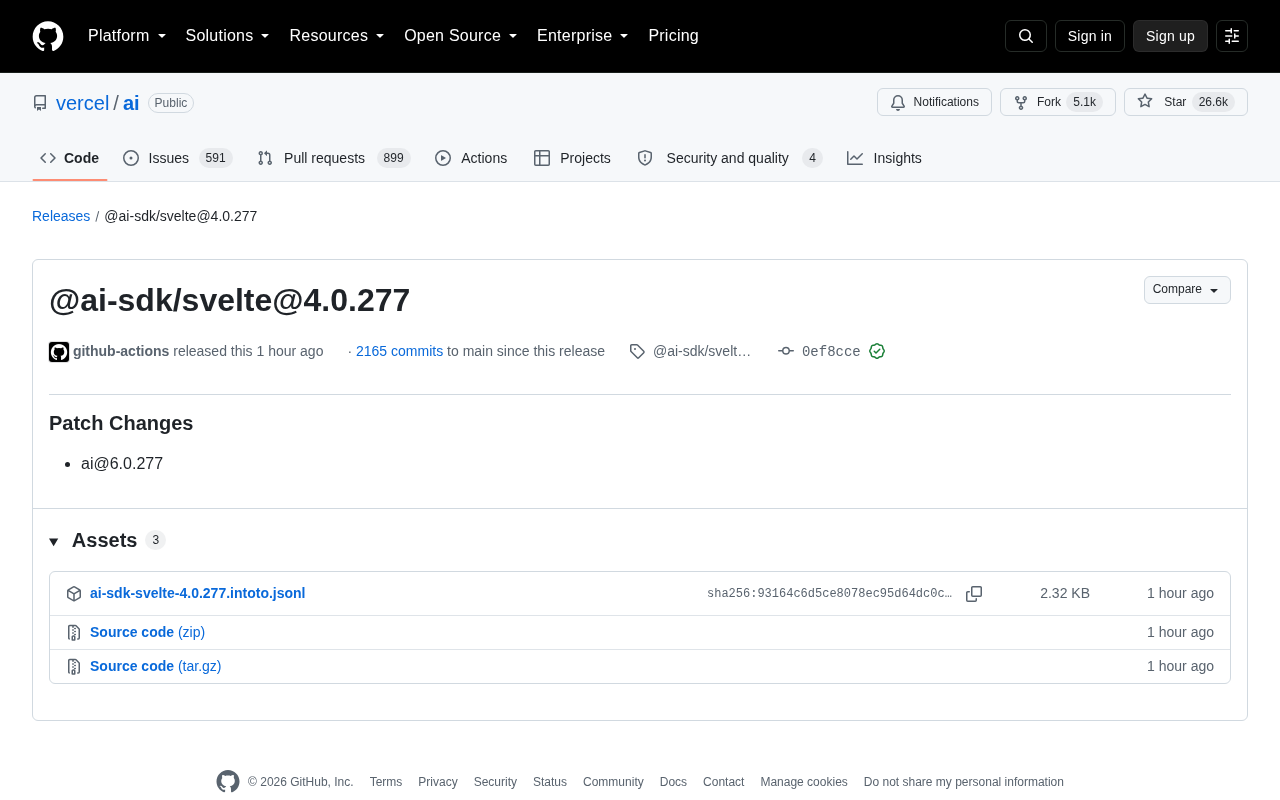
Vercel AI SDK Svelte 4.0.277 patch release syncs core dependencies for stability and consistency.
Vercel AI SDK released @ai-sdk/svelte@4.0.277 as a patch update focused on syncing the underlying ai@6.0.277 dependency. The release reflects the project's monorepo strategy of keeping framework adapters aligned with the core package. With GPG-signed releases and automated CI/CD, the update is low-risk and recommended for teams building AI apps with Svelte.
Release Overview
Vercel's AI SDK project has released @ai-sdk/svelte@4.0.277. The project boasts over 26.6k Stars and 5.1k Forks on GitHub, making it one of the mainstream development toolkits for building AI applications. The update was published automatically via GitHub Actions and secured with a GPG signature (key ID: B5690EEEBB952194) to ensure release integrity.
GPG (GNU Privacy Guard) signing is a critical line of defense for open-source software supply chain security. When a publisher signs an artifact with their private key, downstream users can verify the artifact's origin and integrity using the corresponding public key. In recent years, both the ua-parser-js account hijacking incident (2021) and the xz-utils backdoor incident (2024) have demonstrated that supply chain attacks in the npm ecosystem are a real and present threat. GitHub's verified signature mechanism binds signatures to accounts and displays a "Verified" badge on release pages, allowing enterprise users to confirm that a release genuinely came from Vercel's CI/CD pipeline rather than a compromised build environment.
Judging by the version number, 4.0.277 is a patch-level update focused primarily on dependency synchronization and stability maintenance, with no breaking changes. For Svelte developers in production environments, this type of update can typically be upgraded safely.
Core Changes Analysis
This release is labeled as Patch Changes, with the core content being the synchronization of the underlying dependency ai@6.0.277. This reflects Vercel AI SDK's monorepo management strategy — the core ai package and each framework adaptation layer maintain version linkage to ensure a consistent cross-framework experience.
A monorepo (single repository) is an engineering strategy that manages multiple related projects within the same repository, widely adopted by tech giants like Google and Meta. Under this architecture, Vercel AI SDK manages the core ai package alongside framework adaptation packages like @ai-sdk/svelte, @ai-sdk/react, and @ai-sdk/vue in a unified manner, typically leveraging tools like Turborepo to coordinate build and release processes, combined with the changesets tool to automatically track changes and trigger coordinated releases. This means when the core package fixes an edge case in streaming responses, all framework adaptation packages will release new versions in sync — even if the adaptation layer code itself hasn't changed, the synchronized version numbers ensure dependency graph consistency and avoid the notorious "dependency hell" problem common in the npm ecosystem.
The Role of Framework Adaptation Packages
@ai-sdk/svelte is the adaptation layer for the Svelte framework, wrapping the core ai package's streaming response, message management, and tool calling capabilities into interfaces that conform to Svelte's reactive paradigm. Developers can integrate with large language models directly using Svelte features like Runes and Stores.
Svelte's reactivity system has undergone significant evolution. Traditional Stores were the core state management mechanism in the Svelte 3/4 era, creating subscribable reactive data containers through APIs like writable and readable, with components automatically subscribing to data changes via the $ prefix. Runes, introduced in Svelte 5, are entirely new reactive primitives that replace implicit reactive declarations with compiler directives like $state, $derived, and $effect, making state management more explicit and predictable. For the AI SDK's adaptation layer, this means supporting both paradigms simultaneously — maintaining Store-based streaming data subscriptions for Svelte 4 projects while providing Runes-based reactive AI interaction interfaces for Svelte 5 projects, such as mapping a model's token-by-token streaming output to automatically updating reactive state.
When the core ai package upgrades to 6.0.277, the Svelte adaptation package releases a corresponding version in sync, preventing interface mismatches or behavioral inconsistencies.
Technical Value of Vercel AI SDK
Unified Multi-Framework Development Experience
Vercel AI SDK's abstraction layer design eliminates the need for developers to write different calling logic for different model providers (OpenAI, Anthropic, Google, etc.) or rewrite AI interaction code when switching frontend frameworks. The SDK shields underlying differences through a unified API, reducing switching costs.
One of the SDK's core technical capabilities is the standardized encapsulation of large language model streaming responses. LLMs don't return complete results all at once — they output tokens incrementally. The SDK abstracts this process into a unified streaming interface supporting Server-Sent Events and HTTP streaming, enabling the frontend to render text in real-time as it's being generated, dramatically improving perceived speed for users. Another core capability is Tool Calling (also known as Function Calling), which forms the foundation of current AI Agent architectures — models can decide to invoke external tools during conversation (such as search engines, database queries, or API calls). The SDK provides complete workflow encapsulation for defining tool schemas, handling model call requests, and returning tool results, freeing developers from manually managing complex multi-turn interaction protocols.
For the Svelte ecosystem, an officially maintained adaptation package is particularly significant. Compared to React, which has a wealth of AI frontend integration options like LangChain.js and ChatUI, Svelte's ecosystem is notably thinner when it comes to AI tooling. While SvelteKit as a full-stack framework offers excellent server-side capabilities (such as server routes and streaming responses), community-driven AI-specific component libraries and integration solutions remain limited. @ai-sdk/svelte is officially maintained by Vercel, meaning it can deeply integrate with SvelteKit's routing system, server-side rendering, and streaming capabilities, while benefiting from synchronized updates with the core ai package. This eliminates the concern that "choosing a niche framework means no good AI tools," and objectively promotes Svelte's adoption in AI application scenarios.
Engineering Practices
This release represents one checkpoint among 2,165 commits since the previous version. The high-frequency iteration cadence reflects the team's adoption of a mature automated release process — building, signing, and publishing automatically via GitHub Actions, combined with the changesets tool for managing version changelogs. These engineering practices ensure the project's long-term healthy evolution.
Upgrade Recommendations
For teams building AI applications with Svelte, we recommend incorporating this patch into your routine dependency updates. Since it's a patch-level change with synchronized core dependency upgrades, the risk is minimal. However, keep the following in mind:
- Upgrade companion packages in sync: Ensure ai and @ai-sdk/svelte versions are aligned to avoid mixing different major versions. Under the monorepo coordinated release model, version alignment is a prerequisite for ensuring internal API contract consistency — mixing versions may lead to type mismatches or runtime behavioral anomalies
- Monitor the changelog: Even for patch versions, pay attention to key bug fixes noted in the changelog
- Verify signatures: This release uses GitHub verified signatures, which enterprise users can leverage to validate artifact provenance and strengthen supply chain security
@ai-sdk/svelte@4.0.277 is a typical maintenance update. While it doesn't introduce major new features, it exemplifies the steady evolution of Vercel AI SDK. Keeping up with these updates helps maintain your project's robustness and security.
Related articles

Chain of Thought Isn't Just for AI: How Humans Can Use CoT to Improve Thinking Quality
Chain of Thought isn't just a prompt trick for large models. Starting from a Hacker News discussion, this article analyzes why CoT works for human thinking too, breaks down actionable ways to transfer it, and highlights the key differences between human CoT and machine CoT.
Cloudflare Teams Up with OpenAI: Closi…
Cloudflare Teams Up with OpenAI: Closing the Loop from Vulnerability Discovery to Defense with AI
Cloudflare uses OpenAI Daybreak to investigate security vulnerabilities and generate reviewable remediation plans, while developers use Codex to boost coding efficiency and quality.

Orca Multi-Agent Orchestration in Practice: A Guide to Parallel Collaboration with Claude and Codex
Orca is Stable AI's free open-source agent workbench supporting 34 agents like Claude Code and Codex in parallel. Learn its Git worktree isolation, multi-model orchestration, and mobile management.