Vercel AI SDK TUI: A New Option for Terminal-Based AI Interaction
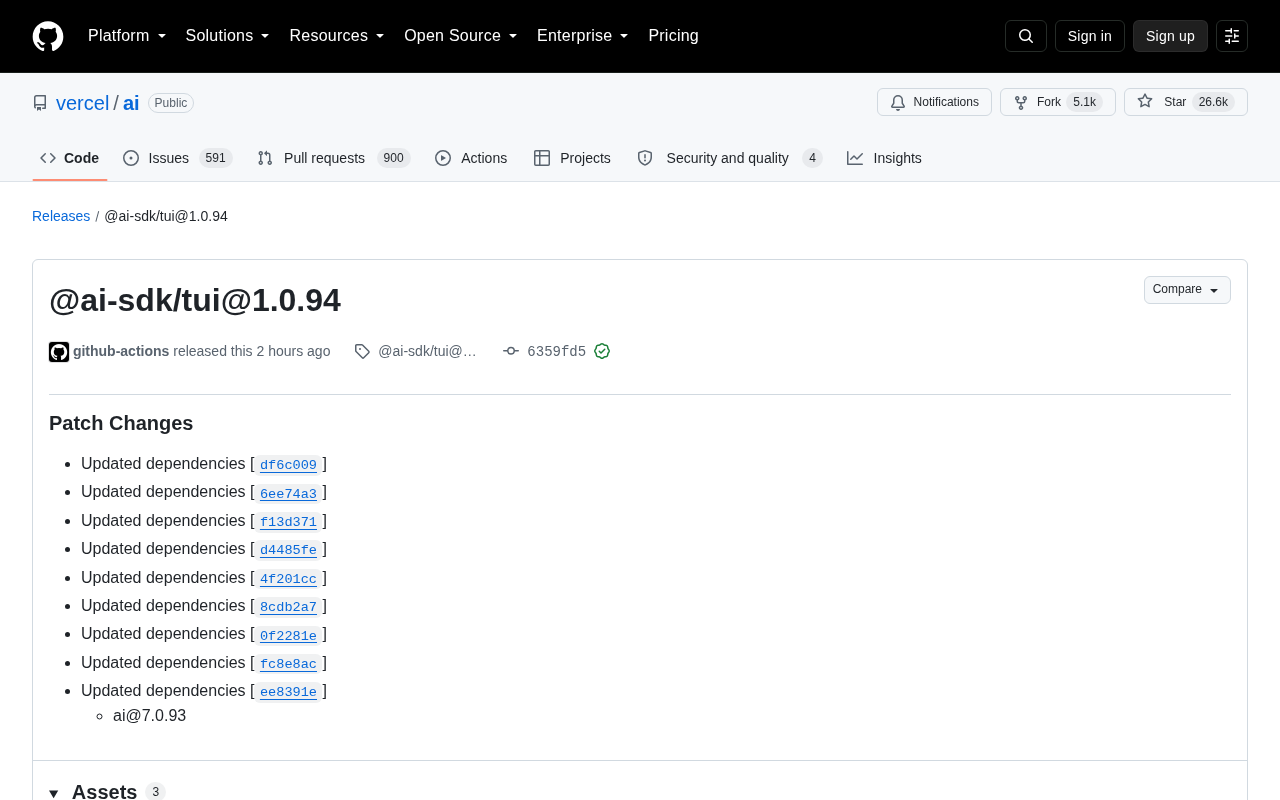
Vercel AI SDK's TUI package brings AI conversations and streaming output to the terminal.
Vercel AI SDK released @ai-sdk/tui@1.0.94, a terminal-focused component package that brings AI conversation, streaming output, and tool calling capabilities to the command line. Built on the SDK's unified abstraction architecture, it enables developers to deploy AI logic to both web and terminal with the same mental model. As AI Coding Agents and CLI assistants reshape developer workflows, this TUI direction signals Vercel's strategic investment in terminal-based AI interaction.
Vercel's AI SDK recently released version @ai-sdk/tui@1.0.94. While this is only a patch-level update — primarily syncing dependency updates (aligning with ai@7.0.93) — the TUI (Text-based User Interface) direction it represents deserves serious attention from the developer community. As a star open-source project with over 26.6k Stars and 5.1k Forks, every step in Vercel AI SDK's evolution is quietly defining engineering practices for AI application development.
What Is @ai-sdk/tui
@ai-sdk/tui is a component package within the Vercel AI SDK ecosystem designed for terminal (command-line) scenarios. Unlike the familiar web-facing React components (such as useChat and useCompletion), TUI aims to bring AI conversation, streaming output, tool calling, and other capabilities directly into the terminal environment that developers know best.
TUI (Text-based User Interface) is an interaction paradigm that sits between a pure command-line interface (CLI) and a graphical user interface (GUI). It runs in the terminal but can draw structured interface elements like windows, buttons, and lists using characters. Classic TUI tools include htop and Midnight Commander on Linux, as well as developer tools that have gained popularity in recent years like Lazygit and k9s. In the Node.js ecosystem, the Ink framework (a React-based terminal rendering library) enables developers to build terminal interfaces using JSX syntax. @ai-sdk/tui is built on top of this kind of technology, bringing complex interactive capabilities like AI streaming conversations into the terminal environment.
In the past, AI applications were almost exclusively delivered through the browser. But with the rise of AI Coding Agents and intelligent CLI assistants, more and more interaction scenarios are returning to the command line. Developers want to converse with large language models, execute tasks, and view streaming responses — all without leaving the terminal. @ai-sdk/tui was born precisely for this trend.
Project Maturity as Reflected by the Version Number
The version number of @ai-sdk/tui has already reached 1.0.94, indicating that it is not a fledgling experimental project but rather a mature component that has gone through extensive iterations and entered a stable maintenance phase. Although this update only syncs several upstream dependencies (involving commits such as df6c009, 6ee74a3, and f13d371), maintaining tight synchronization with the core ai package reflects Vercel's commitment to consistency across the entire SDK ecosystem.
It's worth noting that @ai-sdk/tui follows Semantic Versioning (SemVer), where the 94 in version 1.0.94 represents the 94th patch update. In the Monorepo (single repository managing multiple packages) architecture adopted by Vercel AI SDK, dependency synchronization is a core engineering practice. Sub-packages within the ecosystem (such as @ai-sdk/tui, @ai-sdk/react, and various Provider packages) all maintain version alignment with the core ai package. When the core package fixes a streaming protocol bug or adds support for a new model feature, all downstream packages are updated synchronously to ensure compatibility. While this strategy results in frequent patch releases, it significantly reduces integration issues caused by version incompatibilities.
Overall Architecture and Evolution Logic of the AI SDK
To understand the significance of TUI, it must be viewed within the context of Vercel AI SDK's overall architecture. The core design philosophy of this SDK is unified abstraction + multi-platform adaptation:
- Core Layer: Provides core APIs for model interaction such as
generateText,streamText, andgenerateObject, abstracting away differences between various LLM providers (OpenAI, Anthropic, Google, etc.); - UI Layer: Offers adapted components for different runtime environments — React/Vue/Svelte versions for the web, while terminal scenarios are handled by
@ai-sdk/tui.
The Core Layer uses a Provider pattern to achieve unified abstraction across different large language models. Each model provider (such as OpenAI, Anthropic, Google Gemini, Mistral, etc.) has a corresponding Provider package that implements a unified interface specification. Among these, generateText is used for obtaining a complete response in one shot, streamText enables real-time token-by-token output through a streaming protocol, and generateObject combines Structured Output with JSON Schema validation to have the LLM directly return JSON objects conforming to predefined types. This abstraction allows developers to switch underlying models with virtually no changes to their business code, greatly reducing vendor lock-in risk.
This layered design means developers can deploy the same AI logic to both web and terminal using nearly the same mental model. This is a continuation of Vercel's signature "developer experience first" approach.
Streaming Output: A Key Experience Feature for AI Applications
Before understanding the technical challenges of TUI, it's important to dive deeper into the mechanics of streaming output. Streaming is one of the core experience features of modern AI applications. Large language models generate text token by token — if you wait for the entire response to be generated before returning it, users endure a long blank wait. Streaming output allows each token to be transmitted to the client as soon as it's generated, creating a typewriter-like real-time response effect. On the web, this is typically implemented through Server-Sent Events (SSE) or the ReadableStream API. In terminal scenarios, TUI components need to handle similar incremental rendering logic — progressively rendering received text fragments onto the terminal interface while also handling Markdown formatting, code highlighting, and other rich text display requirements. The implementation difficulty of this in a character-based interface is far greater than in a browser environment.
Tool Calling: A Core Capability for Agent Scenarios
Tool Calling is another important capability of modern large language models and is an indispensable foundation for @ai-sdk/tui in terminal Agent scenarios. This mechanism was first introduced by OpenAI in 2023 under the name Function Calling and has since been widely adopted across the industry. The core workflow is: developers predefine a set of tools (functions) with names, descriptions, and parameter schemas; during inference, the LLM can decide which tool to call and what parameters to pass; the application receives the call request, executes the actual function logic, and returns the result to the model for continued reasoning. Vercel AI SDK encapsulates this mechanism into a unified tools API, supporting automated multi-turn tool calling (agentic loops). This is particularly critical in terminal Agent scenarios, where Agents need to frequently call tools for file operations, search, command execution, and other tasks to complete complex workflows.
Why Terminal Scenarios Are Becoming Increasingly Important
Over the past two years, the explosion of AI programming tools has brought the terminal back into the spotlight. AI Coding Agents are AI systems capable of autonomously understanding tasks, writing code, executing commands, and debugging errors — rather than merely providing code completion suggestions. Between 2024 and 2025, this field experienced explosive growth: Anthropic launched Claude Code (a programming agent that runs directly in the terminal), AI IDEs like Cursor and Windsurf rose rapidly, and autonomous programming agents like Devin and OpenHands attracted widespread attention. These tools share a common trait: deep integration into developers' command-line workflows. They need to read and write to the file system, execute Shell commands, and manage Git operations — all of which are most natural and efficient in a terminal environment.
The command line is becoming the primary battleground for AI-developer collaboration, and the reasons are not hard to understand:
- Close to the workflow: Developers' core work already takes place in the terminal and editor. Having an AI assistant serve them in-place dramatically reduces context-switching costs;
- High composability: The terminal natively supports pipes, scripts, and automation. AI output can seamlessly integrate into existing DevOps workflows — for example, piping model-generated code directly to test scripts or deployment tools;
- Lightweight and efficient: Compared to launching a full web application, TUI is more lightweight and responsive, making it especially suitable for resource-constrained scenarios like SSH remote connections and container environments.
The continued iteration of @ai-sdk/tui is Vercel's clear investment in this trend.
What This Update Means for Developers
For teams and individual developers building AI applications, this update conveys several signals worth noting:
First, Vercel AI SDK's multi-platform capabilities are becoming increasingly complete. Whether your target users are in the browser or the terminal, you can find corresponding official components without having to handle streaming rendering, state management, and other tedious details from scratch.
Second, ecosystem consistency brings long-term benefits. This TUI version closely follows the ai@7.0.93 core package synchronization update, meaning underlying capabilities (such as new model support, tool calling improvements, and streaming protocol optimizations) will be propagated to terminal scenarios immediately. This lowers the cognitive burden on developers when upgrading.
Finally, open-source community activity is an important reference. The 26.6k Stars and frequent version releases indicate that this is a project with substantial investment and a long-term maintenance commitment, making the risk of adopting it in production environments relatively manageable.
A Balanced View of This Update
Of course, it's important to be honest: this 1.0.94 release is essentially just a dependency sync patch update and does not introduce any user-perceivable new features. It is more of a routine engineering maintenance action. What's truly worth looking forward to are substantive breakthroughs in the TUI component's interaction capabilities, rendering performance, and Agent integration down the road.
Conclusion
@ai-sdk/tui@1.0.94 is an unassuming patch release, but the "AI returning to the terminal" trend it represents cannot be ignored. As AI Coding Agents and intelligent CLI assistants gradually become mainstream, Vercel is extending a unified AI development experience from the web to the command line through the AI SDK, providing developers with a more complete toolkit. For developers who care about AI application engineering practices, this is a direction worth tracking closely.
Related articles

Chain of Thought Isn't Just for AI: How Humans Can Use CoT to Improve Thinking Quality
Chain of Thought isn't just a prompt trick for large models. Starting from a Hacker News discussion, this article analyzes why CoT works for human thinking too, breaks down actionable ways to transfer it, and highlights the key differences between human CoT and machine CoT.
Cloudflare Teams Up with OpenAI: Closi…
Cloudflare Teams Up with OpenAI: Closing the Loop from Vulnerability Discovery to Defense with AI
Cloudflare uses OpenAI Daybreak to investigate security vulnerabilities and generate reviewable remediation plans, while developers use Codex to boost coding efficiency and quality.

Orca Multi-Agent Orchestration in Practice: A Guide to Parallel Collaboration with Claude and Codex
Orca is Stable AI's free open-source agent workbench supporting 34 agents like Claude Code and Codex in parallel. Learn its Git worktree isolation, multi-model orchestration, and mobile management.