Vercel AI SDK Update: @ai-sdk/voyage 1.0.29 Released
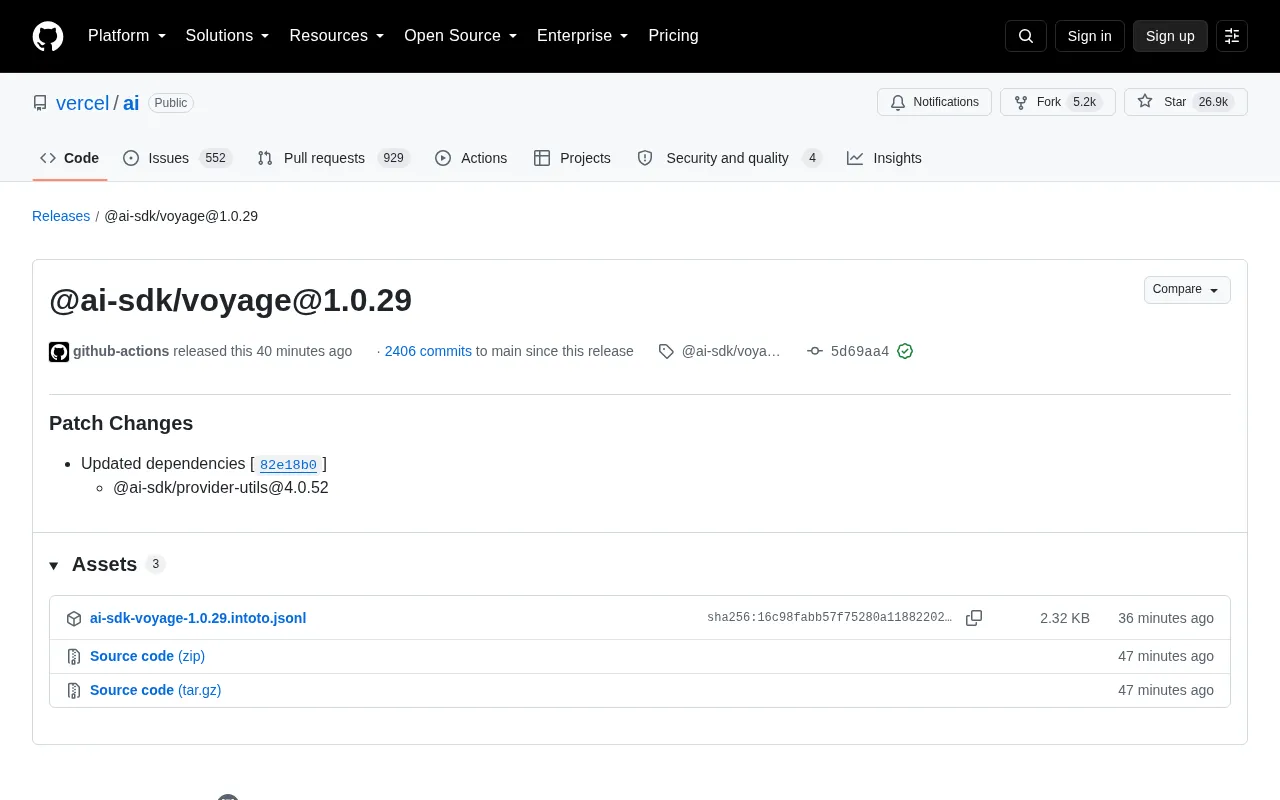
Vercel AI SDK releases @ai-sdk/voyage 1.0.29, a patch update syncing the shared provider-utils dependency.
`@ai-sdk/voyage@1.0.29` is a patch-level update in the Vercel AI SDK ecosystem, with the core change being an upgrade of the internal `@ai-sdk/provider-utils` dependency to 4.0.52. The package integrates Voyage AI's text embedding and reranking models, widely used in RAG and semantic search. As the shared utility layer across all providers, updates to `provider-utils` typically bring stability improvements and better error handling. The release was automated via GitHub Actions and GPG-verified. Given its patch nature, upgrade risk is low — validate in a test environment before deploying.
Vercel AI SDK's ecosystem has recently released @ai-sdk/voyage@1.0.29, a patch update. While the scope of changes is modest — primarily a dependency update — it's still worth noting for developers who rely on this provider to integrate Voyage AI embedding models.
What's New in This Release
According to the official GitHub release notes, @ai-sdk/voyage@1.0.29 is a Patch Change, with the core update being a synchronized upgrade of the internal dependency @ai-sdk/provider-utils@4.0.52.
This release was automatically published via GitHub Actions and verified through GitHub's verified signature mechanism (GPG key ID: B5690EEEBB952194), ensuring the integrity and authenticity of the published package.

Patch releases typically don't introduce breaking changes — they're primarily used to fix issues or keep pace with upstream dependencies. This means existing projects can upgrade with relative confidence, without worrying about API-level compatibility issues.
What Is @ai-sdk/voyage
@ai-sdk/voyage is one of the official providers in the Vercel AI SDK, designed to integrate Voyage AI's model capabilities. Voyage AI is well known for its high-quality text embedding and reranking models, which are commonly used in retrieval-augmented generation (RAG), semantic search, and similar use cases.
Through the unified AI SDK interface, developers can switch between different model providers using a consistent calling convention, without having to rewrite business logic. This is the core value of the Vercel AI SDK ecosystem — abstracting a unified model invocation layer to reduce the complexity of multi-provider integrations.
Voyage AI is an AI company focused on embedding and reranking models, with strong performance across multiple retrieval benchmarks. Text embeddings convert text into high-dimensional vectors, placing semantically similar content closer together in vector space to enable similarity computation and semantic retrieval. Reranking takes the candidate results from an initial retrieval pass and applies a more refined model to re-sort them, improving the relevance of the final output. Both capabilities are critical components of high-quality RAG systems — embeddings map knowledge base documents and user queries into the same vector space, while reranking further filters the most relevant context after the recall stage, directly impacting the accuracy of the large language model's final response.
Why Dependency Updates Matter
The key change in this release is the synchronized upgrade of provider-utils. provider-utils is a shared low-level utility library used across all AI SDK providers, handling common logic such as request construction, response parsing, and type definitions.
Continued maintenance of upstream utility libraries often signals under-the-hood stability improvements, better error handling, or groundwork for upcoming features. For teams running Voyage in production, staying up to date with these patch updates helps maintain consistency across the dependency chain and avoids potential issues from version mismatches.
@ai-sdk/provider-utils plays a cross-cutting concerns role in the Vercel AI SDK architecture. Rather than each provider package (such as @ai-sdk/openai, @ai-sdk/anthropic, @ai-sdk/voyage, etc.) implementing its own HTTP retry logic, streaming response parsing, or error code normalization, they all rely on the shared implementations provided by provider-utils. This design means that fixes or improvements to low-level behavior only need to land in one place — all providers benefit simply by syncing their dependency version. From a semantic versioning (SemVer) perspective, the third-digit increment in provider-utils@4.0.52 indicates a backward-compatible patch fix that should not affect existing callers.
Recommendations for Developers
For projects currently using @ai-sdk/voyage, you can upgrade directly to version 1.0.29 via your package manager. As a patch-level update, the upgrade risk is low — but it's still recommended to verify embedding call behavior in a test environment before rolling out to production.
Keeping an eye on Vercel AI SDK's release cadence helps developers stay on top of low-level optimizations and security fixes as soon as they land. The project has accumulated over 26.9k stars and 5.2k forks on GitHub, with a highly active community and frequent version releases.
Related articles
 Tech Frontiers
Gemini Omni 1.2 Flash: AI Video Moves Toward Draft-Style Editing
Google's Gemini Omni 1.2 Flash update enables conversational, draft-style editing of the same video—swap scenes while keeping products, adjust lighting while keeping characters. Clips up to 15s, 720p costs 30% less than the previous Flash—ideal for e-commerce ads, previs, and short-asset production.

Codex Tutorial: One-Command Install and Run Your First Task
Codex tutorial: one-command install and run your first task. Covers the four Codex forms, sandbox and approval guardrails, AGENTS.md and MCP configs, cloud network policy, and the iron rule of human review—everything you need to get started with this autonomous coding agent.
 Tech Frontiers
Localix: An Open-Source Agentic Development Environment with Multi-Model and Local AI Integration
Localix is an MIT open-source Agentic Development Environment (ADE) supporting seamless Claude Code plugin loading, multi-model cloud and local execution, Mini Apps extensions, and agent context management—an open AI collaboration workbench for developers.