Vercel AI SDK Update: @ai-sdk/voyage 2.0.50 Released

@ai-sdk/voyage 2.0.50 patch release syncs provider dependencies with no breaking changes.
@ai-sdk/voyage 2.0.50 is a purely maintenance-focused patch update, with changes limited to syncing `@ai-sdk/provider-utils` to 5.0.50 and `@ai-sdk/provider` to 4.0.19 — no new features or breaking changes. The package is the official Vercel AI SDK provider for Voyage AI, known for its high-quality embedding and reranking models widely used in RAG pipelines. This release reflects Vercel's high-frequency, coordinated monorepo release strategy. For developers using Voyage models, the upgrade risk is minimal and can be handled as routine dependency maintenance.
Vercel's AI SDK ecosystem has received a routine version update, with @ai-sdk/voyage 2.0.50 now officially released. This is a patch-level update focused on dependency synchronization — a standard maintenance release.
What's in This Update
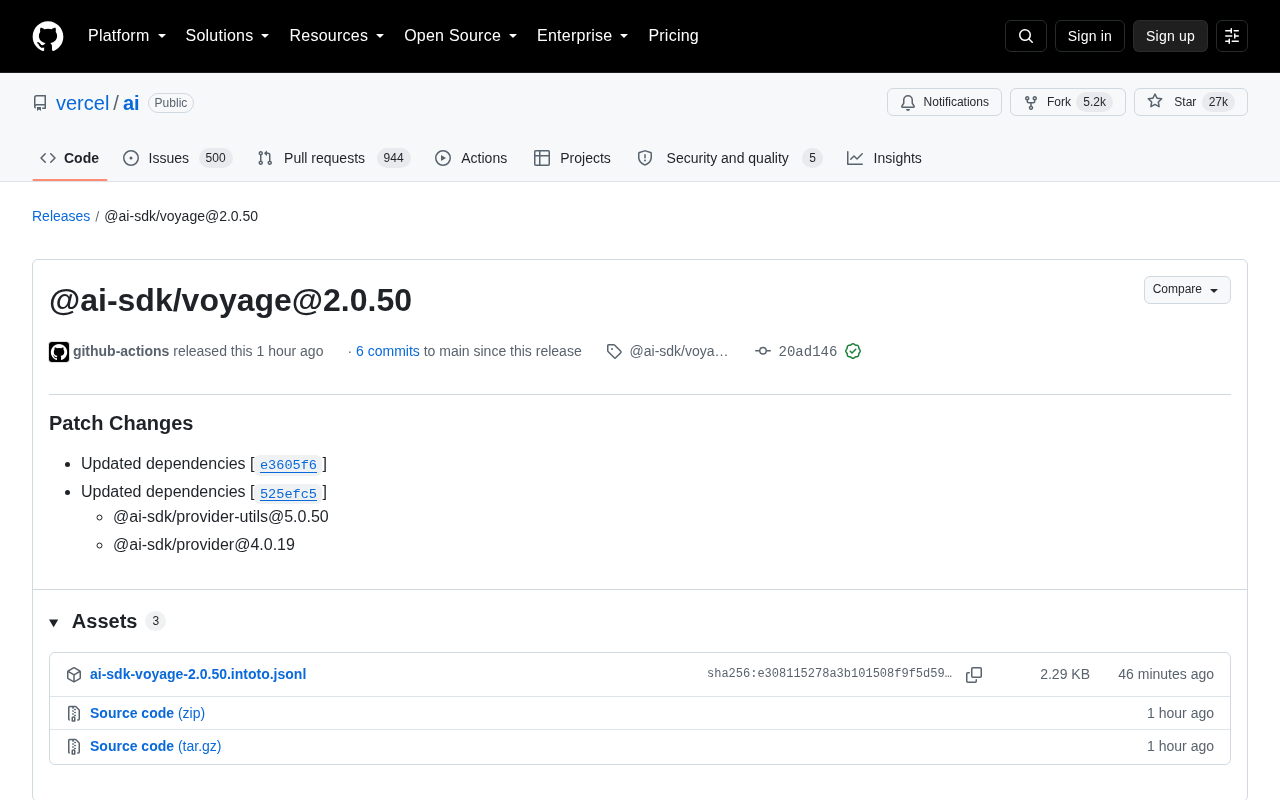
According to the release notes, @ai-sdk/voyage@2.0.50 falls under Patch Changes, with the core modifications limited to dependency upgrades:
- Updated dependency
@ai-sdk/provider-utils@5.0.50 - Updated dependency
@ai-sdk/provider@4.0.19
Patch updates like this typically introduce no breaking changes and no new public APIs. The primary goal is to keep the voyage provider package in sync with the underlying provider utility libraries, ensuring compatibility and stability across the entire SDK toolchain. For developers already using this package, the upgrade cost is minimal.
What Is @ai-sdk/voyage
@ai-sdk/voyage is a provider package within the Vercel AI SDK family, designed to integrate with Voyage AI's model services. Voyage AI specializes in embedding and reranking models, which are commonly used for vectorization tasks in Retrieval-Augmented Generation (RAG) pipelines.
Through this official wrapper package, developers can call Voyage's models under the unified interface of the Vercel AI SDK, without having to manage the underlying API request logic themselves. This "unified abstraction + multiple providers" design is a key reason why Vercel AI SDK is so popular — switching between model providers requires minimal code changes.
Voyage AI is an AI company focused on embedding models, with its core products being high-quality text vectorization (embedding) and reranking models. Embedding models convert text into high-dimensional numerical vectors, enabling computers to measure semantic similarity through vector distances. Reranking models perform a second-pass scoring and reordering of candidate results after an initial retrieval, improving search precision. In a typical RAG pipeline, Voyage's embedding models handle vectorizing knowledge base documents and user queries for storage in a vector database, while its reranking models fine-sort retrieved results before the LLM generates an answer — significantly improving final response accuracy without increasing the LLM's context length. Voyage AI's models have shown strong performance across multiple Chinese and English semantic retrieval benchmarks, making them a common choice for building enterprise-grade knowledge Q&A systems.
Vercel AI SDK's Place in the Ecosystem
Vercel's ai repository has accumulated approximately 27,000 stars on GitHub with over 5,200 forks, making it one of the mainstream libraries for building AI applications — especially full-stack Next.js apps. It provides streaming responses, tool calling, multimodal support, and adapters for a wide range of model providers.
The voyage package's version number, 2.0.50, aligns with the trailing digits of provider-utils at 5.0.50, reflecting Vercel's strategy of frequent, coordinated releases across its monorepo. This high-frequency, small-step release cadence helps quickly address issues and maintain a healthy dependency tree, though it also means developers need to pay attention to version compatibility between packages.
A monorepo (monolithic repository) is a software engineering approach where multiple related packages or sub-projects are managed within a single code repository. The Vercel AI SDK uses a monorepo architecture, meaning @ai-sdk/voyage, @ai-sdk/provider-utils, @ai-sdk/provider, and dozens of other packages coexist in the same repository, with unified version management, testing, and release workflows. The advantage of this architecture is that cross-package changes can be committed and released atomically, preventing version drift between upstream and downstream packages. For consumers, however, it means a sub-package's version bump is often triggered by changes in other packages rather than substantive changes in that package itself. Understanding this context helps developers set the right expectations when seeing frequent minor version updates: most patch versions are "follow-along upgrades" rather than signals of feature iteration.
Practical Implications for Developers
For RAG or semantic search projects that rely on Voyage's embedding capabilities, upgrading @ai-sdk/voyage to 2.0.50 is recommended to ensure consistent behavior with the latest provider utility libraries. Since this is a pure dependency-update patch, the upgrade risk is very low and can be incorporated directly into your regular dependency maintenance workflow.
It's worth noting that the release notes do not disclose what specific underlying issues were fixed — only the dependency update commit hashes (e3605f6, 525efc5) are referenced. For more granular change details, consult the changelogs of the corresponding upstream dependency packages.
Summary
This is a typical maintenance release with no significant functional changes. The focus is on keeping version coordination intact across Vercel AI SDK's components. For teams using Voyage models, it's a safe patch to upgrade to with confidence.
Related articles

Chain of Thought Isn't Just for AI: How Humans Can Use CoT to Improve Thinking Quality
Chain of Thought isn't just a prompt trick for large models. Starting from a Hacker News discussion, this article analyzes why CoT works for human thinking too, breaks down actionable ways to transfer it, and highlights the key differences between human CoT and machine CoT.
Cloudflare Teams Up with OpenAI: Closi…
Cloudflare Teams Up with OpenAI: Closing the Loop from Vulnerability Discovery to Defense with AI
Cloudflare uses OpenAI Daybreak to investigate security vulnerabilities and generate reviewable remediation plans, while developers use Codex to boost coding efficiency and quality.

Orca Multi-Agent Orchestration in Practice: A Guide to Parallel Collaboration with Claude and Codex
Orca is Stable AI's free open-source agent workbench supporting 34 agents like Claude Code and Codex in parallel. Learn its Git worktree isolation, multi-model orchestration, and mobile management.