Vercel AI SDK Update: @ai-sdk/workflow@2.0.40 Release Notes

Vercel AI SDK workflow module receives a patch update syncing core library dependencies with no breaking changes.
`@ai-sdk/workflow@2.0.40` is a routine patch release in the Vercel AI SDK ecosystem, primarily syncing the dependency on `ai@7.0.109` with no standalone functional code changes. This release pattern stems from the SDK's monorepo structure, where sub-packages automatically follow core library updates to maintain version compatibility. The `@ai-sdk/workflow` module focuses on organizing multiple AI call steps into structured pipelines, suited for multi-step reasoning and complex branching scenarios. The release is GPG-signed, reflecting Vercel's commitment to supply chain security. As a SemVer patch release, the upgrade risk is low — though reviewing the core library changelog and validating in a test environment before going live is still recommended.
Update Overview
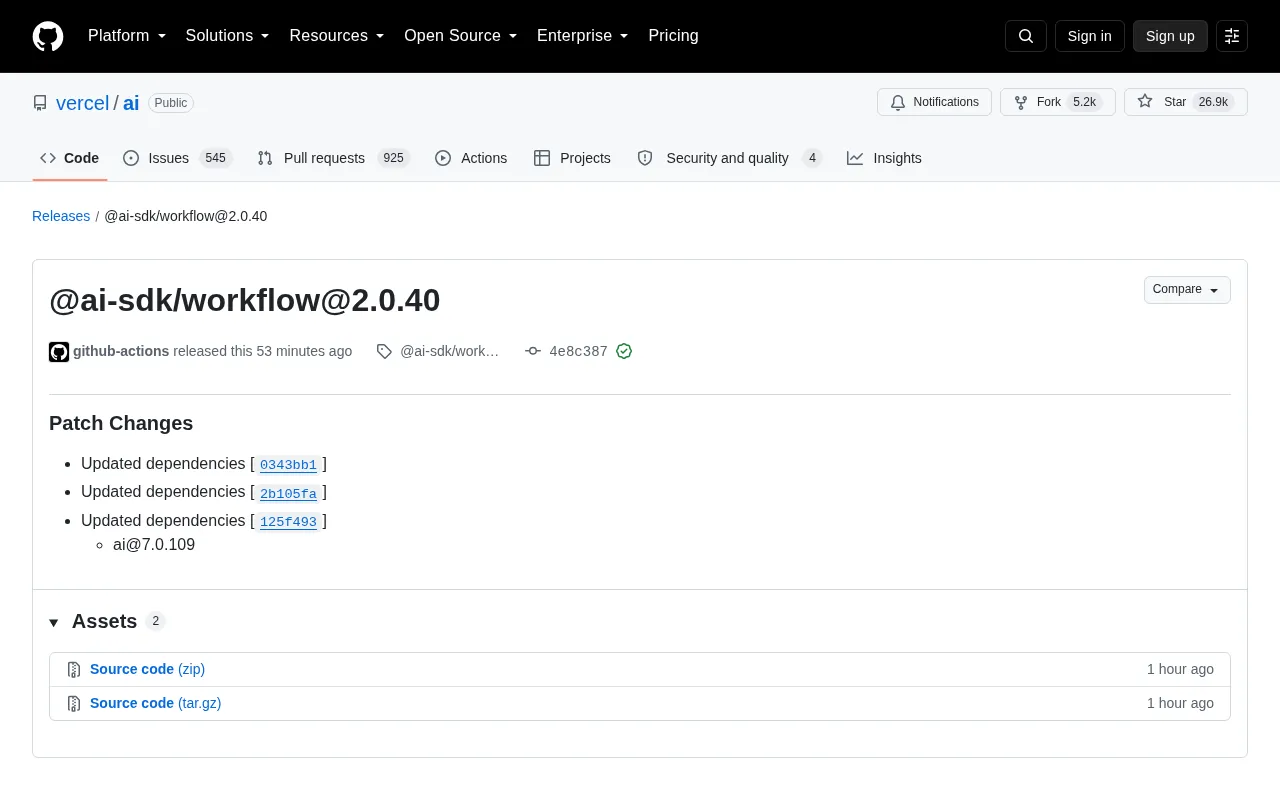
The Vercel AI SDK ecosystem has received a minor update: @ai-sdk/workflow@2.0.40 was recently published automatically via GitHub Actions. This is a dependency-sync patch release, primarily aimed at keeping up with changes in the core library ai@7.0.109.
Based on the release record, this update introduces no breaking changes or major new features. Instead, it updates internal dependencies to maintain alignment with the AI SDK mainline. For developers currently using workflow orchestration capabilities, patch releases like this typically signal improved stability and potential bug fixes.
What Changed
According to the official Patch Changes notes, @ai-sdk/workflow@2.0.40 includes the following:
- Updates to several internal dependencies (corresponding to commits
0343bb1,2b105fa,125f493) - Synced upgrade to
ai@7.0.109
This means the release itself contains no standalone functional code changes — it simply propagates improvements from the upstream ai core package into the workflow module. This release pattern is very common in monorepo-structured projects: when the core library ships a new version, dependent sub-packages automatically follow with their own releases to ensure version compatibility and a clean dependency tree.
Notably, the commit is signed with a GitHub verified signature (GPG key ID: B5690EEEBB952194), confirming the authenticity of the published artifact — a consistent practice by Vercel when it comes to supply chain security.
Background: Monorepo & Automated Publishing A monorepo (monolithic repository) is an engineering strategy where multiple related projects or modules are maintained in a single Git repository. The Vercel AI SDK uses this structure to manage its many sub-packages. Within a monorepo, tooling (such as Turborepo and Changesets) automatically tracks inter-package dependencies: when the
aicore package releases a new version, all sub-packages that declare a dependency on it — like@ai-sdk/workflow— automatically trigger a version bump and a synchronized release. This mechanism ensures version consistency across the entire SDK ecosystem, preventing implicit API incompatibility issues caused by lagging sub-package versions. GPG signature verification (i.e., verified signature) adds an extra layer of assurance that each release genuinely originates from an authorized CI pipeline, guarding against "package hijacking" — a common vector in supply chain attacks.
What Is @ai-sdk/workflow
@ai-sdk/workflow is a module within the Vercel AI SDK family, designed for scenarios where multiple AI call steps need to be organized into a structured pipeline. Compared to a single model invocation, the workflow pattern is better suited for complex tasks that require multi-step reasoning, conditional branching, or stateful transitions between steps.
Vercel's ai repository currently has around 26,900 stars and 5,200 forks on GitHub, making it one of the most widely followed AI development frameworks in the TypeScript/JavaScript ecosystem. Its modular design lets developers pull in only the capability packages they need — workflow being the component responsible for process orchestration.
Background: Workflow Orchestration in AI Applications The importance of workflow orchestration in AI application development has grown significantly with the rise of agent architectures. Unlike a traditional single LLM call, complex AI tasks often require chaining together multiple steps — retrieval, reasoning, tool invocation, result validation — while passing intermediate state between them. The abstraction layer provided by
@ai-sdk/workflowallows developers to define the execution order and dependencies of these steps in a declarative or imperative style, without manually managing async control flow or error retry logic. This is conceptually similar to LangChain's Chain/Agent model and LlamaIndex's Pipeline, but deeply integrated into Vercel's TypeScript-first ecosystem — making it particularly well-suited for full-stack AI application development in environments like Next.js.
Recommendations for Developers
For teams already running AI SDK in production, upgrading a patch release is generally a low-risk operation. The recommended approach is:
- Review the full changelog for
ai@7.0.109to determine whether core library changes affect your use case - Validate behavior after upgrading in a test environment, especially for logic involving workflow state transitions
- Keep your dependency versions in sync with the SDK mainline to avoid compatibility issues caused by version fragmentation
Since this is a Patch-level update following Semantic Versioning (SemVer), it should not contain any breaking changes by convention, making the upgrade cost relatively low.
Background: Semantic Versioning (SemVer) The Semantic Versioning specification defines version numbers as a three-part structure:
MAJOR.MINOR.PATCH. When only the patch version is incremented, the convention dictates that the release contains only backward-compatible bug fixes — no new features or breaking changes are permitted. A minor version bump indicates new backward-compatible functionality has been added; a major version bump signals breaking changes. Understanding this convention helps developers quickly assess upgrade risk: a patch jump like2.0.39 → 2.0.40is theoretically safe to upgrade without hesitation, while a major version change requires careful review of a migration guide. That said, this assumes the publisher strictly adheres to SemVer — in practice, it's still advisable to validate in a test environment before pushing to production.
Summary
@ai-sdk/workflow@2.0.40 is a typical dependency-sync patch release, with the core change being an upgrade to follow ai@7.0.109. While the release itself carries limited new information, it reflects the high-frequency, consistent iteration cadence that the Vercel AI SDK maintains. For developers actively using this framework, staying on top of these version updates is a good way to continuously benefit from core library improvements and fixes.
Related articles

Chain of Thought Isn't Just for AI: How Humans Can Use CoT to Improve Thinking Quality
Chain of Thought isn't just a prompt trick for large models. Starting from a Hacker News discussion, this article analyzes why CoT works for human thinking too, breaks down actionable ways to transfer it, and highlights the key differences between human CoT and machine CoT.
Cloudflare Teams Up with OpenAI: Closi…
Cloudflare Teams Up with OpenAI: Closing the Loop from Vulnerability Discovery to Defense with AI
Cloudflare uses OpenAI Daybreak to investigate security vulnerabilities and generate reviewable remediation plans, while developers use Codex to boost coding efficiency and quality.

Orca Multi-Agent Orchestration in Practice: A Guide to Parallel Collaboration with Claude and Codex
Orca is Stable AI's free open-source agent workbench supporting 34 agents like Claude Code and Codex in parallel. Learn its Git worktree isolation, multi-model orchestration, and mobile management.