Vercel AI SDK Update: @ai-sdk/workflow 2.0.47 Released

@ai-sdk/workflow 2.0.47 upgrades to ES2022 compilation target and syncs core dependencies.
`@ai-sdk/[email protected]` is a low-risk patch update in the Vercel AI SDK ecosystem with two core changes: upgrading the package's compilation target to ES2022, and syncing dependencies including `[email protected]` and `@ai-sdk/[email protected]`. The ES2022 target enables features like private class fields and top-level `await` without unnecessary transpilation, benefiting projects on modern Node.js or edge runtimes. The dependency sync is routine monorepo maintenance. No breaking changes are included; teams on modern runtimes are encouraged to upgrade after testing.
Vercel's AI SDK ecosystem has received another version update. According to automated release records on GitHub, @ai-sdk/[email protected] has been officially released. This is a patch-level update, primarily focused on build target adjustments and dependency synchronization.
What's Changed
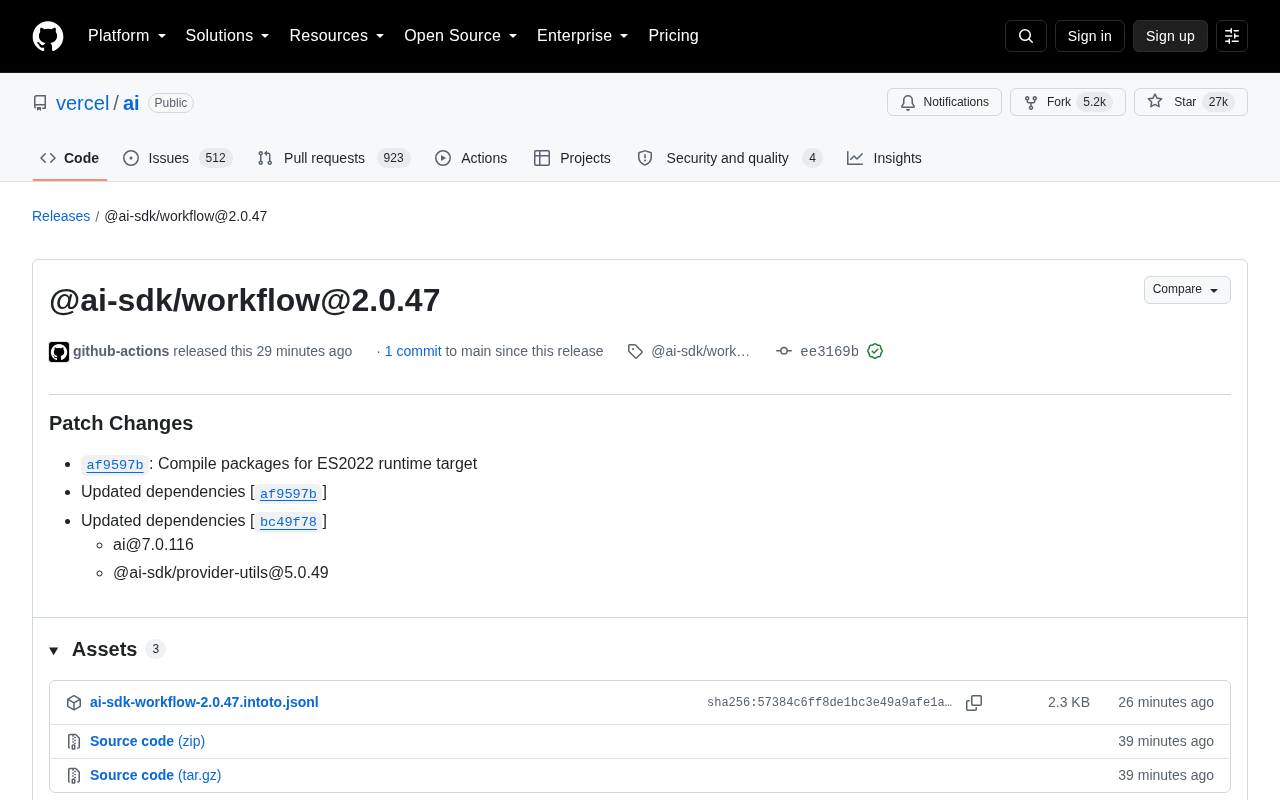
This @ai-sdk/[email protected] patch release centers on two key changes.
The first is updating the package's compilation target to the ES2022 runtime (Compile packages for ES2022 runtime target). This means build outputs will target more modern JavaScript runtime environments, taking direct advantage of language features introduced in ES2022 and reducing unnecessary transpilation. In theory, this should produce leaner, more efficient code. For projects running on recent Node.js versions or modern browsers, this is a forward-looking optimization.
The second change is a synchronized update of several dependencies, including [email protected] and @ai-sdk/[email protected]. This kind of cascading dependency update is common in monorepo-structured projects — when a shared low-level library (like provider-utils) changes, packages that depend on it also release new versions to ensure consistency across the entire SDK ecosystem.
What is a Monorepo? A monorepo (monolithic repository) is an architectural pattern where multiple related packages or projects are managed together in a single code repository. Vercel AI SDK uses this structure, allowing
@ai-sdk/workflow,@ai-sdk/provider-utils,ai, and other packages to share the same build, test, and release pipeline. When a low-level package likeprovider-utilschanges, dependent packages are detected by automation tools (such as Changesets) and published in lockstep, ensuring that any package a user installs always resolves to mutually compatible dependency versions. This is why patch updates frequently include "dependency sync" entries — it doesn't mean the higher-level package itself has changed functionally; it's simply routine ecosystem maintenance.
What the ES2022 Compilation Target Means
Raising the compilation target from an older standard to ES2022 is a trend many modern JavaScript libraries are following. ES2022 introduced features such as private class fields, top-level await, and Object.hasOwn(). When a library ships with these features directly, it avoids the redundant polyfills and transpilation code that would otherwise be needed to support older environments.
For developers, the practical impact of this change depends on the runtime environment. If your project is deployed on a recent Node.js runtime or a modern edge computing platform — exactly the kind of environment Vercel specializes in — you can upgrade seamlessly and benefit from reduced bundle size and improved performance. Conversely, if your project still needs to support older runtime environments, you'll want to pay attention to compatibility configuration.
@ai-sdk/workflow's Place in the Ecosystem
Vercel AI SDK is one of the more popular AI application development toolkits in the TypeScript ecosystem, widely used for building chatbots, AI agents, and streaming generation interfaces. @ai-sdk/workflow, as the workflow module within this suite, focuses on orchestrating multi-step AI task pipelines.
The version number 2.0.47 indicates the module has undergone extensive iteration and refinement. Frequent patch updates typically signal an actively maintained project, where the team is continuously fixing issues and optimizing internals rather than introducing sweeping breaking changes. For production projects that rely on this SDK, this steady update cadence is a reassuring sign.
What does
@ai-sdk/workflowactually do? Its core value lies in providing declarative task orchestration. In real-world AI applications, a single model call is often insufficient to complete complex tasks. Developers need to chain multiple steps together — for example, first calling a model to generate search keywords, then invoking a tool to perform the search, and finally passing the results back to the model for summarization. Managing this kind of multi-step pipeline manually makes state tracking, error retries, and concurrency control tedious.@ai-sdk/workflowprovides a structured way to define the execution graph for these pipelines and handles data passing and lifecycle management between steps. This is conceptually similar to LangChain's LCEL (LangChain Expression Language) or LlamaIndex's Pipeline, but designed specifically for Vercel AI SDK's TypeScript-first ecosystem.
Should You Upgrade Now?
As a patch release, 2.0.47 contains no breaking changes, making the upgrade low-risk. For teams already using Vercel AI SDK, it's recommended to validate in a test environment first, then upgrade to take advantage of the potential gains from ES2022 compilation and to stay in sync with the [email protected] mainline dependencies.
It's worth noting that this release information comes from GitHub's automated pipeline release notes, which only list a summary of changes without detailed performance comparison data. Developers who want to understand the specific impact can refer to the CHANGELOG and related PR records in the project repository.
Related articles

Felix Rieseberg Personal Homepage
Felix Rieseberg's personal homepage sparks attention on Hacker News. This article covers the Slack engineer's technical background, the rise and fall of nativefier, and the value of a developer homepage as a tech calling card.

@ai-sdk/vue 3.0.306 Patch Release Syncs with [email protected] Update
@ai-sdk/vue 3.0.306 released, synced with [email protected]. A routine patch release for the Vercel AI SDK ecosystem with no public API changes; the Vue adapter layer stays version-aligned with the core package.

Gemini 4 Argon API Launches: The Era of Million-Token Output Begins
Google launches Gemini 4 Argon with sparse MoE architecture, up to 1M output tokens, and a 68.90% Vals Index score, available across API, AI Studio, and the Gemini app.