Vercel AI SDK Update @ai-sdk/[email protected]: A Dependency Sync Breakdown

@ai-sdk/[email protected] is a routine patch syncing three core upstream dependencies with no code logic changes.
`@ai-sdk/[email protected]` is a routine patch update for the Zhipu AI model provider in the Vercel AI SDK ecosystem. It contains no code logic changes and simply aligns with upstream version bumps across three core dependencies: `@ai-sdk/provider`, `@ai-sdk/provider-utils`, and `@ai-sdk/openai-compatible`. These cascading releases are a natural byproduct of a monorepo + changesets workflow, where any change to a foundational package triggers version bumps in all dependent packages. Following SemVer patch conventions, this update introduces no breaking changes and is safe to adopt. The high release cadence reflects the active maintenance and engineering maturity of Vercel AI SDK, a framework with over 27,000 GitHub stars.
A Routine Patch Update Worth Understanding
Vercel's open-source AI SDK recently released @ai-sdk/[email protected], a patch-level update. Based on the GitHub Release page, the core changes in this release center on dependency synchronization rather than new features or breaking changes. For developers building applications with the Vercel AI SDK, these kinds of updates may seem minor at first glance, but they're essential to keeping the entire toolchain running smoothly.
@ai-sdk/zai is the provider adapter package in the Vercel AI SDK ecosystem for Zhipu AI (Z.ai / Zhipu) models. It allows developers to call the corresponding model services through a unified AI SDK interface, without needing to worry about the differences in the underlying APIs.
What Actually Changed in This Update
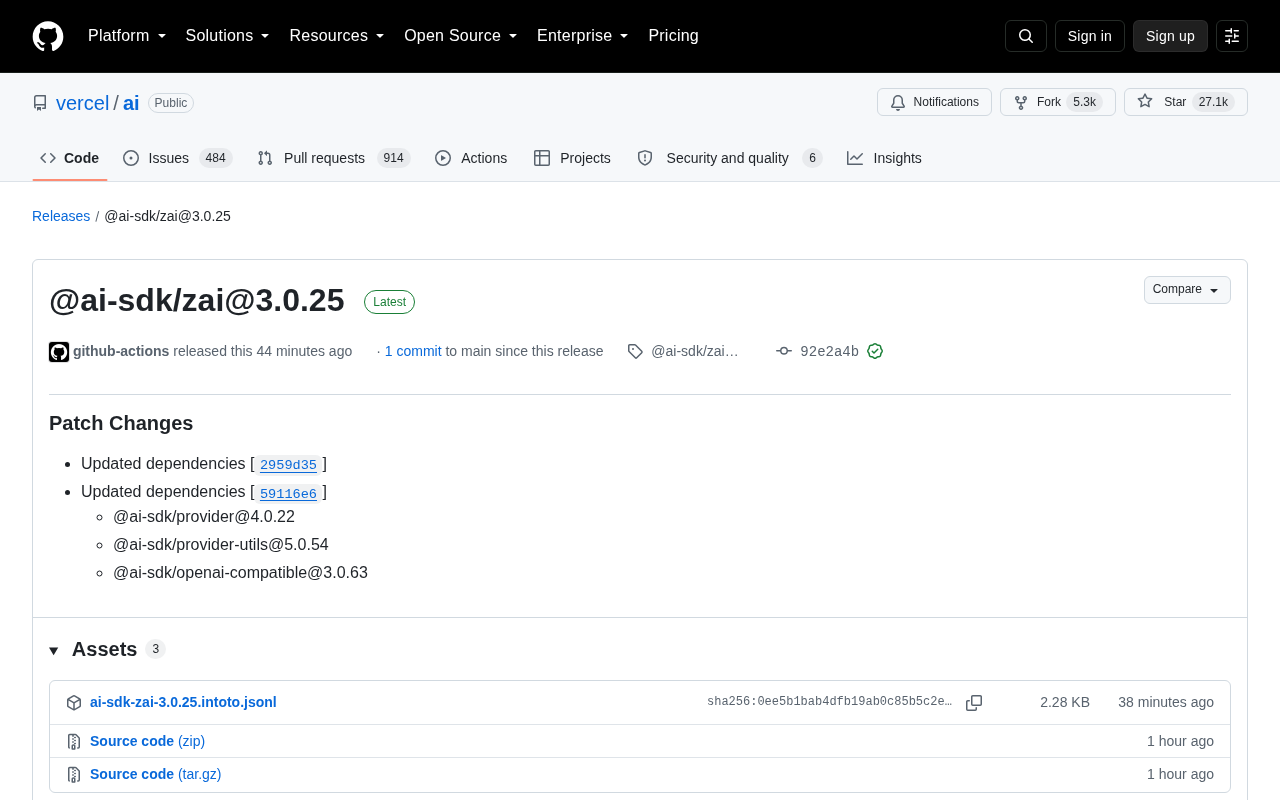
According to the Patch Changes notes in the release, version 3.0.25 contains no direct code logic changes. Instead, it aligns with upstream dependency updates. The specific packages involved are:
@ai-sdk/[email protected]@ai-sdk/[email protected]@ai-sdk/[email protected]
These packages form the core infrastructure of the Vercel AI SDK. @ai-sdk/provider defines the standard interface spec for providers, @ai-sdk/provider-utils supplies general-purpose utility functions, and @ai-sdk/openai-compatible is the foundational module for implementing OpenAI-compatible protocols. Since Zhipu and many other model services use an OpenAI-compatible API format, @ai-sdk/zai is built directly on top of this compatibility layer.
In other words, when the underlying compatibility layer or utility functions are updated (in this case corresponding to commits 2959d35 and 59116e6), the higher-level @ai-sdk/zai also needs to publish a corresponding patch version to ensure version consistency and correct dependency resolution.
Why There Are So Many Cascading Updates
Vercel AI SDK uses a monorepo structure and manages releases with tools like changesets. In this architecture, a change to a lower-level package propagates up through the dependency tree, triggering a chain of version bumps across related packages. This explains why @ai-sdk/zai's patch version increments so frequently — most of these bumps are the result of dependency syncing, not significant changes to the package's own functionality.
Background: Monorepo + Changesets
A monorepo is an organizational approach where multiple related packages or projects are managed together in a single repository, as opposed to the polyrepo model where each package maintains its own repository. With Vercel AI SDK's monorepo setup, all provider packages (e.g.,
@ai-sdk/zai,@ai-sdk/openai) and infrastructure packages (e.g.,@ai-sdk/provider) share the same CI pipeline and release tooling. Changesets is a version management tool designed specifically for monorepos: developers attach a "changeset" file to their PRs describing the scope of the change and its semantic version level (patch/minor/major). When merged to the main branch, the tool automatically aggregates all pending changes, calculates the new version number for each affected package, and generates the corresponding CHANGELOG. This mechanism significantly reduces the manual overhead of coordinating multi-package releases, but it also introduces the side effect of "cascading releases" — any change to a lower-level package triggers new version releases for all packages that depend on it up the dependency tree, even if those upstream packages haven't had a single line of code changed.
What This Means for Developers
For projects currently using @ai-sdk/zai, upgrading to 3.0.25 is generally safe and recommended. Patch versions follow Semantic Versioning (SemVer) conventions and should not introduce breaking changes, making the upgrade essentially zero-cost. Keeping your dependency chain up to date helps you benefit from bug fixes and potential performance improvements from upstream packages.
However, since the substantive changes in this update originate from upstream dependencies, developers who want to understand the specific details are encouraged to review the changelogs for @ai-sdk/provider-utils and @ai-sdk/openai-compatible at their respective versions — those packages are the true source of this cascading update.
Background: Semantic Versioning (SemVer)
SemVer defines version numbers as a three-part
MAJOR.MINOR.PATCHstructure, each corresponding to a different level of change: a PATCH increment means a backwards-compatible bug fix; a MINOR increment means new backwards-compatible functionality has been added; a MAJOR increment means breaking changes have been introduced. Projects following SemVer allow package managers (such as npm or pnpm) to make predictable decisions when automatically resolving dependencies — for example, a version range like^3.0.0means the package manager will automatically accept all3.x.xupdates but will not cross over to4.0.0. For a pure dependency-sync patch like@ai-sdk/[email protected], developers can generally upgrade with confidence and without writing additional regression tests — though it's still advisable to run basic smoke tests in a staging environment to catch any edge cases where upstream fixes may have inadvertently affected existing behavior.
What a Patch Update Reveals About the AI SDK Ecosystem
Vercel AI SDK currently has over 27,000 stars and 5,300 forks on GitHub, making it one of the most popular AI application development frameworks in the TypeScript/JavaScript ecosystem. Through its standardized provider abstraction, it enables model services from OpenAI, Anthropic, Google, Zhipu, and many others to be called in a nearly uniform way.
High-frequency minor updates like @ai-sdk/[email protected] are actually a reflection of a healthy, active open-source project: clear module boundaries, automated release pipelines, and continuous maintenance across a wide range of model providers. For teams that rely on this framework, understanding the versioning mechanism helps make smarter decisions when upgrading — distinguishing feature changes that warrant thorough testing from dependency syncs that require little concern.
Related articles

ChatGPT Space Launches: Team Collaboration and New Pages Features Explained
ChatGPT Space is OpenAI's new team collaboration feature with Pages, real-time collaboration, and Slack/Google Drive sync. We break down its privacy design, multi-platform integration, and the full workflow from conversation to document.

Migrating Apache Spark UDFs to GPU Acceleration with AI Agents
NVIDIA developer blog explains how AI Agents rewrite Apache Spark UDFs for GPU acceleration, covering migration criteria, agent rewriting and verification workflows, plus pitfalls like result consistency and CPU-GPU transfer overhead.

Zed Editor v0.40.4-rc2 Released: Usage Credits Now Available Without Upgrading
Zed editor releases v0.40.4-rc2, allowing users to use usage credits for AI features without upgrading to a paid plan, lowering the trial barrier.