Vercel AI SDK Update: Amazon Bedrock 5.0.97 Released

Vercel AI SDK releases Amazon Bedrock 5.0.97 patch, syncing an internal dependency with no breaking changes.
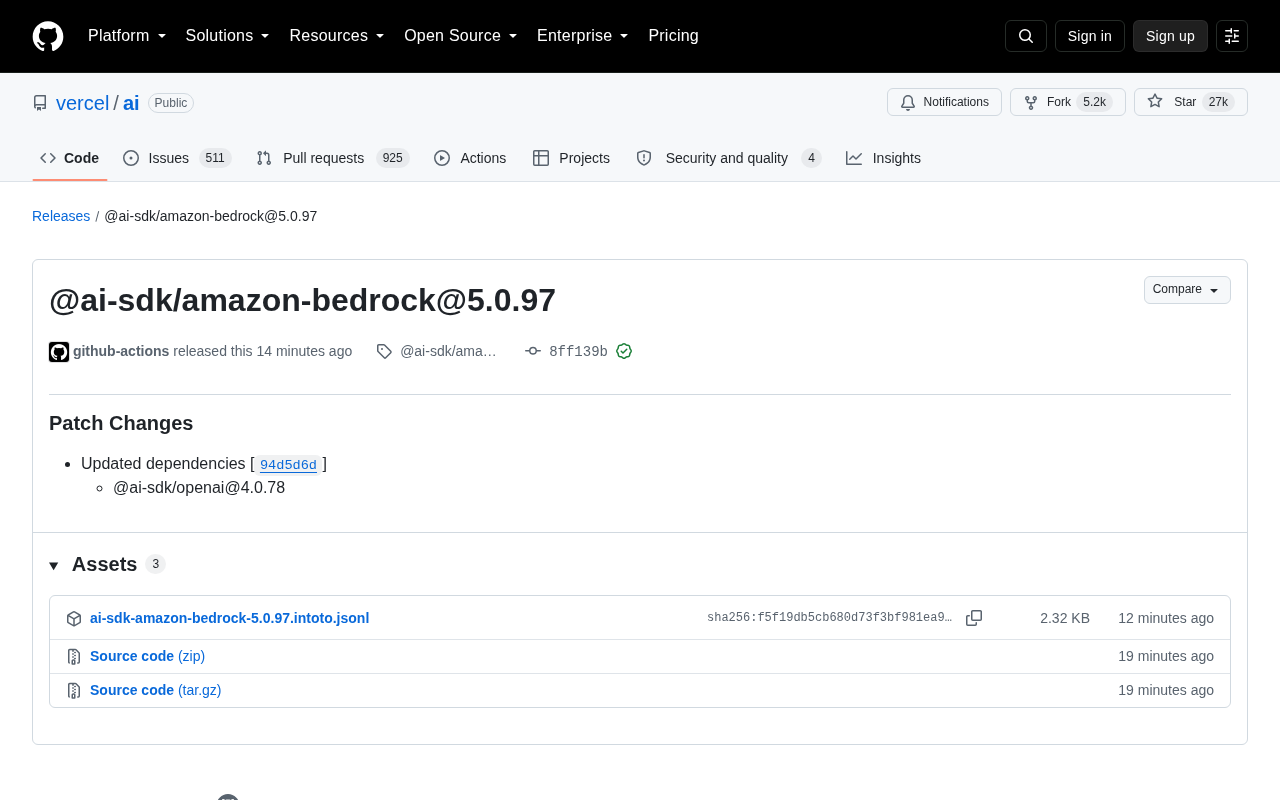
The `@ai-sdk/amazon-bedrock` package in Vercel AI SDK has shipped version 5.0.97, a patch release with a single change: syncing the internal `@ai-sdk/openai` dependency to 4.0.78. This cascading upgrade reflects the SDK's modular architecture, where multiple provider packages share underlying infrastructure. For developers, a patch-level bump means the public API stays stable and the update is safe to adopt. With ~27K GitHub stars, Vercel AI SDK abstracts LLM provider differences behind a unified interface. The release is GPG-verified, ensuring supply chain integrity.
Vercel's open-source AI SDK has received another minor update. According to automated release records on GitHub, the @ai-sdk/amazon-bedrock package has been bumped to version 5.0.97 — a patch-level release focused on dependency synchronization.
What's in This Update
According to the release notes, the 5.0.97 Patch Changes contain a single modification: updating the internal dependency @ai-sdk/openai to version 4.0.78. This is a classic cascading dependency upgrade — when an underlying provider package changes, the corresponding adapter packages publish new versions to maintain compatibility.
For developers using Amazon Bedrock as their LLM backend, patch updates like this rarely introduce breaking changes and are generally safe to adopt immediately. A bump in the patch version (the third number) signals only internal fixes or dependency syncs, with the public API remaining stable.
About Vercel AI SDK
Vercel's AI SDK is one of the most popular AI application development toolkits in the frontend and full-stack ecosystem, with around 27,000 GitHub stars and 5,200 forks — a testament to its active community. Its core design goal is to provide developers with a unified interface that abstracts away the differences between various LLM providers.
@ai-sdk/amazon-bedrock is the provider adapter package responsible for integrating with Amazon Web Services' Bedrock service. Through it, developers can invoke a variety of foundation models hosted on Bedrock — such as Anthropic Claude and Amazon Titan — without writing separate integration logic for each cloud vendor.
Why Dependency Syncing Matters
The synchronized upgrade of @ai-sdk/openai in this release reflects the modular architecture behind AI SDK. Multiple provider packages share portions of the underlying infrastructure, and when core logic is updated, dependency versioning ensures consistency across the entire SDK ecosystem. This engineering practice reduces the risk of cross-package version conflicts and makes high-frequency iteration sustainable.
Amazon Bedrock is AWS's fully managed foundation model platform, enabling developers to call large language models from providers like Anthropic, Meta, Mistral, and Cohere through a unified API — without needing to manage model infrastructure themselves. Its key advantage lies in deep integration with the AWS ecosystem, including IAM permission management, VPC network isolation, and CloudWatch monitoring, making it well-suited for enterprise scenarios with strict data security and compliance requirements. For teams already building on AWS, using @ai-sdk/amazon-bedrock to connect to Bedrock avoids routing data through third-party AI services while reusing existing cloud account permission structures.
It's worth noting that @ai-sdk/amazon-bedrock depending on @ai-sdk/openai does not mean you need an OpenAI account or API key. This dependency relationship stems from Vercel AI SDK's architectural design — the @ai-sdk/openai package actually encapsulates general-purpose capabilities such as HTTP request handling, streaming response parsing, and Tool Calling protocols. Multiple provider packages share this infrastructure to avoid duplicate implementations. This layered architecture — where core capabilities sink to a shared layer and provider-specific logic sits on top — is common in large-scale SDKs. It significantly reduces maintenance overhead across adapter packages while ensuring consistent behavior for streaming output, error handling, and other critical features across all providers.
What Developers Should Do
For production projects, it's advisable to monitor the official release notes and confirm the update type before upgrading. A purely patch-level version like 5.0.97 can generally be applied directly; for minor or major version changes, potential interface adjustments should be evaluated first.
This release was published automatically via GitHub Actions and verified with an official GitHub GPG signature, ensuring the authenticity of the release artifact — a fundamental safeguard for open-source supply chain security.
Overall, this is a routine maintenance release. While it carries limited new information on its own, it reflects the high-frequency iteration pace that Vercel AI SDK maintains, continuously providing stable support for AI capability integration across different cloud platforms.
Related articles

Chain of Thought Isn't Just for AI: How Humans Can Use CoT to Improve Thinking Quality
Chain of Thought isn't just a prompt trick for large models. Starting from a Hacker News discussion, this article analyzes why CoT works for human thinking too, breaks down actionable ways to transfer it, and highlights the key differences between human CoT and machine CoT.
Cloudflare Teams Up with OpenAI: Closi…
Cloudflare Teams Up with OpenAI: Closing the Loop from Vulnerability Discovery to Defense with AI
Cloudflare uses OpenAI Daybreak to investigate security vulnerabilities and generate reviewable remediation plans, while developers use Codex to boost coding efficiency and quality.

Orca Multi-Agent Orchestration in Practice: A Guide to Parallel Collaboration with Claude and Codex
Orca is Stable AI's free open-source agent workbench supporting 34 agents like Claude Code and Codex in parallel. Learn its Git worktree isolation, multi-model orchestration, and mobile management.