Vercel AI SDK Update: harness-deepagents Patch Release

Vercel AI SDK patch 1.0.133 replaces createSandboxCredentialEnvironment() with resolveSandboxCredentialEnvironment() across all bridge adapters.
Vercel AI SDK releases `@ai-sdk/harness-deepagents@1.0.133`, introducing `resolveSandboxCredentialEnvironment()` to replace `createSandboxCredentialEnvironment()` and standardize credential handling across all bridge adapters. The shift from "create" to "resolve" signals a move toward more reusable, consistent state management. The release also ships `@ai-sdk/harness@1.0.133` with dependency updates. Developers using the old API directly should migrate soon; those on higher-level APIs can upgrade with minimal friction.
Vercel's AI SDK repository on GitHub has published @ai-sdk/harness-deepagents@1.0.133. This is primarily a patch update, focused on changes to how sandbox credential environments are handled. While the version bump is minor, developers building agent applications with this SDK should be aware of what's changed.
What's New in This Release
According to the GitHub Release page, the key change in this release is the addition of a new resolveSandboxCredentialEnvironment() helper function in the harness module. It replaces the previous createSandboxCredentialEnvironment() and is now used consistently across all bridge-backed adapters.
The naming shift itself is telling. The difference between resolve and create carries meaningful semantic weight: resolve implies parsing and reusing an existing credential environment, whereas create implies building one from scratch. This kind of renaming typically signals that the underlying implementation is evolving toward greater reusability and predictability — reducing overhead from repeated creation and minimizing potential state inconsistency issues.
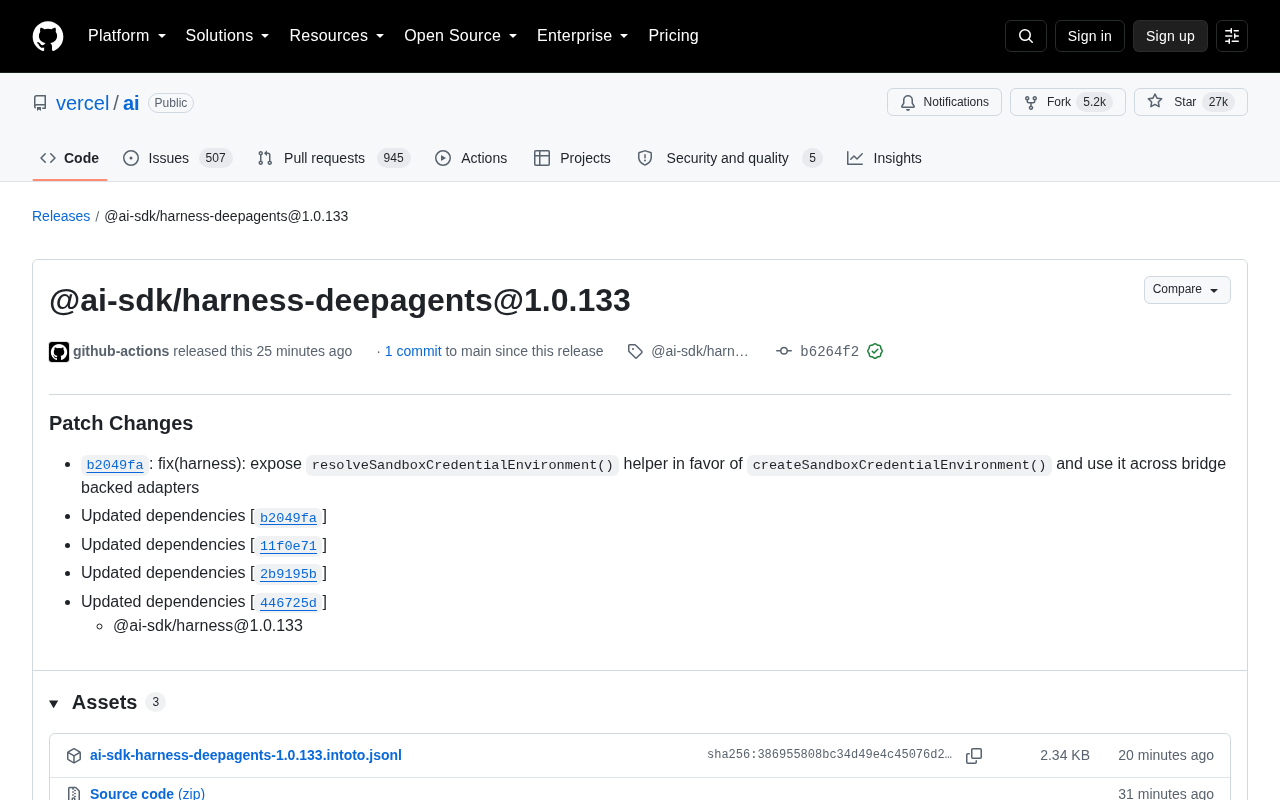
Beyond this primary fix, the release also includes updates to several dependencies (corresponding to commits 11f0e71, 2b9195b, 446725d, and others), along with a coordinated release of @ai-sdk/harness@1.0.133. This reflects the tight version coupling within the harness family of packages — developers upgrading should keep related packages in sync.
What Are harness and deepagents?
For readers less familiar with the Vercel AI SDK ecosystem, a quick overview is helpful. Vercel's ai repository is a widely used open-source toolkit for building AI applications, with over 27k stars and 5.2k forks on GitHub and an active community.
The harness module can be thought of as the "runtime framework" or "execution environment" for running AI agents — it manages agent execution flow, tool calls, and runtime isolation. deepagents builds on top of this, providing agent capabilities geared toward more complex multi-step reasoning and autonomous task execution. The sandbox mechanism plays a central role here: it provides an isolated execution space for agents to run code or call external tools, and credential environment management determines how agents securely access the keys and configuration they need within that sandbox.
This update focuses specifically on that credential environment layer — it's an infrastructure-level reliability improvement rather than a feature-level overhaul.
Bridge-backed adapters are an important architectural concept in harness worth explaining further. In Vercel AI SDK's design, the bridge layer serves as an abstraction between the agent runtime and underlying execution environments (such as sandboxes, external services, or different model providers). Each concrete execution backend plugs into harness by implementing a unified bridge interface, so that upper-level agent logic doesn't need to know about backend differences. This architecture makes unified credential management especially important — having all bridge adapters share a single credential resolution logic reduces duplicate implementation and lowers the security risk that comes from each adapter handling credentials independently. Consolidating credential handling into resolveSandboxCredentialEnvironment() is a direct expression of this architectural principle.
Practical Impact for Developers
As a patch release, upgrading to 1.0.133 carries low risk — but there are a few things worth noting.
If your code directly calls createSandboxCredentialEnvironment(), be aware that it has been superseded by resolveSandboxCredentialEnvironment(). While patch versions typically maintain backward compatibility, from a long-term maintenance perspective it's worth migrating to the new recommended API sooner rather than later, to avoid breaking changes if the old function is removed in a future version.
For users who interact with the SDK only through higher-level APIs and never touch sandbox credential internals directly, this update should be essentially transparent — just make sure to keep harness-related packages in sync when upgrading.
Summary
@ai-sdk/harness-deepagents@1.0.133 is a classic infrastructure-hardening update. Its core contribution is introducing resolveSandboxCredentialEnvironment() and unifying credential handling logic across bridge adapters. It reflects Vercel AI SDK's continued iteration on the foundational capabilities of agent runtimes and sandbox security. For teams building autonomous agent applications on this framework, staying current with these minor version updates is a practical way to maintain system stability and long-term maintainability.
Related articles

Chain of Thought Isn't Just for AI: How Humans Can Use CoT to Improve Thinking Quality
Chain of Thought isn't just a prompt trick for large models. Starting from a Hacker News discussion, this article analyzes why CoT works for human thinking too, breaks down actionable ways to transfer it, and highlights the key differences between human CoT and machine CoT.
Cloudflare Teams Up with OpenAI: Closi…
Cloudflare Teams Up with OpenAI: Closing the Loop from Vulnerability Discovery to Defense with AI
Cloudflare uses OpenAI Daybreak to investigate security vulnerabilities and generate reviewable remediation plans, while developers use Codex to boost coding efficiency and quality.

Orca Multi-Agent Orchestration in Practice: A Guide to Parallel Collaboration with Claude and Codex
Orca is Stable AI's free open-source agent workbench supporting 34 agents like Claude Code and Codex in parallel. Learn its Git worktree isolation, multi-model orchestration, and mobile management.