Vercel AI SDK [email protected] Patch Update Explained

Vercel AI SDK's valibot adapter gets a patch release, syncing provider-utils to 5.0.54 with no breaking changes.
`@ai-sdk/[email protected]` is a patch release in the Vercel AI SDK ecosystem with no functional code changes — it simply bumps the shared `@ai-sdk/provider-utils` dependency to `5.0.54`. This is a natural byproduct of the monorepo's versioning mechanism. The package serves as a schema validation adapter, letting developers use lightweight Valibot instead of Zod for structured output and tool calling. Teams can safely upgrade alongside `[email protected]` with no changes to existing code.
Vercel's widely adopted AI SDK recently released @ai-sdk/[email protected]. As a patch-level update, it introduces no new features — the change centers entirely on a dependency sync. While the version bump is minor, understanding what these kinds of updates mean is worthwhile for developers building AI applications on this toolchain.
What Actually Changed
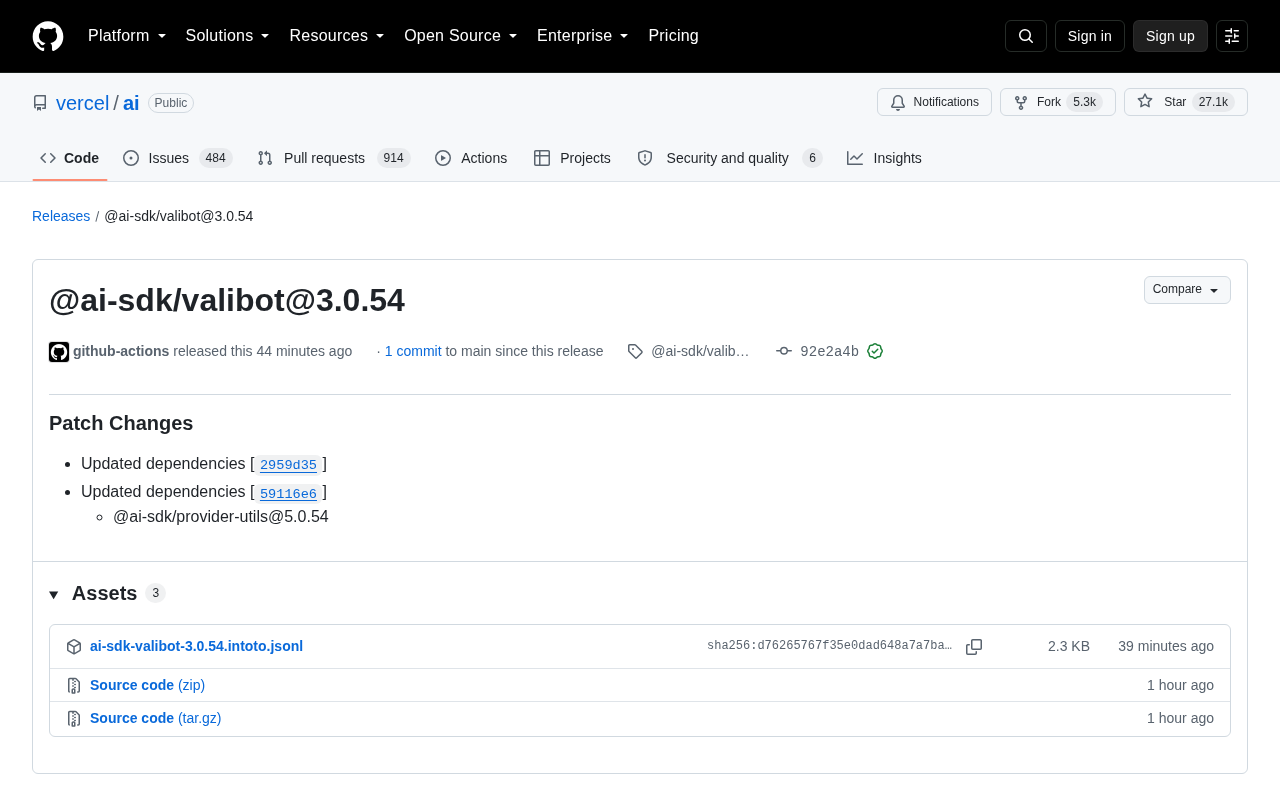
According to the GitHub Release page, @ai-sdk/[email protected] falls under Patch Changes, with the core update being a dependency upgrade. The release notes list two dependency update commits (hashes 2959d35 and 59116e6) and bump @ai-sdk/provider-utils to 5.0.54.
In other words, this release introduces no functional code changes — it simply aligns with an upstream provider-utils update. This is standard practice in modern monorepo projects. Vercel's ai repository uses a unified version management strategy: when a shared utility package is updated, dependent sub-packages automatically trigger cascading releases.
This version was published through an automated GitHub Actions workflow and is verified with a GitHub GPG signature (key ID: B5690EEEBB952194), ensuring the authenticity of the release artifact.
What is a monorepo? A monorepo is a code organization strategy where multiple related packages or projects live in a single Git repository. Vercel's
airepo follows this pattern, housing dozens of sub-packages (e.g.,@ai-sdk/openai,@ai-sdk/anthropic,@ai-sdk/valibot) managed through Changesets. When the shared base package@ai-sdk/provider-utilschanges, Changesets automatically calculates all directly and indirectly dependent sub-packages and triggers corresponding version bumps and releases. This is why a single upstream update can produce a wave of sub-package releases with seemingly no substantive changes — it's a deliberate mechanism to maintain version consistency across the ecosystem and prevent dependency drift.
The Role of the valibot Package in AI SDK
@ai-sdk/valibot is a schema validation adapter package within the Vercel AI SDK ecosystem. Valibot itself is a lightweight TypeScript validation library, similar in purpose to Zod, but known for its smaller bundle size and modular design.
Schema validation plays a critical role in AI application development: when using large language models for structured output or tool calling, developers need to define strict data structures to ensure the model's responses conform to expected formats. @ai-sdk/valibot lets developers use Valibot to define these schemas as an alternative to Zod.
For frontend projects that prioritize smaller bundle sizes, or teams that prefer Valibot's functional API style, this adapter package offers practical flexibility.
Valibot vs. Zod — the key difference comes down to how schemas are built. Zod uses an object-oriented chained API (e.g.,
z.object({}).string()), while Valibot uses pure function composition — each validation rule is an independent function, allowing tree-shaking tools to precisely eliminate unused parts. This gives Valibot a minimum production bundle size of just a few KB, compared to Zod's roughly 12 KB (gzipped). In the AI SDK context, structured output means getting the model to return data in a developer-defined JSON Schema format rather than free-form text, while tool calling lets the model decide when to invoke external functions and generate arguments matching the function signature. Both rely heavily on runtime schema validation for type safety.@ai-sdk/valibot's job is to convert Valibot schema definitions into the unified internal format recognized by the AI SDK.
Practical Impact of This Patch
From a Semantic Versioning (SemVer) perspective, incrementing the patch number to 3.0.54 signals a backward-compatible revision. Developers can generally upgrade without worrying about breaking changes.
- No business code changes needed: Patch updates don't affect the API, so existing code will continue to work after upgrading.
- Keep dependencies aligned: It's recommended to upgrade alongside
@ai-sdk/[email protected]to avoid potential issues from version mismatches. - Security and stability: Updates to underlying utility packages often include bug fixes or internal optimizations — staying current helps keep your project healthy.
For teams running Vercel AI SDK in production, this kind of high-frequency minor iteration reflects the project's active maintenance. The repository currently has 27.1k stars and 5.3k forks, with a steadily growing community.
How to Upgrade
Upgrading is straightforward — just run the appropriate command for your package manager:
npm install @ai-sdk/[email protected]
# or
pnpm add @ai-sdk/[email protected]
After upgrading, it's good practice to run your test suite to confirm schema validation behavior is unchanged. Since this is a pure dependency sync, no compatibility issues are expected.
Summary
@ai-sdk/[email protected] is a typical patch release whose sole purpose is syncing the upstream provider-utils dependency. It brings no new features, but it reflects the high-cadence, disciplined release rhythm of Vercel AI SDK. For developers building AI applications on this ecosystem, understanding the nature of these updates — which ones require immediate action and which can wait — is a fundamental part of keeping a project healthy long-term.
Related articles

Felix Rieseberg Personal Homepage
Felix Rieseberg's personal homepage sparks attention on Hacker News. This article covers the Slack engineer's technical background, the rise and fall of nativefier, and the value of a developer homepage as a tech calling card.

@ai-sdk/vue 3.0.306 Patch Release Syncs with [email protected] Update
@ai-sdk/vue 3.0.306 released, synced with [email protected]. A routine patch release for the Vercel AI SDK ecosystem with no public API changes; the Vue adapter layer stays version-aligned with the core package.

Gemini 4 Argon API Launches: The Era of Million-Token Output Begins
Google launches Gemini 4 Argon with sparse MoE architecture, up to 1M output tokens, and a 68.90% Vals Index score, available across API, AI Studio, and the Gemini app.