Vercel AI SDK Vue 4.0.104 Released: Dependency Update Breakdown
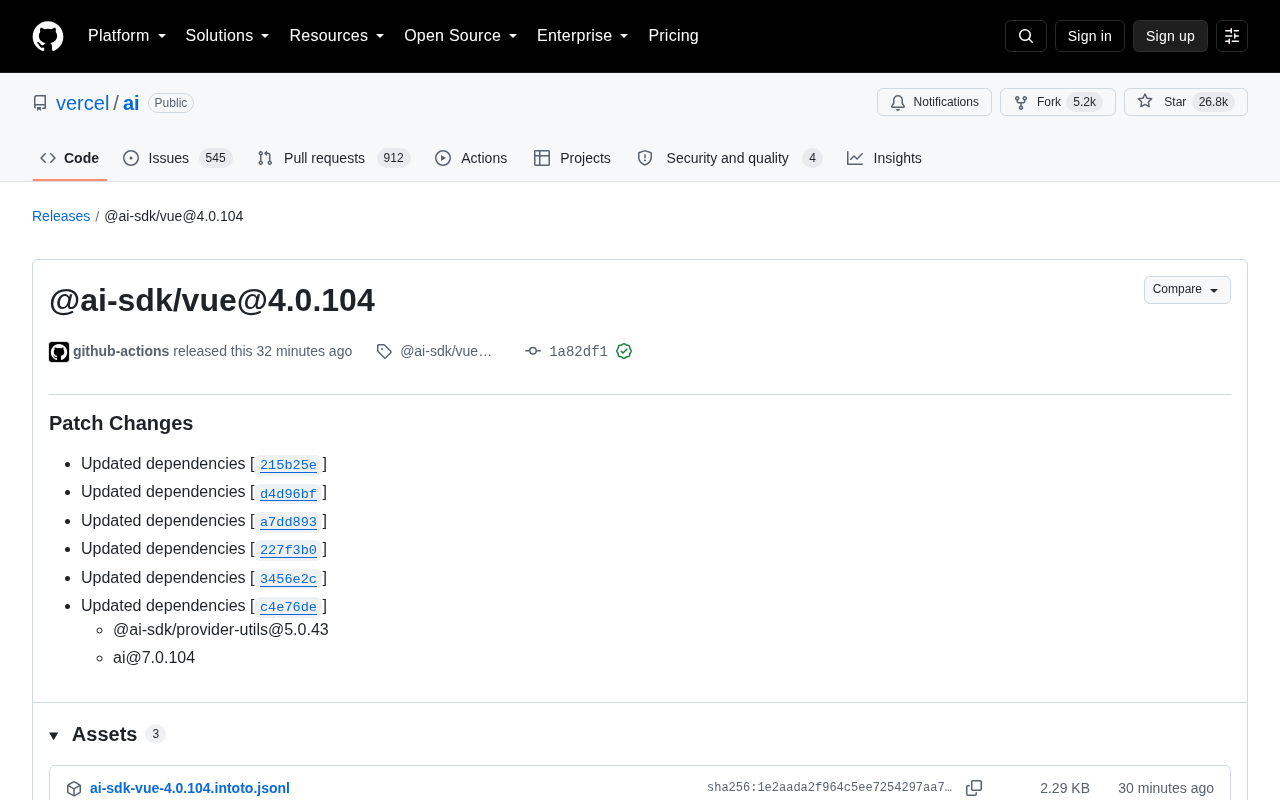
Vercel AI SDK Vue 4.0.104 patch release syncs upstream dependencies with ai@7.0.104.
`@ai-sdk/vue@4.0.104` is a patch release of Vercel AI SDK's official Vue binding, with changes focused on syncing upstream dependencies — including `ai@7.0.104` and `@ai-sdk/provider-utils@5.0.43`. Published automatically via GitHub Actions with trusted signing, this update reflects the Monorepo-driven, automated release cadence of one of the most popular AI frontend frameworks on GitHub (26.8k+ stars). Patch releases generally carry no breaking changes, but developers should pin versions and review changelogs when upgrading.
Vercel AI SDK Vue 4.0.104 Released
Vercel's open-source AI SDK ecosystem continues its rapid release cadence, with @ai-sdk/vue@4.0.104 now officially published as a patch release. While the changes are modest in scope, this version focuses on dependency updates and reflects the coordinated engineering practices driving the Vercel AI SDK toolchain forward.
Version Overview
@ai-sdk/vue is the official Vue framework binding for the Vercel AI SDK, providing Vue developers with composables and utility functions for integrating large language model capabilities — such as streaming conversations and completions — into their applications. It is part of the broader Vercel AI open-source project, which has accumulated over 26.8k stars and 5.2k forks on GitHub, making it one of the most popular frameworks for building AI-powered frontend applications today.
This 4.0.104 release was automatically published via GitHub Actions and verified through GitHub's trusted signing mechanism, ensuring the integrity and authenticity of the release artifacts.
Composables are a core programming paradigm introduced in Vue 3, allowing developers to encapsulate stateful logic into reusable functions — typically prefixed with use, such as useChat and useCompletion. @ai-sdk/vue leverages this mechanism to abstract away the complexity of streaming response state management, request lifecycle control, and error handling, so developers can integrate large language model capabilities into Vue components with just a few lines of code. Analogous to React Hooks, Composables make AI feature integration declarative and easy to test — and that's the core value @ai-sdk/vue offers over calling REST APIs directly.
What Changed: Patch Changes
According to the release notes, this is a typical patch release with changes centered entirely on dependency updates. The version incorporates updates from several upstream commits, including 215b25e, d4d96bf, a7dd893, 227f3b0, 3456e2c, and c4e76de.
The associated packages updated in lockstep are:
@ai-sdk/provider-utils@5.0.43ai@7.0.104
This kind of coordinated version bumping is standard practice in Monorepo projects. Since @ai-sdk/vue depends on the underlying ai core package and the @ai-sdk/provider-utils utility package, whenever upstream packages change, the framework binding publishes a corresponding release to keep the entire toolchain version-consistent and compatible.
A Monorepo (single repository) is a project organization approach where multiple related packages are managed together in one Git repository. Vercel AI SDK uses this architecture to centrally maintain the ai core package, framework bindings (Vue, React, Svelte, etc.), and utility packages like @ai-sdk/provider-utils. Tools such as Changesets or Turborepo can automatically compute inter-package dependencies and cascade version releases when upstream packages change. This is why a single low-level fix can trigger patch releases across multiple packages simultaneously — it's the automated result of toolchain coordination, not manual maintenance.
What This Means for Developers
For teams building Vue applications with the Vercel AI SDK, patch releases typically indicate bug fixes, internal dependency upgrades, or minor optimizations at the lower levels — and generally do not introduce breaking changes. Developers can upgrade with relative confidence.
It's worth noting that the ai core package is now at version 7.0.x while the Vue binding remains at 4.0.x. This version number discrepancy is a natural result of each sub-package evolving independently under its own Semantic Versioning (SemVer) history — it does not imply any feature gap. When upgrading, developers should refer to each package's changelog to ensure dependency versions are mutually compatible.
Semantic Versioning (SemVer) defines version numbers as MAJOR.MINOR.PATCH. A patch increment signals a backward-compatible bug fix; a minor increment signals a backward-compatible new feature; a major increment signals a breaking change. In a Monorepo, each sub-package independently calculates its own SemVer based on its own change history, so the ai core package having a higher major version (7.x) than @ai-sdk/vue (4.x) is entirely normal — there is no direct semantic relationship between them. What developers truly need to watch for when upgrading is whether a package's changelog flags any breaking changes, not the absolute size of the version number.
The Engineering Logic Behind High-Frequency Releases
The Vercel AI SDK version number has now accumulated to a high patch count (.104), which is a testament to the project's extremely active development pace. Frequent small releases combined with automated CI/CD pipelines (GitHub Actions) and signed release verification represent a mature, modern approach that open-source infrastructure projects use to balance quality with iteration speed.
For production projects that depend on this SDK, it's advisable to pin versions or adopt a cautious upgrade strategy — capturing the benefits of updates while minimizing the risk that comes with frequent dependency churn.
Summary
@ai-sdk/vue@4.0.104 is fundamentally a patch release driven by dependency updates, with changes focused on syncing the underlying toolchain. While any single release carries limited information on its own, it reflects the continuous evolution of one of the leading AI application development frameworks, and demonstrates the maturity of Vercel AI SDK's engineering and automation practices.
Related articles
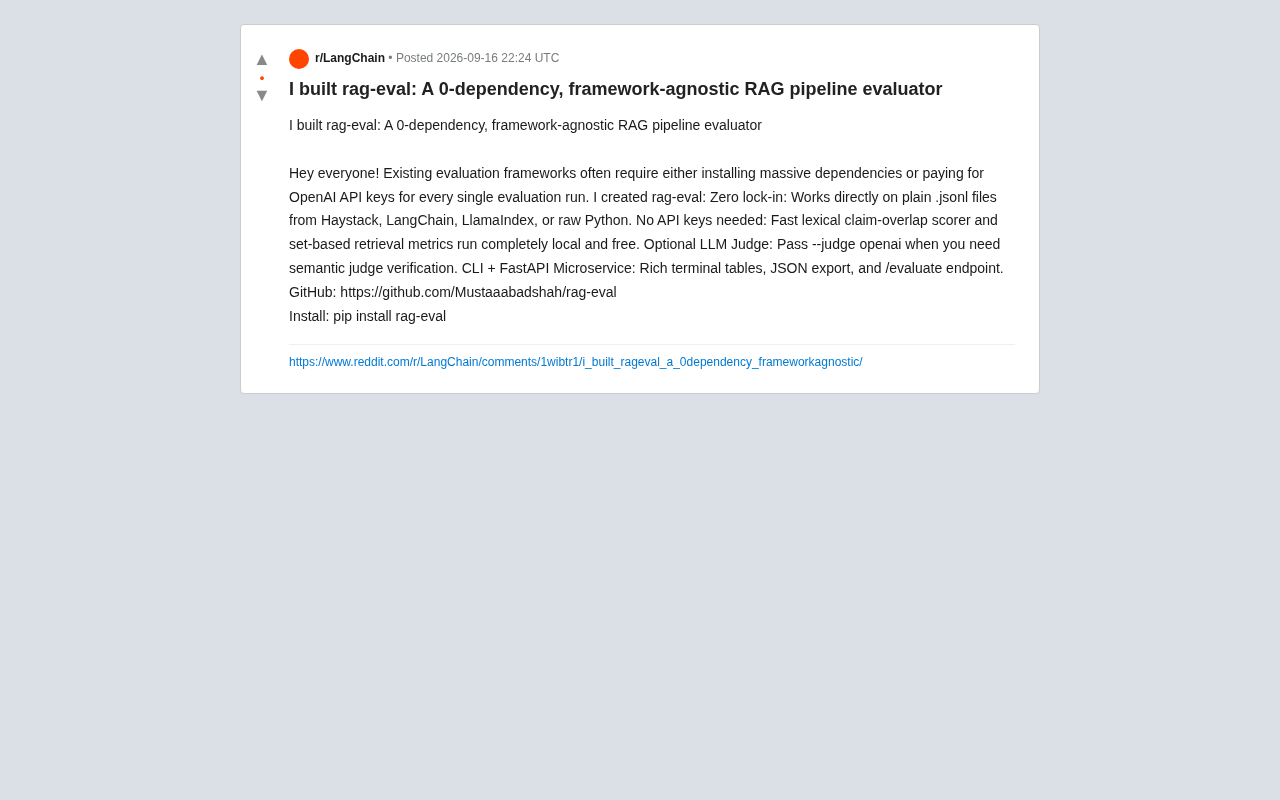
rag-eval: A Zero-Dependency, No-API-Key RAG Evaluation Tool
rag-eval is a zero-dependency, framework-agnostic open-source RAG pipeline evaluation tool. It supports free local lexical and retrieval metrics with no API keys required, and offers optional LLM Judge for semantic validation. Compatible with Haystack, LangChain, and LlamaIndex.
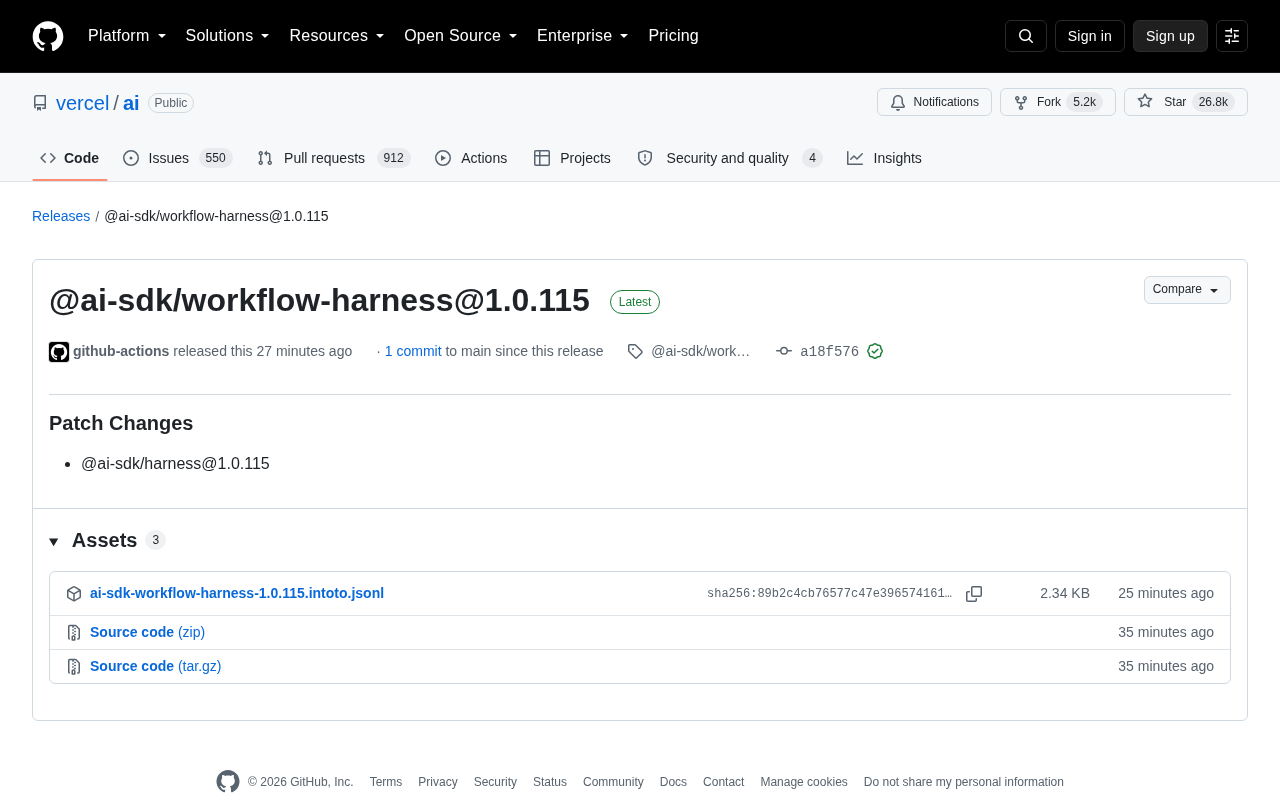
Vercel AI SDK Releases workflow-harness 1.0.115 Patch Update
Vercel AI SDK releases @ai-sdk/workflow-harness 1.0.115 patch update, syncing the @ai-sdk/harness dependency. Learn about the update, release mechanism, and what it means for developers.
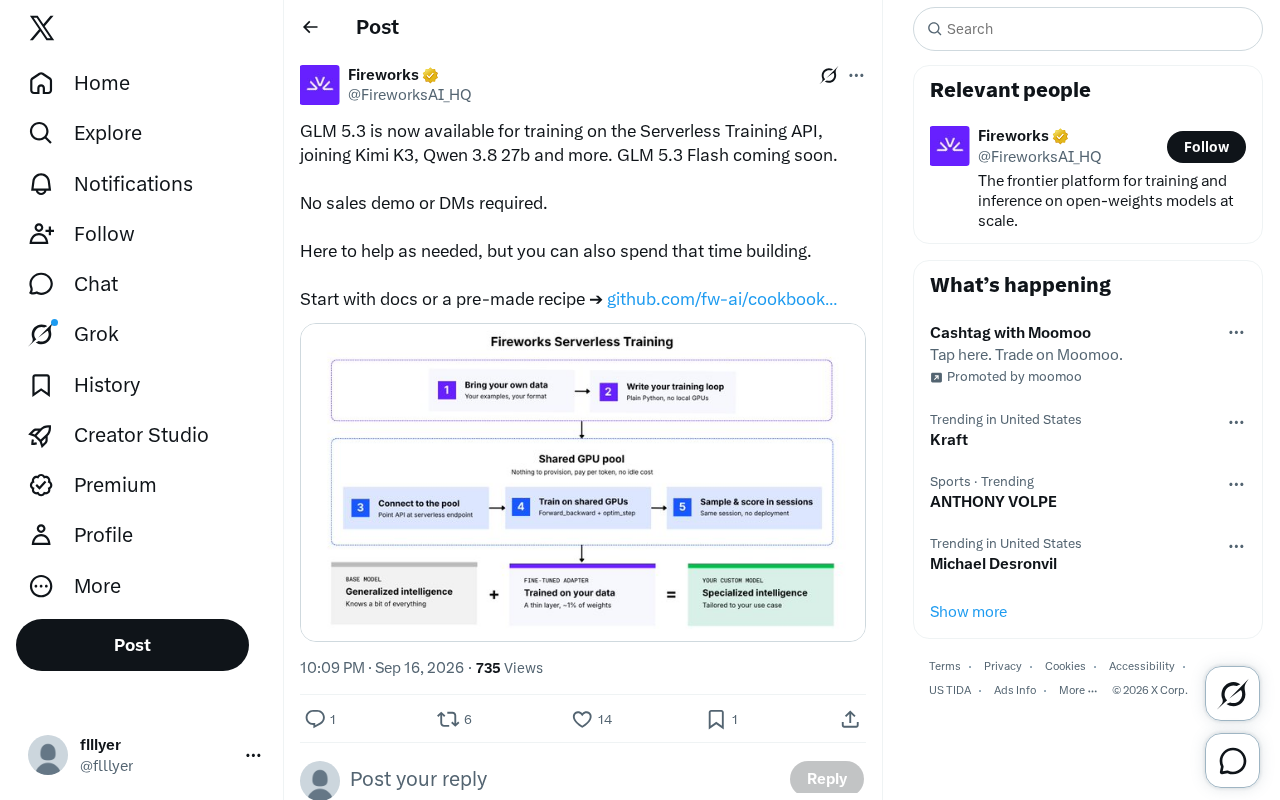
GLM 5.3 Now Available on Serverless Training API — No Sales Process Required
GLM 5.3 is now available on Serverless Training API alongside Kimi K3 and Qwen 3.8 27b. No sales process needed — start fine-tuning directly via docs or pre-made recipes.