Vercel AI SDK Vue 4.0.108 Released: useChat Gains Configurable Message Throttling

Vercel AI SDK Vue 4.0.108 adds useChat message throttling to improve streaming output render performance.
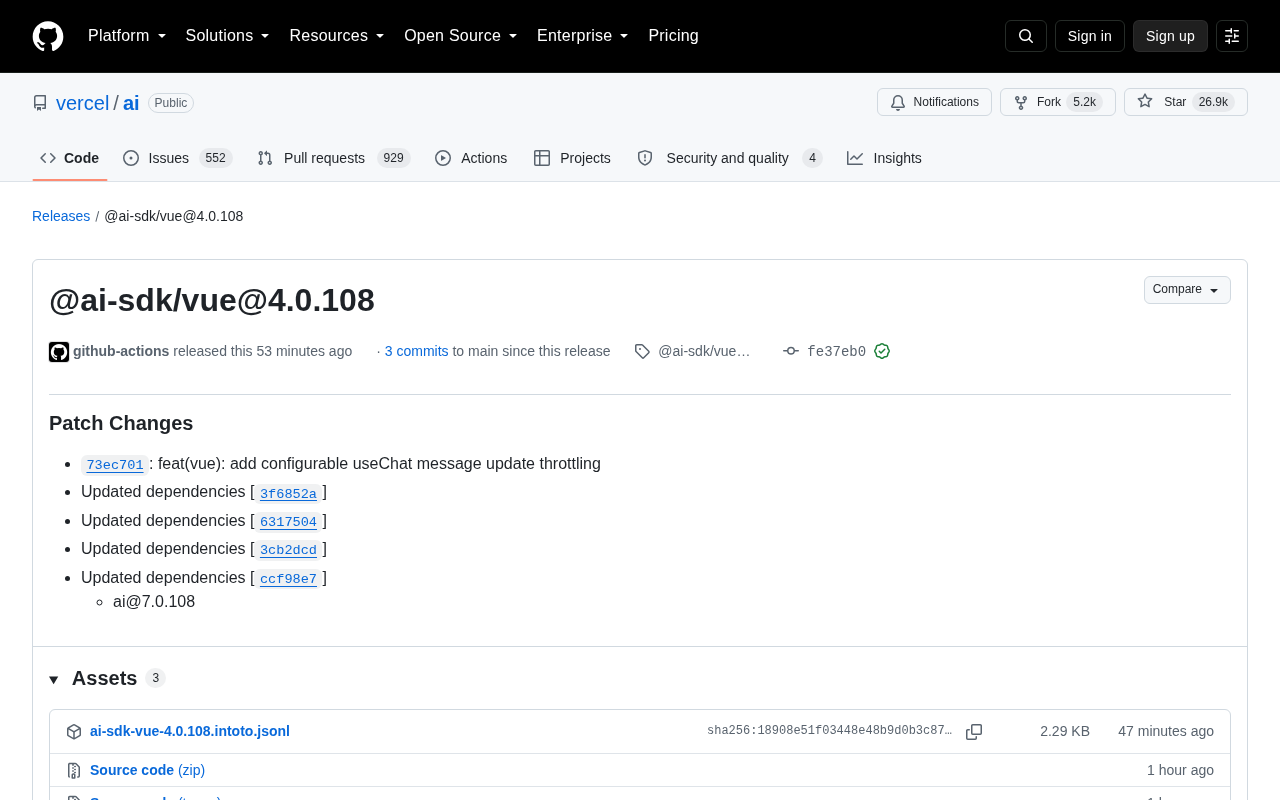
Vercel released `@ai-sdk/vue@4.0.108`, a patch update whose core change introduces configurable message update throttling for `useChat`. In AI streaming scenarios, models push content token by token at high frequency; without throttling, each update triggers Vue reactivity, creating render pressure in long conversations or complex UIs. The throttling mechanism lets developers cap update frequency to preserve the typewriter effect while dramatically reducing re-renders. Previously available in the React version, this feature is now parity-aligned for Vue. The release corresponds to core package `ai@7.0.108` and is considered a low-risk upgrade.
Vercel's officially maintained AI SDK has released a patch update, @ai-sdk/vue@4.0.108. As an open-source project with over 26,000 stars, the AI SDK provides unified AI integration capabilities for frontend frameworks. This update focuses on optimizing the chat interaction experience within the Vue ecosystem.
Core Changes in This Release
This is a patch-level update, primarily introducing one practical new feature for useChat: configurable message update throttling.
In streaming response scenarios, AI models return content character by character or chunk by chunk at an extremely high frequency. If every incoming chunk triggers a Vue reactive update and component re-render, this can create significant performance pressure during long conversations or high-frequency output, resulting in UI stuttering. The new throttling configuration allows developers to control how often useChat message updates fire, striking a balance between smoothness and performance.
What Problem Does Throttling Solve?
For developers building chat applications, rendering performance during streaming output has always been an under-the-radar pain point. By default, the view updates on every received token — a noticeable cost on mobile devices or in complex UIs. By introducing configurable throttling, developers can cap the update frequency to a reasonable interval (e.g., batching updates every few milliseconds), preserving the feel of a real-time typewriter effect while significantly reducing the number of re-renders.
This capability was previously available in the React version of the AI SDK and is now being brought to Vue, reflecting Vercel's commitment to maintaining a consistent experience across multiple frameworks.
Throttling is a classic frontend performance optimization technique. The core idea is simple: no matter how many times an event fires within a fixed time window, the callback executes at most once. Unlike debouncing — which waits until events stop before firing — throttling guarantees a uniform execution interval, making it better suited for streaming data scenarios where content is continuously generated and needs to be displayed in real time. During AI streaming output, a model may push dozens of tokens per second. Mapping each one directly to Vue's reactivity system means triggering dozens of
reforreactivewrites and DOM diffs per second — a significant burden for low-end devices or chat interfaces with complex child components. By configuring the update frequency to batch-refresh every 50ms or 100ms, for example, re-render counts can be reduced by 5 to 20 times. Since the human eye is virtually insensitive to delays under 50ms, the visual experience of the typewriter animation remains essentially unaffected.
Dependency Sync and Version Relationships
This release also synchronizes several underlying dependencies, aligning with the core package ai@7.0.108. This means the Vue adapter layer stays version-locked with the AI SDK core library, ensuring consistent API behavior.
For Vue projects already using the AI SDK, upgrading to this version is generally low-risk, as patch releases typically contain no breaking changes. Developers are encouraged to review their useChat usage after upgrading and evaluate whether enabling the throttling option makes sense for their use case.
The Vercel AI SDK uses a Monorepo architecture, with core logic centralized in the
aipackage. Framework adapter layers (@ai-sdk/react,@ai-sdk/vue,@ai-sdk/svelte, etc.) are published as separate packages but keep their version numbers in sync with the core. The benefit of this design is that each adapter layer stays lightweight — handling only the framework-specific reactive bindings and lifecycle logic — while capabilities like stream processing, protocol parsing, and tool calling are provided uniformly by the core package. When upgrading, developers only need to pay attention to whether Major version bumps introduce breaking API changes; Patch and Minor updates can generally be adopted with confidence. For projects with pinned dependencies, you can also review the correspondingaicore package Changelog to understand the specific underlying changes in a given release.
What This Means for Vue Developers
Within the frontend ecosystem, the AI SDK has long been primarily React-focused, with Vue support lagging behind on new features. The addition of throttling capability is a signal that Vue users are progressively gaining feature parity with the React experience.
For teams building AI-powered conversation products, customer service assistants, or content generation tools with Vue, these kinds of low-level optimizations may seem minor but directly impact how fluid the end-user experience feels during long conversations. Properly configuring throttling parameters can improve interaction quality without adding any additional engineering overhead.
As AI application patterns continue to evolve, the direction of frontend SDK refinement is shifting from "functional" to "polished." Fine-grained control over performance is often the key detail that separates a mature framework from an experimental tool.
Related articles

Chain of Thought Isn't Just for AI: How Humans Can Use CoT to Improve Thinking Quality
Chain of Thought isn't just a prompt trick for large models. Starting from a Hacker News discussion, this article analyzes why CoT works for human thinking too, breaks down actionable ways to transfer it, and highlights the key differences between human CoT and machine CoT.
Cloudflare Teams Up with OpenAI: Closi…
Cloudflare Teams Up with OpenAI: Closing the Loop from Vulnerability Discovery to Defense with AI
Cloudflare uses OpenAI Daybreak to investigate security vulnerabilities and generate reviewable remediation plans, while developers use Codex to boost coding efficiency and quality.

Orca Multi-Agent Orchestration in Practice: A Guide to Parallel Collaboration with Claude and Codex
Orca is Stable AI's free open-source agent workbench supporting 34 agents like Claude Code and Codex in parallel. Learn its Git worktree isolation, multi-model orchestration, and mobile management.