Vercel AI SDK Vue Releases 3.0.288 Patch Update

Vercel AI SDK Vue adapter releases patch 3.0.288, syncing with core package — safe to upgrade with no breaking changes.
`@ai-sdk/vue@3.0.288` is a patch-level release of Vercel AI SDK's Vue adapter, with the core change being a version alignment to `ai@6.0.288`. The patch introduces no breaking changes, making it low-risk to adopt as part of routine dependency maintenance. The SDK provides Vue developers with composables like `useChat` and `useCompletion` for declarative streaming and state management. Notably, each framework adapter uses an independent major version but a shared patch number — a common monorepo versioning practice.
Release Overview: @ai-sdk/vue@3.0.288
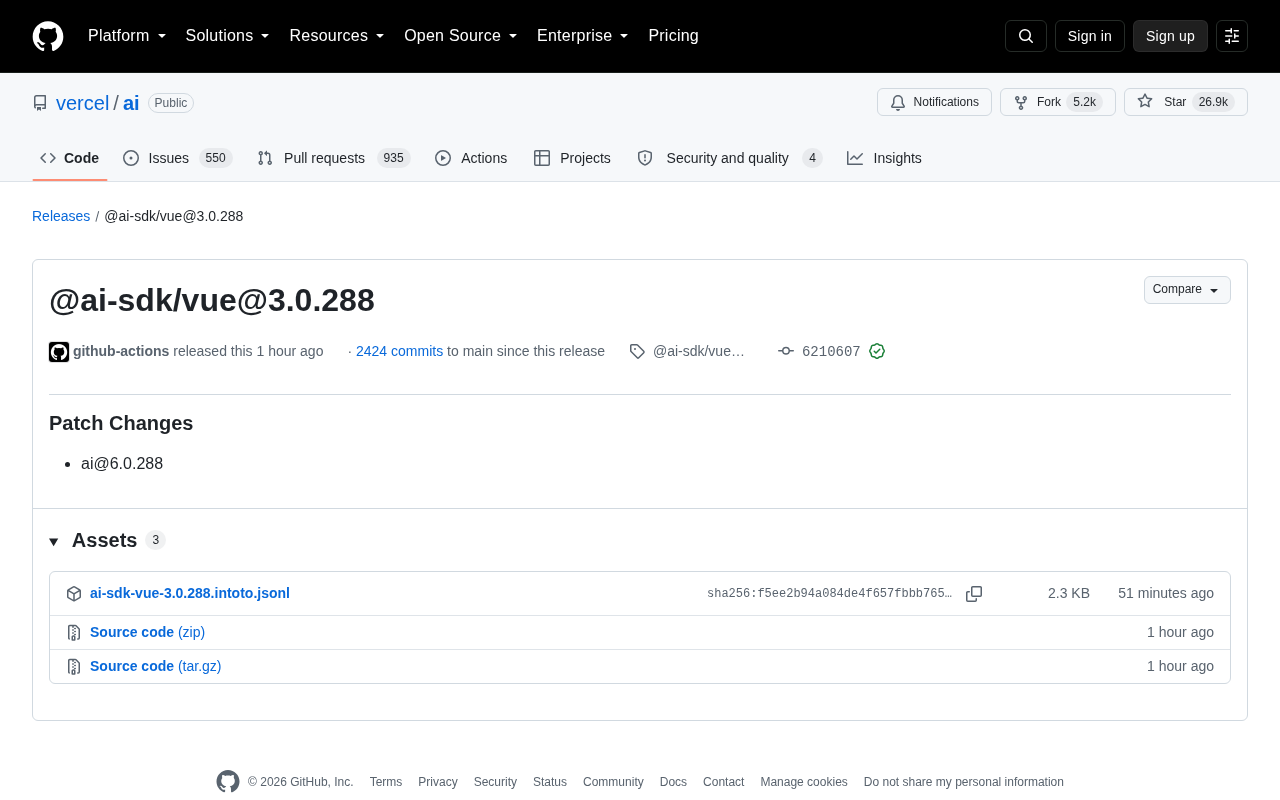
Vercel's open-source AI toolkit ai repository has released @ai-sdk/vue@3.0.288. According to the GitHub release record, this update was automatically published by github-actions and represents a patch-level version bump, synced with the ai@6.0.288 core package.
The version number tells a familiar story — this is yet another incremental update along the 3.0.x mainline. As one of the most widely used toolkits for building AI applications, Vercel AI SDK's Vue adapter package gives Vue ecosystem developers a convenient way to integrate large model capabilities, including streaming responses and chat UI state management.
What a Patch Update Means
This release is labeled Patch Changes, with the core change being a version alignment to follow the ai@6.0.288 main package. Patch updates typically do not introduce breaking changes — they're primarily used for bug fixes, internal optimizations, or keeping dependency versions in sync. For projects currently using @ai-sdk/vue, upgrading to this version should be safe.
One thing worth noting is the version number offset: @ai-sdk/vue uses 3.0.288, while its core dependency ai is at 6.0.288. This reflects Vercel AI SDK's independent package versioning strategy — each framework adapter (Vue, React, Svelte, etc.) maintains its own major version number, but they stay in sync through a shared patch number (288), keeping their release cadence aligned.
Semantic Versioning (SemVer) is a widely adopted versioning standard in the open-source community, using the format MAJOR.MINOR.PATCH. A PATCH increment indicates backward-compatible bug fixes; MINOR indicates new backward-compatible features; MAJOR indicates breaking changes. Vercel AI SDK lets each framework adapter maintain an independent MAJOR version (e.g., the Vue package is at 3, while the React package may differ), but locks the same PATCH number to identify packages belonging to the same release batch. This approach is common in monorepo multi-package management — it makes it easy to tell at a glance whether packages are part of the same release, while still preserving the flexibility for each package to evolve its API design independently.
About Vercel AI SDK
Vercel's ai repository currently has approximately 26,900 stars and 5.2k forks on GitHub, making it one of the most active open-source projects in the AI application development space. The SDK provides a unified, cross-framework API that helps developers quickly integrate with model providers such as OpenAI, Anthropic, and others.
For Vue developers specifically, @ai-sdk/vue wraps composables like useChat and useCompletion, enabling declarative handling of message streams, loading states, and error management — significantly lowering the barrier to building conversational AI interfaces in Vue applications.
useChat and useCompletion are the two core composables provided by @ai-sdk/vue. useChat is designed for multi-turn conversation scenarios, encapsulating message history management, user input submission, and server-side streaming response reception — developers only need to bind the returned reactive variables to render a full chat interface. useCompletion is suited for single-turn text completion use cases, such as auto-continuation or summary generation. It exposes interfaces like completion (the current result text) and complete() (to trigger a request), which can be combined with Vue's reactivity system to achieve a typewriter-style character-by-character output. Both composables rely on the Fetch API's streaming reads (ReadableStream) under the hood. By keeping the transport layer framework-agnostic, they internalize state management complexity within the SDK itself — developers no longer need to manually manage AbortController instances or parse SSE data chunk by chunk.
Upgrade Recommendations
Since this is a patch update and has been verified with a GitHub verified signature, it's recommended that teams using this SDK include the upgrade as part of their routine dependency maintenance. If your project has high stability requirements, consider validating core functionality (such as streaming output and state synchronization) in a test environment before merging into the production branch.
It's worth noting that the official release notes are fairly brief and do not list specific bug fixes or feature changes. Developers looking for a more complete picture of what changed can consult the repository's CHANGELOG file or compare commit history between adjacent versions.
Related articles

Chain of Thought Isn't Just for AI: How Humans Can Use CoT to Improve Thinking Quality
Chain of Thought isn't just a prompt trick for large models. Starting from a Hacker News discussion, this article analyzes why CoT works for human thinking too, breaks down actionable ways to transfer it, and highlights the key differences between human CoT and machine CoT.
Cloudflare Teams Up with OpenAI: Closi…
Cloudflare Teams Up with OpenAI: Closing the Loop from Vulnerability Discovery to Defense with AI
Cloudflare uses OpenAI Daybreak to investigate security vulnerabilities and generate reviewable remediation plans, while developers use Codex to boost coding efficiency and quality.

Orca Multi-Agent Orchestration in Practice: A Guide to Parallel Collaboration with Claude and Codex
Orca is Stable AI's free open-source agent workbench supporting 34 agents like Claude Code and Codex in parallel. Learn its Git worktree isolation, multi-model orchestration, and mobile management.