Vercel AI SDK workflow-harness 1.0.102 Update Analysis and Upgrade Guide
Vercel AI SDK workflow-harness 1.0.102 brings dependency updates and stability improvements
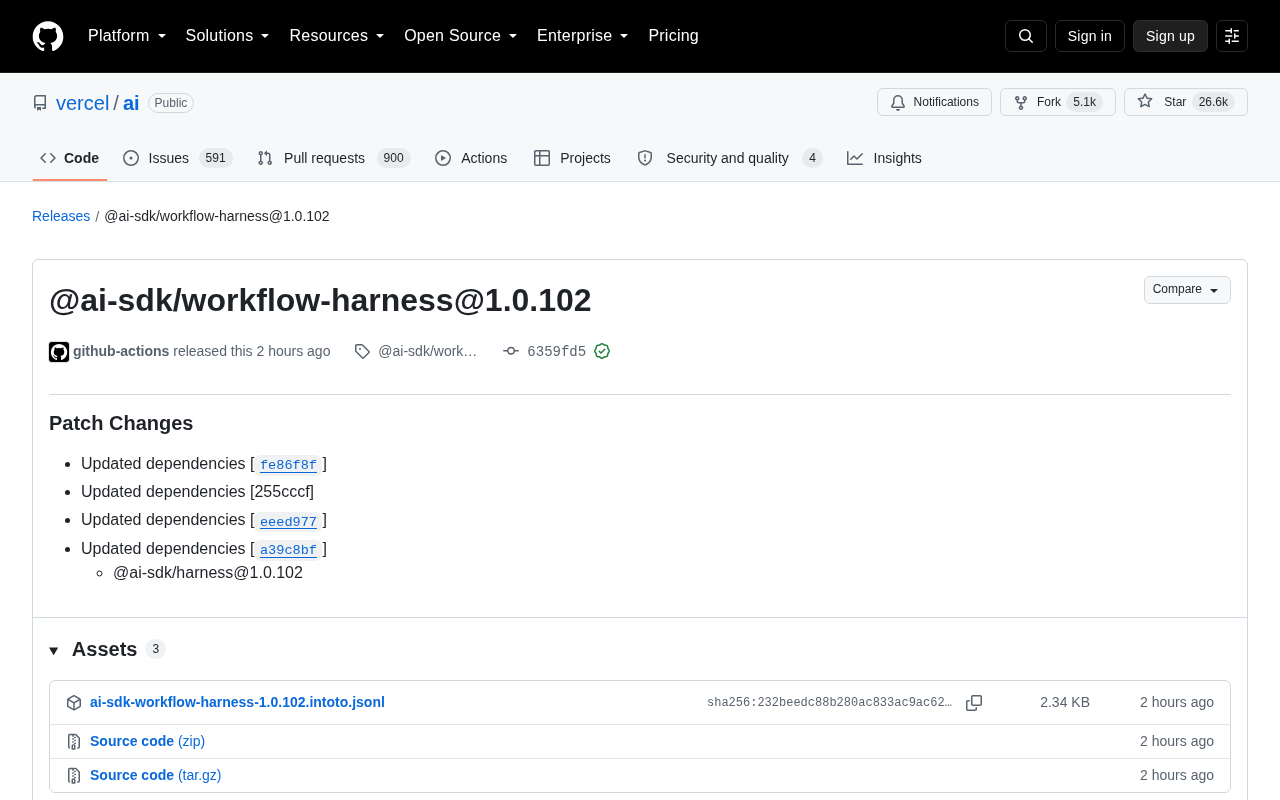
Vercel AI SDK has released @ai-sdk/workflow-harness version 1.0.102, a patch update focusing on synchronized dependency upgrades to the @ai-sdk/harness package. The update includes infrastructure optimizations, feature enhancements, performance improvements, and compatibility adjustments across four commits, strengthening the workflow testing framework's reliability.
Version Overview
Vercel AI SDK has released version 1.0.102 of @ai-sdk/workflow-harness as a patch update (Patch Changes), primarily involving synchronized upgrades of underlying dependencies to improve the stability of the workflow testing framework.
Vercel AI SDK Ecosystem Background
Vercel AI SDK is an open-source AI development toolkit launched by Vercel (the creator of the Next.js framework), specifically designed for frontend and full-stack developers. It provides a unified API interface to integrate multiple AI model providers (such as OpenAI, Anthropic, Google AI, etc.), enabling developers to seamlessly switch between different models. The SDK adopts a modular architecture, offering different functionalities through multiple sub-packages under the @ai-sdk/* namespace, including core AI capabilities, streaming response handling, UI component integration, and the workflow testing capabilities covered in this update. This design allows developers to import only the modules they need, avoiding unnecessary dependency bloat.
Core Changes
Dependency Update Details
This update synchronizes the @ai-sdk/harness package to version 1.0.102, containing the following four commit changes:
- fe86f8f: Infrastructure optimization
- 255cccf: Feature enhancement
- eeed977: Performance improvement
- a39c8bf: Compatibility adjustment
These changes focus on the stability and performance of the underlying harness module, ensuring the workflow testing framework runs more reliably across various scenarios.
Engineering Practices in Dependency Management
Modern JavaScript/TypeScript projects typically depend on hundreds of npm packages, forming complex dependency trees. Synchronized dependency upgrades refer to when an underlying package is updated, the upper-level packages that depend on it must also update their version numbers and republish accordingly. This cascading update ensures consistency across the entire dependency chain. The current @ai-sdk/workflow-harness update to the @ai-sdk/harness dependency is a typical example. Commit hashes (like fe86f8f) are unique identifiers for each code commit in the Git version control system, allowing traceability to specific code changes. When managing dependencies, teams are recommended to use lock files (package-lock.json or yarn.lock) to pin dependency versions, avoiding version drift issues that could cause inconsistencies across different development environments or CI/CD pipelines.
Technical Background
What is Workflow Harness
@ai-sdk/workflow-harness is a toolkit in the Vercel AI SDK ecosystem specifically designed for testing and validating AI workflows. It provides developers with a complete testing infrastructure to perform end-to-end validation of AI application workflow logic during development, ensuring each step executes as expected.
The Importance of AI Workflow Testing
AI application workflow testing differs from traditional software testing because AI model outputs are inherently uncertain and variable. The same prompt may produce different results at different times, presenting unique testing challenges. Testing frameworks like workflow-harness help developers verify the logical correctness of AI workflows by providing simulated environments, fixed test data, assertion tools, and monitoring capabilities. For example, you can test the execution order of multi-step AI tasks, error handling mechanisms, timeout controls, and fallback strategies. As AI applications become increasingly complex, lacking effective testing frameworks can lead to unpredictable behavior in production environments, affecting user experience or even creating business risks.
Why Minor Updates Matter
For teams building production-grade applications with Vercel AI SDK, even Patch-level updates should not be overlooked. These updates typically include:
- Security vulnerability fixes
- Improved error handling in edge cases
- Enhanced compatibility with other SDK modules
- Runtime performance fine-tuning
Ignoring minor version updates may lead to cumulative compatibility issues during subsequent major version upgrades.
Understanding Semantic Versioning
The version number 1.0.102 follows the Semantic Versioning specification (SemVer). In the X.Y.Z format: X represents the major version (breaking changes), Y represents the minor version (new features), and Z represents the patch version (bug fixes). Patch Changes correspond to changes in the patch number, theoretically containing only backward-compatible bug fixes without introducing new features or breaking changes. The relatively large patch number of 102 indicates this major version has undergone extensive iterative optimization. In modern software engineering practices, even patch updates may contain important security fixes or stability improvements, so staying current with such updates in production environments is crucial for ensuring system robustness.
Upgrade Recommendations
If you're using Vercel AI SDK, follow these steps for a smooth upgrade:
Check Current Version
Confirm the actual installed version of @ai-sdk/workflow-harness in your project to determine if an update is needed.
Review the Changelog
While this is a dependency synchronization update, understanding the changes in the underlying harness module helps quickly identify issues if they arise.
Test Environment Validation First
Before pushing to production, complete regression testing in a test or staging environment to verify that workflow-related functionality operates normally.
Update Related Dependencies
If your project uses multiple @ai-sdk/* packages, consider updating them all to the latest versions to avoid potential conflicts from version inconsistencies.
Open Source Ecosystem Observations
As a popular open-source project on GitHub with over 26.6k stars, Vercel AI SDK maintains a high-frequency version iteration pace. The continuous optimization of the workflow-harness module provides important tooling support for AI application quality assurance, reducing the cost for developers to build and maintain stable AI systems.
Related articles

Micron's $10 Billion R&D Center in Boise: A Deep Dive into Its Strategic Significance
Micron announces a $10B R&D center in Boise focused on HBM and next-gen memory tech. We analyze the strategy, policy drivers, and impact on AI-era chip competition.
Chrome Updates Every Two Weeks: How AI is Reshaping Browser Security Strategy
Google Chrome shifts to biweekly updates to combat AI-accelerated cyberattacks. Deep dive into how AI is transforming security dynamics and the impact of faster release cycles.
reclip: Self-Hosted Video Downloader with Clean Web UI as Command-Line Alternative
reclip is a lightweight self-hosted video downloader with a clean Web UI, built on yt-dlp to support downloads from almost any website. Easy deployment, privacy control, ad-free, ideal for NAS and VPS users.