Vercel AI SDK xAI 5.0.15 Update: Expanded Grok Image and Speech Capabilities

Vercel AI SDK xAI 5.0.15 adds Grok image generation and speech transcription capabilities to its multimodal provider.
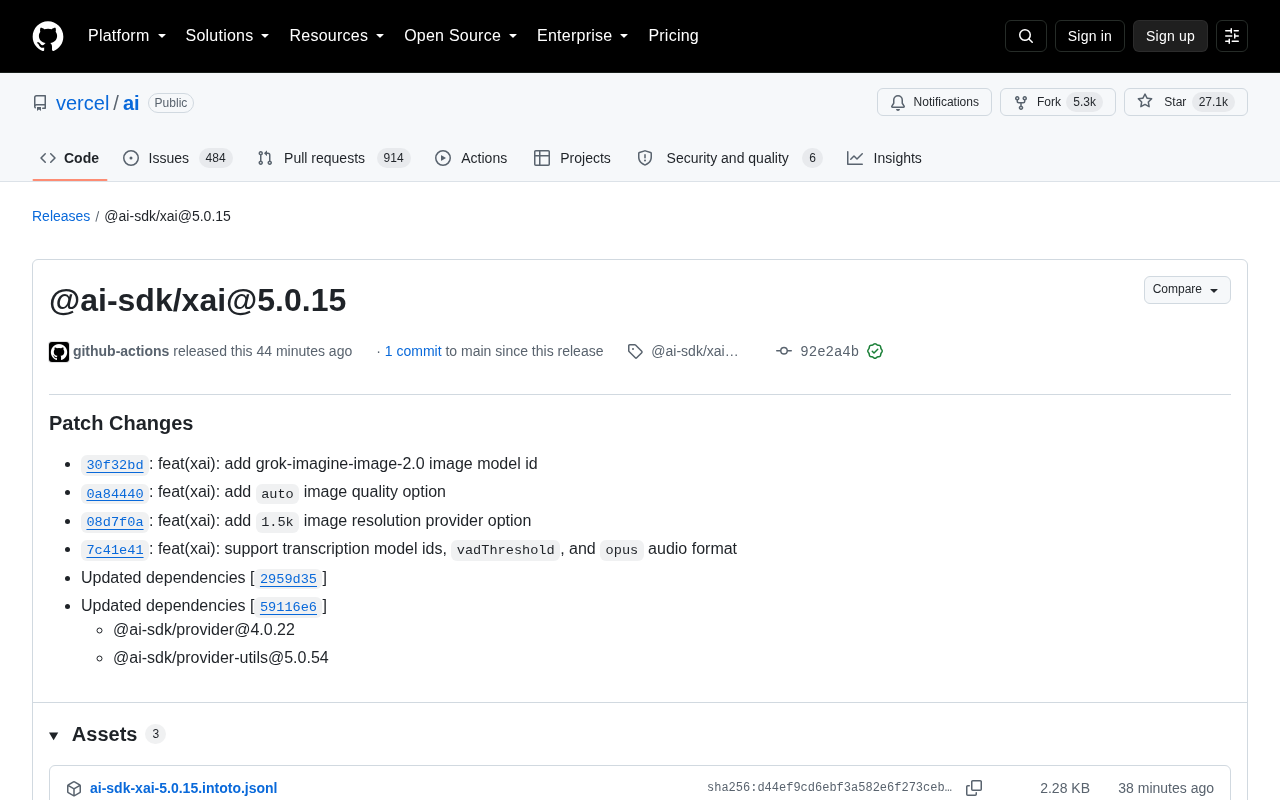
`@ai-sdk/[email protected]` is the latest patch release of Vercel AI SDK's xAI (Grok) provider. Despite the minor version bump, it delivers meaningful multimodal expansions: on the image side, it adds the `grok-imagine-image-2.0` model ID, an `auto` quality option, and `1.5k` resolution support; on the speech side, it introduces transcription model IDs, a `vadThreshold` parameter, and `opus` audio format support. Underlying packages `@ai-sdk/provider` and `@ai-sdk/provider-utils` are also updated in sync to ensure type consistency across the abstraction layer.
Vercel's AI SDK recently released @ai-sdk/[email protected], a patch update that brings a set of practical enhancements to the xAI (Grok) provider, focused on image generation and speech processing. While the version bump is just a single patch increment, the changes represent meaningful multimodal capability expansions with direct value for developers building applications on top of the Grok model family.
Key Changes in This Release
According to the official Release Notes, @ai-sdk/[email protected] is classified as a Patch Change, but it actually introduces several new features rather than being a pure bug fix:
- Added the
grok-imagine-image-2.0image model ID, allowing developers to invoke this image generation model directly through the SDK. - Added an
autoquality option for image generation, letting the model automatically determine output quality based on context. - Added a
1.5kimage resolution provider option, offering a higher-clarity output choice. - Added support for transcription model IDs, along with a new
vadThreshold(voice activity detection threshold) parameter andopusaudio format support.
Taken together, these changes point in one clear direction: making the xAI provider's multimodal coverage in the AI SDK more complete — expanding from text to image and speech.
Filling Out Image Generation Capabilities
The addition of the grok-imagine-image-2.0 model ID means developers can call xAI's latest image model without manually constructing requests. Combined with the auto quality setting and 1.5k resolution option, developers now have more flexibility to balance quality, resolution, and cost when generating images. The auto mode is especially well-suited for general-purpose use cases where manual tuning isn't desired, while the 1.5k resolution targets product requirements that demand higher visual clarity.
Speech and Transcription Support
The addition of transcription model IDs gives the xAI provider a speech-to-text entry point. The new vadThreshold parameter controls the sensitivity of voice activity detection, helping filter out silent segments and improve transcription accuracy. The opus audio format support, meanwhile, aligns with a mainstream low-bitrate, high-quality codec — ideal for transmitting audio in bandwidth-constrained or real-time scenarios.
VAD (Voice Activity Detection) is a critical preprocessing step in speech processing systems. Its core task is to distinguish between "someone speaking" and "silence/background noise" segments in an audio stream. The
vadThresholdparameter is essentially an energy or probability threshold: the higher the value, the stricter the system is about what it classifies as speech, causing more low-energy frames to be treated as silence and discarded; a lower value makes the system more sensitive, suitable for capturing faint speech in quiet environments. In real-time transcription or long-audio processing scenarios, properly configuring the VAD threshold can significantly reduce the transmission and processing overhead of invalid frames, lowering API call costs and improving final transcription accuracy. Opus is an open-source audio codec developed by the Xiph.Org Foundation, standardized by the IETF (RFC 6716). It performs excellently across a wide bitrate range from 16kbps to 512kbps, serves as the default codec for WebRTC real-time calls, and is a common choice for voice AI applications that need to strike a balance between bandwidth and audio quality.
Dependency Updates
This release also synchronizes underlying dependencies, including @ai-sdk/[email protected] and @ai-sdk/[email protected]. These dependency updates are typically necessary to maintain provider interface consistency and ensure that the newly added image and speech parameters are correctly handled by the unified provider abstraction layer. For teams already running the AI SDK in production, it's worth paying attention to version alignment of these two underlying packages when upgrading, to avoid type or runtime issues caused by dependency mismatches.
Vercel AI SDK uses a layered provider architecture:
@ai-sdk/providerdefines the abstract interfaces that all model providers must follow (type contracts such asLanguageModel,ImageModel, andTranscriptionModel), while@ai-sdk/provider-utilsprovides shared utility functions for request construction, response parsing, and streaming. Vendor-specific providers (like@ai-sdk/xaiin this case) implement their respective API integration logic on top of these two foundation packages. When new image resolution enum values or audio format types are added, the underlying interface packages often need to expand their type definitions in sync — otherwise TypeScript compilation will throw type incompatibility errors. This is why a seemingly simple feature patch causes version bumps across multiple packages: maintaining type consistency across the entire dependency graph is standard practice in monorepo-style SDK maintenance.
What This Means for Developers
Vercel AI SDK is one of the more popular unified multi-model invocation frameworks available today. Its value lies in wrapping different vendors' model capabilities behind a consistent API. The continued iteration of the xAI provider signals that the Grok family is expanding beyond pure conversational models into multimodal territory — covering image and speech — and that AI SDK is tracking these capabilities in a timely manner.
For developers currently evaluating Grok, this release lowers the barrier to accessing image generation and speech transcription. Rather than diving into the details of xAI's native API, you can use these new models through the familiar SDK interface. Teams following this project are encouraged to review the full changelog before upgrading and to validate the behavior of the new parameters in a non-production environment first.
Summary
@ai-sdk/[email protected] may be a patch release, but the addition of a new image model ID, quality and resolution options, and speech transcription capabilities meaningfully extends the xAI provider's multimodal reach. For developers seeking rapid integration of multi-model capabilities, this is an update worth paying attention to.
Related articles

Felix Rieseberg Personal Homepage
Felix Rieseberg's personal homepage sparks attention on Hacker News. This article covers the Slack engineer's technical background, the rise and fall of nativefier, and the value of a developer homepage as a tech calling card.

@ai-sdk/vue 3.0.306 Patch Release Syncs with [email protected] Update
@ai-sdk/vue 3.0.306 released, synced with [email protected]. A routine patch release for the Vercel AI SDK ecosystem with no public API changes; the Vue adapter layer stays version-aligned with the core package.

Gemini 4 Argon API Launches: The Era of Million-Token Output Begins
Google launches Gemini 4 Argon with sparse MoE architecture, up to 1M output tokens, and a 68.90% Vals Index score, available across API, AI Studio, and the Gemini app.