Vercel AI SDK xAI Adapter 3.0.133 Patch Explained
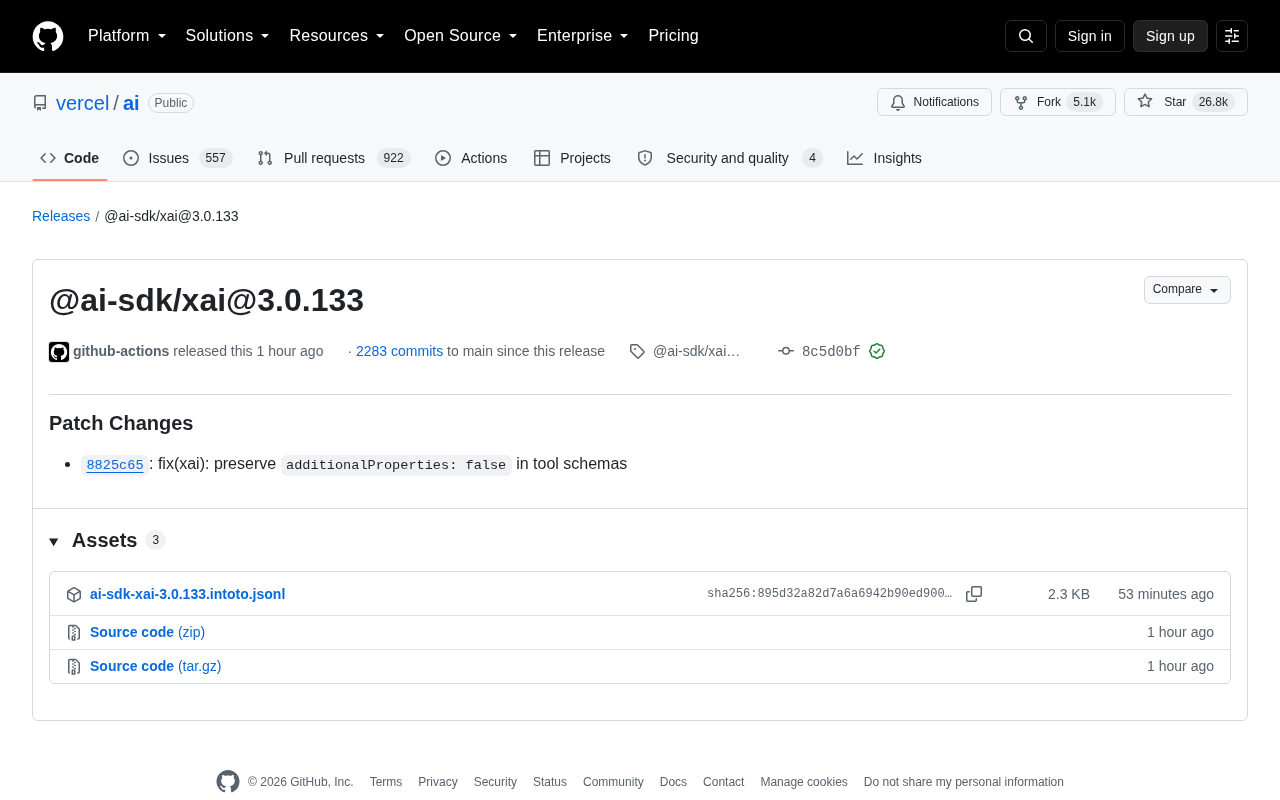
@ai-sdk/xai 3.0.133 fixes additionalProperties: false being silently dropped from tool call schemas.
Vercel AI SDK's xAI provider adapter `@ai-sdk/xai` has released patch version 3.0.133, with a core fix ensuring that the `additionalProperties: false` constraint in JSON Schema is correctly preserved when passing tool definitions to xAI (Grok series) models. This field strictly limits model output objects to only schema-declared properties — if dropped, models may return extra fields causing downstream parsing or type validation failures. As a patch release with no breaking changes, developers using tool calling, structured data extraction, or Agent orchestration are encouraged to upgrade immediately.
The xAI provider adapter @ai-sdk/xai for Vercel AI SDK has released version 3.0.133. This is a patch-level update focused on fixing a schema handling issue in tool calling scenarios. While the version bump is minor, for developers relying on xAI (Grok series models) for structured output and function calling, this kind of fix can directly impact application stability.
What Changed: Tool Schema Handling Fix
This update contains a single change from commit 8825c65:
fix(xai): preserve
additionalProperties: falsein tool schemas
In short, this patch ensures that when passing tool definitions to xAI models, the additionalProperties: false field in JSON Schema is correctly preserved.
additionalProperties: false is a critical JSON Schema constraint that explicitly tells the model: only properties declared in the schema are allowed in the object — no extra fields permitted. In structured output and function calling scenarios, this constraint is essential for ensuring strict model output. If accidentally dropped, the model may return responses with extra fields, causing downstream parsing failures or type validation errors.
From a technical standpoint, additionalProperties: false typically gets lost during schema transformation or serialization within the SDK. Different model providers have subtle differences in their tool schema format requirements, so the adapter layer needs to map and clean up the original schema. During this process, if the code only performs a shallow copy of properties, or uses a serialization library that filters out "unknown fields," keywords like additionalProperties — which are non-standard but valid JSON Schema keywords — can be silently dropped. OpenAI's function calling spec and xAI may also handle this field differently, and a slight misalignment when reconciling the two can easily produce this kind of omission.
Why This Fix Matters
Tool calling is one of the core capabilities in modern AI application development. Developers define structured tool schemas so that models return parameters in a predictable format, which code then executes. If the SDK loses additionalProperties: false during schema transformation, the output constraints on the model are loosened, potentially introducing edge-case bugs that are hard to debug.
For projects using xAI Grok models to build Agents, structured data extraction, or API orchestration, the correctness of these low-level adapters directly determines the reliability of business logic. Small as this patch is, it's a necessary piece to ensure that "strict mode" works as expected.
Here's how tool calling (Tool Calling / Function Calling) works: when calling a model API, developers attach a set of "tool definitions" to the request. Each tool includes a name, description, and a JSON Schema for its parameters. When generating a response, if the model determines it needs to use a tool, it outputs a structured parameter object matching that schema — rather than plain text. The application code then takes those parameters, calls the corresponding local function or external API, and feeds the result back to the model, completing one "think–act–observe" cycle. This is the foundational mechanism for building AI Agents, and it's why schema constraint correctness is so critical — if the model's output parameters deviate from the expected format, the entire tool-calling pipeline can break down.
About Vercel AI SDK
Vercel AI SDK is one of the most popular TypeScript AI development toolkits available today, with over 26,000 stars and 5,100 forks on GitHub. Through a unified interface abstraction, it lets developers connect to multiple model providers — including OpenAI, Anthropic, and xAI — in a consistent way. @ai-sdk/xai is the official adapter package for xAI within this ecosystem.
This "provider adapter" architecture means that each model vendor's API quirks — such as schema format differences, parameter naming conventions, and tool calling protocols — are encapsulated in separate packages. As a result, patch updates targeting individual providers tend to be fairly frequent. Developers are encouraged to keep their dependencies up to date to benefit from compatibility and stability fixes.
Upgrade Recommendation
If your project uses xAI models and involves tool calling or structured output, it's recommended to upgrade @ai-sdk/xai to 3.0.133. The upgrade is straightforward:
npm install @ai-sdk/xai@3.0.133
As a patch release, this update contains no breaking changes and is safe to apply. If you've previously encountered issues with Grok models returning extra fields or failing structured output validation, this fix is likely the solution you've been waiting for.
Related articles

LynnReal-Omni: 32B Unified Video Diffusion Model Goes Open Source with Multi-Task Coverage in Four Steps
LynnReal-Omni is a 32B unified video diffusion model on MiniMax H3, covering text-to-video, pose guidance, style transfer, restoration in 4 steps. Flash version generates 540p video in 377ms on one H100.

Anthropic Co-Founder: AI 'Kill Switch' May Need to Be Mandatory by Law
Anthropic's co-founder tells the BBC that AI 'kill switches' may need to be legally mandated. We analyze the industry logic, technical challenges, and the tension between regulation and innovation.

The AI Data Center Boom Is Colliding With Cities Scarred by Heavy Industry
The AI data center boom is clashing with post-industrial communities. Philadelphia's case reveals structural conflicts between AI growth, energy use, water, and environmental justice.