Vercel Applies for .vercel Top-Level Domain: A New Namespace for AI-Generated Content?
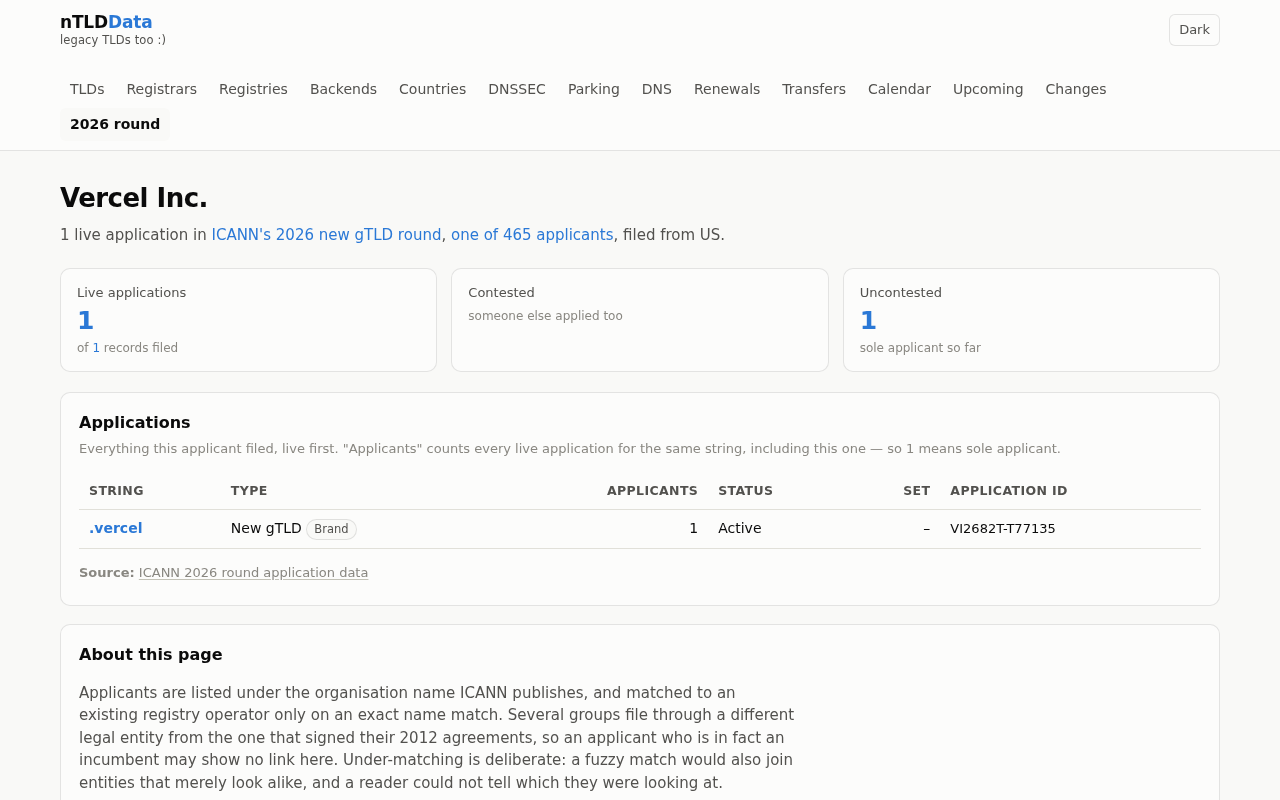
Vercel applies for the .vercel domain, raising community concerns it could become a hub for low-quality AI content.
Vercel applied for the .vercel top-level domain at ICANN 2026, and the Hacker News community interpreted it as the starting point of an "AI slop" namespace. The article argues that brand TLDs are a conventional move, but in the AI era they may evolve from brand assets into labels for content production methods. The community worries about the centralization of AI-generated content, but the TLD itself is not the problem — the key is how Vercel defines access rules and use cases. If quality review or AI usage declarations are introduced, the narrative could be reversed. For developers, the domain's value depends on pricing and openness strategy; for the content ecosystem, this could signal TLDs evolving from ownership markers to content labels.
Vercel's application for the .vercel top-level domain at ICANN 2026 has sparked discussion on Hacker News. On the surface, it's a routine brand domain upgrade, but the community has interpreted it as the starting point of a namespace for "AI slop" (low-quality, mass-generated AI content).
Why a Domain Application Triggers "AI Slop" Associations
Vercel's application for the .vercel TLD is itself a conventional brand domain move, similar to Google owning .dev or Amazon owning .aws. But the Hacker News headline directly links it to "AI slop," reflecting the developer community's anxiety over the flood of AI-generated content.
The original post had only 8 points and 1 comment — low engagement — but the phrase "namespace for AI slop" precisely captures the current mood: when AI can generate web pages, applications, and content at extremely low cost and at scale, a dedicated top-level domain could become a marker for where such content congregates.
ICANN's New Generic Top-Level Domain (gTLD) Application Process: ICANN (Internet Corporation for Assigned Names and Numbers) coordinates the global domain name system. New gTLD applications are typically opened in rounds; the last large-scale application round was in 2012, and no new round had opened for years afterward. ICANN plans to launch a new application window in 2026, during which companies can submit brand TLD applications. Applications must go through string review, dispute resolution, technical evaluation, and other stages, with an evaluation fee of $185,000 plus subsequent annual fees. Vercel's application falls within this round, hence the "ICANN 2026" timing.
Origin of the term "AI slop": "Slop" originally refers to cheap, mass-produced low-quality feed or food. Around 2023, it began to be used to describe low-quality content mass-generated by AI, such as spam-like blogs, crudely made images, and template-driven web pages. The term is pejorative, emphasizing a lack of originality and human review. The Hacker News headline linking .vercel to AI slop borrows this buzzword to express vigilance against the proliferation of AI-generated content.
Pros and Cons of Brand TLDs and Their Special Significance in the AI Era
Brand top-level domains are not new. Companies' motivations for applying for their own TLDs typically include brand control, security, and marketing differentiation, but actual usage rates tend to be very low.
In the AI era, this logic takes on new variables. If .vercel becomes the default domain suffix for AI-generated projects on the Vercel platform, it may naturally carry a "machine-generated" label. This isn't necessarily pejorative — it could also become an identity marker for AI applications, similar to how .dev represents developers and .ai represents AI companies.
The key lies in how Vercel defines the access rules and use cases for this namespace.
Actual usage of brand top-level domains: Since ICANN opened new gTLDs in 2012, many companies have applied for brand TLDs such as .google, .microsoft, and .apple. But most brand TLDs have not been opened for large-scale registration; they are mainly used for internal IT systems, redirects, or security isolation, with extremely low public usage. Some companies even abandoned their operations later. The pros and cons of brand TLDs: the pros are enhanced brand control and security; the cons are high operating costs, low user awareness, and the potential to divert traffic from the main domain.
The Real Concerns Behind Community Sentiment
The choice of headline on Hacker News is telling. "AI slop begins" implies a pessimistic expectation: AI-generated content will move from scattered distribution to centralization and scale.
This concern has a basis in reality. AI coding tools have lowered the barrier to building websites, and a large volume of low-quality, repetitive web pages and applications is emerging. A dedicated TLD could make such content easier to identify, or it could let it cluster more covertly.
From an SEO and content governance perspective, the TLD itself is not the problem — the problem lies in content quality and platform governance mechanisms. If Vercel can introduce quality review or AI usage declarations at the domain level, it might be able to reverse the "slop" narrative.
The relationship between TLDs, SEO, and content governance: A top-level domain itself has no direct impact on search engine rankings, but a TLD can convey trust signals. For example, .gov and .edu are strictly restricted and regarded as authoritative; .dev and .ai carry specific meanings due to their community associations. If .vercel is used by a large amount of low-quality AI content, search engines may algorithmically lower its overall quality assessment, similar to how free second-level domains were treated in the past. If the platform introduces content review or AI usage declarations at the domain registration stage, it can filter out low-quality content in advance, but it needs to balance openness and governance costs.
Impact on Developers and the Content Ecosystem
For developers, the direct value of a .vercel domain depends on Vercel's pricing and openness strategy. If it is limited to enterprise customers or bundled at a high price, the impact will be limited; if it is opened to all users, it could spawn a wave of personal projects and AI applications with .vercel suffixes.
For the content ecosystem, this could be a signal of top-level domains evolving from "brand assets" to "content labels." In the future, a TLD may not only represent ownership but also hint at how content is produced — human-created or AI-generated.
Vercel's application still needs to go through ICANN's approval process, but the discussion it has sparked already reveals a trend: infrastructure decisions in the AI era are being re-examined by the community through the lens of AI governance.
One-line Summary
Vercel applies for the .vercel domain, and the community worries it will become a gathering place for low-quality AI content.
Paragraph Summary
Vercel applied for the .vercel top-level domain at ICANN 2026, and the Hacker News community interpreted it as the starting point of an "AI slop" namespace. The article argues that brand TLDs are a conventional move, but in the AI era they may evolve from brand assets into labels for content production methods. The community worries about the centralization of AI-generated content, but the TLD itself is not the problem — the key is how Vercel defines access rules and use cases. If quality review or AI usage declarations are introduced, the narrative could be reversed. For developers, the domain's value depends on pricing and openness strategy; for the content ecosystem, this could signal TLDs evolving from ownership markers to content labels.
Related articles

The Real Danger of AI Is Power Imbalance, Not Value Differences
AI safety debates often focus on value differences, but the real risk is power imbalance. Drawing on Cortés and the Virginia Company, this article argues that checks on power matter more than value alignment.
My Frame TV Died on Black Friday, So I Bought a Hisense Instead
When my Samsung Frame TV suddenly died on Black Friday, I skipped the repair and bought a Hisense. Reflections on art TV premiums, reliability trade-offs, and the return to pragmatism in consumer decisions.

War Forges a Military-Industrial Power: How Ukraine Became a Leading Global Weapons Producer
How Russia's war forced Ukraine's defense industry transformation: from aid recipient to arms producer, drone-driven asymmetric breakthroughs, combat validation spillovers, and funding and supply chain constraints.