Vercel Drives Launches CLI Commands and Standalone SDKs to Simplify Storage Management

Vercel Drives adds CLI, TypeScript/Python SDKs, and a REST API, shedding its Sandbox dependency.
Vercel added CLI commands, standalone TypeScript and Python SDKs, and a dedicated REST API endpoint /v1/drives to its Drives product, so Drives no longer has to be managed through the Sandbox API and permissions. All three share core operations like create, list, and fork, with support for async iteration and method chaining. Drives also gets dedicated Dashboard and Observability pages, existing Sandbox usage stays compatible, and it's available on Hobby, Pro, and Enterprise plans.
Vercel recently added CLI commands, standalone TypeScript/Python SDKs, and a REST API to its Drives product, giving developers a more direct way to manage storage resources. Previously, working with Drives required relying on the Sandbox API and permissions—now that limitation is gone, making Drives a more independent storage unit.
Saying Goodbye to the Sandbox Dependency: Drives Becomes a First-Class Citizen
In the past, although Vercel Drives could be mounted into Sandboxes, management operations like create, list, and fork had to go through the Sandbox interface, and permissions were bound to the Sandbox system. Now, Vercel provides Drives with a dedicated REST API endpoint /v1/drives and an independent permission model, meaning developers can operate on Drives directly without involving Sandbox.
This change elevates Drives from an attached feature of Sandbox to a platform-level storage service. For scenarios that need persistent workspace caches, shared data, or cross-project storage reuse, the independent management entry point significantly reduces cognitive overhead.
REST API and platform storage: REST (Representational State Transfer) is an HTTP-based architectural style that operates on resources through standard methods like GET, POST, PUT, and DELETE. The /v1/drives endpoint provided by Vercel means Drives is abstracted as an independent resource, so developers can call it directly with any language or tool that supports HTTP (such as curl or Postman), without embedding it in the Sandbox call chain. This design also makes Drives easier to integrate into CI/CD pipelines, local scripts, or third-party automation tools, because REST interfaces are inherently cross-language and cross-environment—a common way for platform-level services to expose their capabilities.
CLI and SDK: Three Ways, One Set of Capabilities
Vercel offers three ways to manage Drives: CLI commands, the TypeScript SDK, and the Python SDK. They share the same core operations—create, list, and fork.
CLI Commands
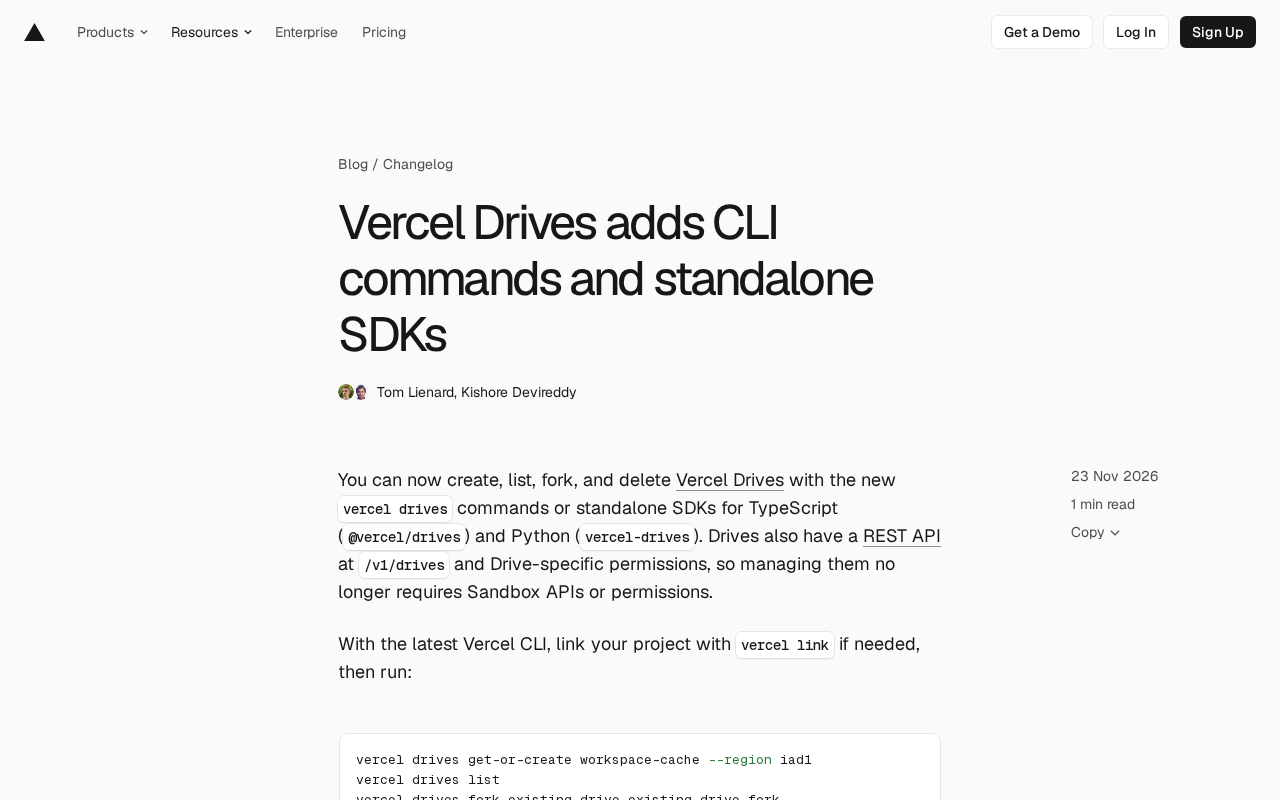
With the latest version of the Vercel CLI, developers can operate directly through the vercel drives command family. For example, to get or create a Drive named workspace-cache with the region set to iad1:
vercel drives get-or-create workspace-cache --region iad1
Listing all Drives and forking an existing Drive is equally straightforward:
vercel drives list
vercel drives fork existing-drive existing-drive-fork
TypeScript and Python SDKs
If you prefer to integrate in code, you can install the standalone SDKs. The TypeScript version is installed via npm as @vercel/drives, and the Python version via pip as vercel-drives.
The following TypeScript example shows the complete flow of get-or-create, list, and fork:
import { Drive } from '@vercel/drives';

await Drive.getOrCreate({
  name: 'workspace-cache',
  region: 'iad1',
});

const driveList = await Drive.list();
for await (const item of driveList) {
  console.log(item.name);
}

const source = await Drive.get({ name: 'existing-drive' });
const fork = await source.fork({ name: 'existing-drive-fork' });
console.log(fork.name);
The SDK is designed in a style consistent with Vercel's existing toolchain, supporting async iteration and method chaining. The Python SDK offers similar functionality, making it easy for teams on non-JavaScript stacks to use.
Async iteration and method chaining: The for await (const item of driveList) in the TypeScript example uses the Async Iterable pattern. When list results may be paginated or large, the SDK doesn't load all entries into memory at once—it fetches them one by one on demand, which suits scenarios with a large number of Drives. Method chaining means that after await Drive.get(...) returns a Drive object, you can call .fork(...) directly on it, keeping the "get then fork" flow within the same object context. The code is more compact and reduces the chance of errors from manually passing identifiers. The Python SDK follows a similar philosophy, letting teams on non-JavaScript stacks operate storage resources in a consistent way.
Dashboard and Observability Support
Beyond the API and SDKs, Drives now has dedicated pages in the Vercel Dashboard and Observability. Developers can view Drives' status, usage, and related metrics in the console without jumping to the Sandbox interface. This is a useful addition for scenarios that require monitoring storage performance and troubleshooting.
Observability: Observability refers to the ability to understand a system's internal state through three types of data: logs, metrics, and traces. In storage scenarios, it typically covers metrics such as Drive read/write latency, request volume, error rate, and storage usage. By bringing Drives into a dedicated Observability page, Vercel means developers can identify performance bottlenecks or anomalies at the storage layer within the same console, rather than indirectly troubleshooting through Sandbox logs. For teams using Drives as a workspace cache or shared data store, this independent monitoring view helps quickly determine whether a problem lies on the storage side or the application side—an important addition for production operations.
Compatibility and Availability
Vercel explicitly states that Drives can still be mounted into Vercel Sandboxes as before, and existing Sandbox CLI commands and SDK code continue to work. This means the upgrade won't break existing workflows.
Drives is available on the Hobby, Pro, and Enterprise plans. For more details, see the official Drives documentation.
What It Means for Developers
From a product evolution perspective, Vercel is turning Drives into an independent storage abstraction layer. The launch of standalone SDKs and a REST API reduces coupling with Sandbox and makes Drives easier to integrate into CI/CD pipelines, local development scripts, or third-party tools. For teams already in the Vercel ecosystem, this is a smooth capability expansion; for developers still evaluating, the simpler management interface may be a reason to try Drives.
With CLI, SDK, and dashboard support now in place, Drives' positioning is becoming clear: it's not just the storage backend of Sandbox, but a storage resource that can be independently orchestrated on the Vercel platform.
One-line Summary
Vercel Drives adds CLI, TypeScript/Python SDKs, and a REST API, shedding its Sandbox dependency.
Paragraph Summary
Vercel added CLI commands, standalone TypeScript and Python SDKs, and a dedicated REST API endpoint /v1/drives to its Drives product, so Drives no longer has to be managed through the Sandbox API and permissions. All three share core operations like create, list, and fork, with intuitive syntax that supports async iteration and method chaining. Drives also has dedicated pages in the Dashboard and Observability for viewing status and metrics. Existing Sandbox mounting methods and code remain compatible, and it's available on Hobby, Pro, and Enterprise plans. This change elevates Drives from an attached Sandbox feature to a platform-level standalone storage service that's easier to integrate into CI/CD, local scripts, or third-party tools.
Related articles

Prompt Engineering for Beginners: From Writing Prompts to Engineering Thinking
Starting from the essence and four functions of prompts, this article systematically explains the six-step process, four success criteria, learning value, and practical limitations of prompt engineering to help you build a complete understanding.

Anthropic Launches Nasdaq IPO: AI Giant's Listing and Risk Disclosures
Anthropic officially launches its Nasdaq IPO under ticker ANT, with market valuation expected to potentially exceed SpaceX's record. The prospectus devotes nearly 100 pages to AI risks, while first-half revenue grew over 14x but net losses widened sharply, reigniting the AI bubble debate.

Rust cURL Clone Uses 4,832 unsafe Blocks—Is the Memory Safety Myth Broken?
A Rust cURL clone uses 4,832 unsafe keywords, challenging Rust's memory safety narrative. We analyze what unsafe really means, compare Fil-C, and examine rewrite motives.