Vercel Plugin Lands on Antigravity: New Progress in AI Coding Agent Integration

Vercel's official plugin lands on Antigravity, injecting Vercel API skills into AI coding agents.
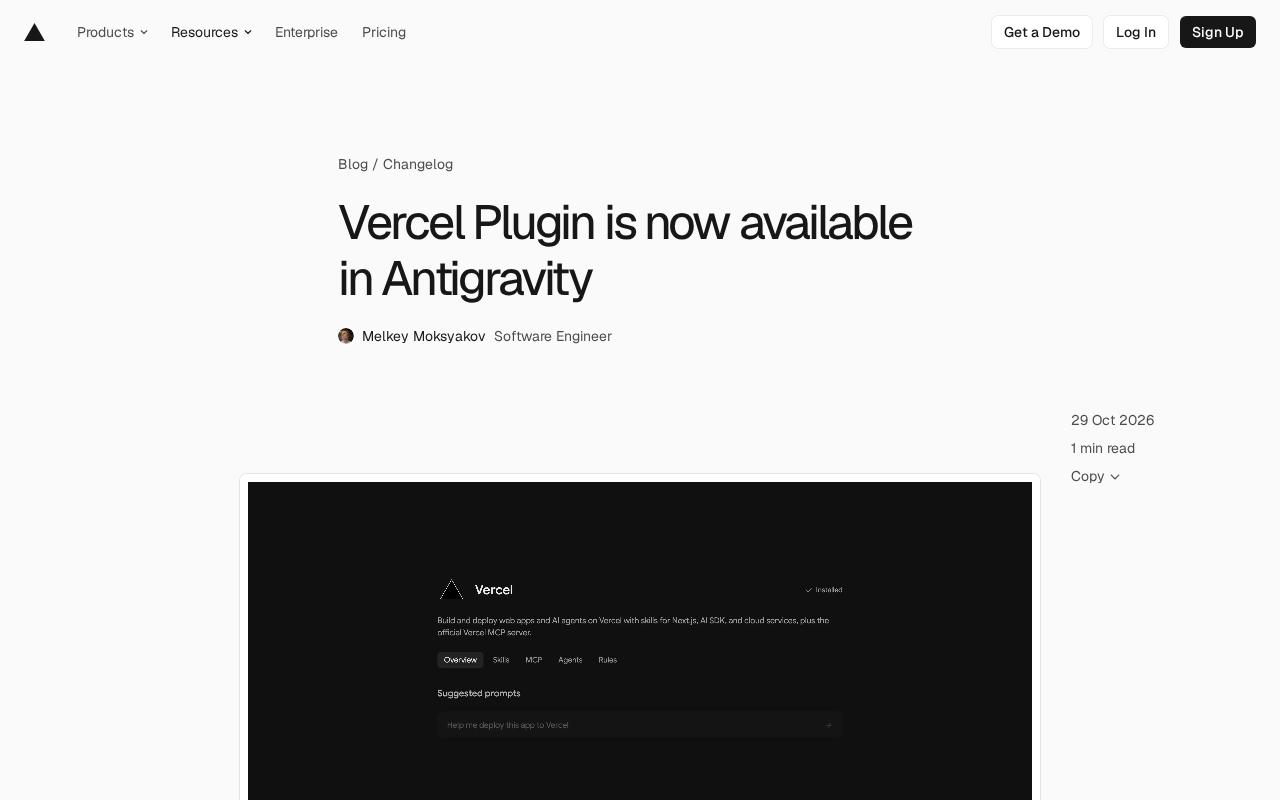
Google's AI coding agent platform Antigravity welcomes the Vercel official plugin to its Marketplace. The plugin provides agents with real-time API guidance and recommended patterns for AI SDK, Vercel Functions, and Workflow, enabling code generation based on official best practices and reducing errors. In the official demo, the agent used the plugin to build a Python backend and leveraged Vercel Sandbox to safely execute untrusted code in an isolated environment before deployment. Developers can install it in two steps by searching for Vercel in Customizations → Marketplace. The article argues this reflects two trends: AI coding agents shifting from general assistants to deep platform integration, and cloud providers proactively adapting to the agent ecosystem—reducing context switching and improving generated code reliability.
Google's AI coding agent platform Antigravity recently received a major update: the official Vercel plugin is now live on its Marketplace. This integration allows Antigravity's intelligent agents to directly access guidance and recommended patterns for Vercel APIs, covering core products such as AI SDK, Vercel Functions, and Workflow—marking a further convergence of AI-assisted coding tools and the cloud service ecosystem.
Plugin Core Features: Injecting Vercel Knowledge into Agents
According to Vercel's official blog, the plugin's main role is to provide Antigravity agents with real-time guidance on Vercel APIs. When developers use the agent to build applications, the plugin supplies product-specific skills, including AI SDK, Vercel Functions, and Workflow. This means the agent no longer relies on general knowledge to answer Vercel-related questions; instead, it generates code based on officially recommended patterns, reducing the likelihood of errors.
AI SDK is an open-source TypeScript toolkit from Vercel for calling APIs from multiple LLM providers such as OpenAI, Anthropic, and Google through a unified interface within applications, while handling common needs like streaming responses, function calling, and structured output. It abstracts away interface differences between model providers, enabling developers to switch models without rewriting business logic. By injecting AI SDK's recommended patterns, the plugin ensures the agent generates code that follows the library's current API conventions rather than potentially outdated patterns from model training data.
Vercel Functions is the serverless compute capability of the Vercel platform. Developers write backend functions as files, and the platform handles building, scaling, and edge distribution. Workflow, meanwhile, is an orchestration capability for long-running, multi-step tasks, supporting persistent state and retries. These two address the scenarios of "execute-on-request" and "reliable execution of long processes" respectively. Agents need to understand their constraints (such as execution duration and state storage methods) to generate deployable code.
Hands-on Demo: Python Backend and Sandbox Deployment
In the official demo released alongside the announcement, an Antigravity agent used the Vercel plugin to build and deploy a Python backend. The demo highlights the use of Vercel Sandbox—a feature for running untrusted Python code, providing an isolated environment for the agent's generated executable logic. The demo flow shows the agent understanding Vercel's deployment specifications, calling Sandbox to safely execute code, and ultimately completing deployment. This case直观ly demonstrates how the plugin embeds Vercel's best practices into the AI agent's workflow.
Vercel Sandbox is an isolated code execution environment provided by Vercel, typically running as containers or microVMs with boundary controls for file system, network access, and resource quotas. Its typical use is executing code of untrusted origin or uncertain behavior, such as user-submitted scripts or AI agent-generated logic. For AI coding agents, this is particularly critical: agent-generated code may be syntactically correct but its runtime behavior is difficult to verify in advance, and executing it directly in the host environment poses risks. Sandbox allows the agent to "run it once before delivering," using execution results as feedback signals for self-correction while avoiding impact on production environments.
Installation and Usage: Two-Step Quick Start
Developers simply open Customizations → Marketplace within the Antigravity app and search for "Vercel" to install the plugin. After installation, the agent automatically gains the relevant skills and guidance. Vercel also provides plugin documentation detailing the available skills list and usage methods. For teams already using Antigravity, this is an almost seamless experience upgrade.
Impact on the AI Coding Tool Ecosystem
The Vercel plugin's arrival on Antigravity reflects two trends. First, AI coding agents are shifting from general-purpose assistants to deep integration with specific platforms, gaining domain knowledge through plugin mechanisms to improve output quality. Second, cloud service providers are proactively adapting to the AI agent ecosystem, packaging their product capabilities as agent-callable skills to expand developer reach. For developers, this means fewer context switches and more reliable code generation—especially for teams working within the Vercel ecosystem, where the agent's utility will be significantly enhanced.
The plugin is currently available in the Antigravity Marketplace. Interested developers can consult the Vercel plugin documentation for a detailed skills list.
The technical foundation for such integrations is typically referred to as tool use / function calling and skills mechanisms. The model itself can only output text; the agent framework wraps external capabilities into structured interfaces that the model can invoke. The plugin's role is to package a platform's API knowledge, invocation conventions, and best practices into modules that the agent can load. Compared to cramming all knowledge into prompts, plugin-based loading is easier to version and enable on demand, and it allows platform providers to update their skill content independently of the agent product—this is precisely the technical path by which cloud service providers proactively adapt to the AI agent ecosystem.
Related articles

How Gen Turns Data into Decisions with ChatGPT Work
In an OpenAI user case, business leader Gen shares how ChatGPT Work turns data into decisions: within hours of launch, teams can judge whether integrations and onboarding flows work, shifting decision iteration from hundreds of trial-and-error attempts to a fast feedback loop.

ChatGPT vs. Claude In-Depth Comparison: Strong at Coding but Weak at Research — How to Bridge the Gap?
A user considers switching from ChatGPT to Claude, finding Claude stronger at coding but shallower at research. We analyze the differences and share tips to make Claude's research deeper.

Theranos Whistleblower Warns: The AI Boom Is "a Great Opportunity to Deceive"
Theranos whistleblower Tyler Shultz warns the AI boom is "a great opportunity to deceive" as never-profitable companies raise capital at trillion-dollar valuations. This article examines the real-world context, key differences between AI and Theranos, and practical criteria for investors and practitioners.