Vercel Sandbox Startup Speed Increased 4x: How Regional Caching Works

Vercel Sandbox enables regional image caching outside iad1, delivering up to 4x faster startup on cache hits.
To address startup latency outside iad1, Vercel Sandbox redesigned the image data read path: reused image data is cached closer to where the Sandbox runs, so cache hits avoid cross-region fetches back to iad1 source storage, delivering up to 4x faster startup. Internal benchmarks show Paris startup down ~75% and Seoul from ~3.5s to 1.05s. It covers VCR-managed and custom images and their snapshots, with no API changes. Gains depend on distance and cache hit rate.
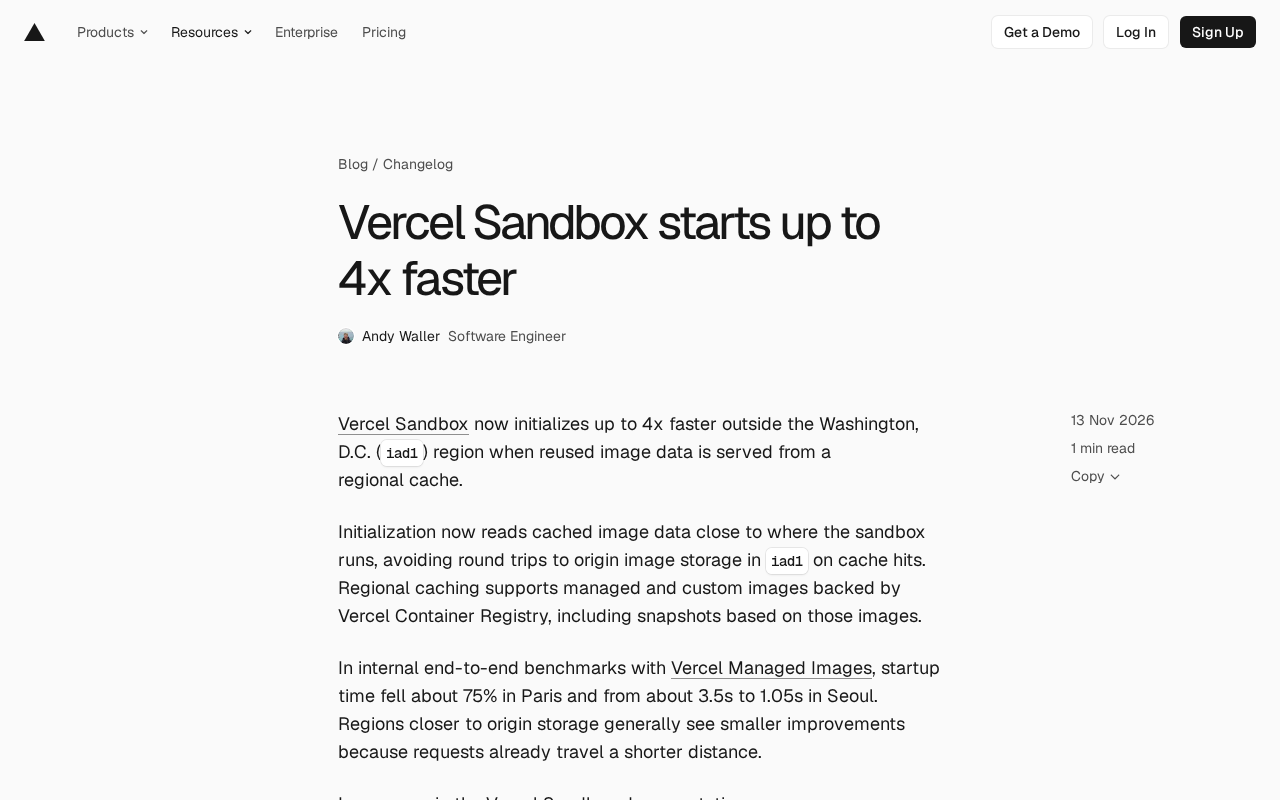
Vercel Sandbox initialization just got a substantial speed boost—in regions outside Washington, D.C. (iad1), startups are up to 4x faster when reused image data is served from a regional cache. This isn't a simple parameter tweak; it's a redesign of the image data read path.
What Was the Problem: The Cost of Cross-Region Image Reads
Vercel Sandbox image data was originally stored centrally in the source storage in the iad1 region. When users launched Sandboxes in distant regions like Paris or Seoul, initialization required pulling image data across regions back to the source, and this network round-trip showed up directly as startup latency.
The farther the distance, the more noticeable the latency. This also explains why the gains from this optimization vary significantly across regions: regions closer to the source storage already had shorter round-trip distances, so there was naturally less room for improvement.
Vercel Container Registry (VCR) is a container image hosting service provided by Vercel for centrally storing and managing the image artifacts required for deployments. In the Sandbox context, images can be either Vercel-maintained managed images (Vercel Managed Images) or custom images that users build and push themselves, both managed uniformly through VCR. VCR and image source storage are two separate concepts: the former is the registry and distribution entry point for images, while the latter is the physical location where image data is stored. In this optimization, image data remains in the iad1 source storage, and VCR is responsible for identifying image identity and supporting cache hit determination for the regional cache. Therefore, only images managed through VCR enter the regional cache path, which explains why the scope of applicability below is bounded by VCR.
How the Regional Cache Works
The new mechanism caches reused image data closer to where the Sandbox runs. When there is a cache hit, initialization reads the nearby cached data directly instead of going back to the image storage in iad1.
This capability covers managed images and custom images supported by Vercel Container Registry, as well as snapshots created from these images. In other words, as long as an image is managed through Vercel Container Registry, whether managed or custom, it can benefit from the startup acceleration provided by the regional cache.
Cache Hits Are the Key Prerequisite
It should be clear that the acceleration depends on cache hits. On the first pull or when there is a cache miss, data still needs to be fetched from the source, and the startup path is the same as before. This means the benefits are most direct for workloads that frequently reuse the same image; for scenarios where images change frequently, the cache hit rate will be affected.
Regional cache is an architectural pattern that copies hot data to edge locations close to compute nodes to shorten the read path, similar in spirit to CDN caching for static assets. Its key design is "source storage stays put, reads happen nearby": the authoritative copy of the image remains in iad1, and the regional cache simply adds a layer of local hit-capable copies in front of it. The advantage of this layered structure is that write and consistency logic need not change, while read latency can decrease as geographic distance shrinks; the cost is that cache invalidation and hit rates must be maintained, and first access or cache eviction still requires going back to the source. For a global platform, this is lighter weight than fully multi-active replication of source storage, and more directly eliminates long-distance network round-trips than simply scaling up source storage.
Measured Data: The Difference Between Paris and Seoul
Vercel's published internal end-to-end benchmark used Vercel Managed Images. The data shows that startup time in the Paris region dropped by about 75%; in the Seoul region, it fell from about 3.5 seconds to 1.05 seconds.
Looking at these two numbers together is interesting. Paris's reduction is presented as a percentage, while Seoul's is presented as absolute time, but both point to the same conclusion: the farther a region is from the source storage, the more pronounced the improvement from the regional cache. The drop from 3.5 seconds to 1.05 seconds in Seoul is a span whose cumulative effect cannot be ignored for development and CI scenarios that need to create Sandboxes frequently.
Vercel also notes that regions closer to the source storage see relatively smaller improvements because the round-trip distance of the requests themselves is already short. This fits the basic logic of optimizations like regional caching—it eliminates long-distance network round-trips, not the cost of computation itself.
What It Means for Development Workflows
Sandbox startup latency gets amplified in many scenarios. In CI pipelines, each task may need to create a new Sandbox, AI coding agents may repeatedly create isolated environments during iteration, and interactive development also relies on fast sandbox readiness. Saving more than two seconds per startup translates into a perceptible efficiency difference in batch tasks.
From an architectural perspective, this optimization reflects a common pattern: put data closer to compute. The regional cache does not change the source storage location of images; instead, it adds a layer of nearby serving on the read path. For platforms deployed globally, this layered caching strategy addresses cross-region latency more effectively than simply scaling up source storage.
Scope and Limitations
The regional cache currently supports managed images and custom images backed by Vercel Container Registry, as well as snapshots based on these images. Further details about this feature are available in the Sandbox documentation.
For workloads that rely on image sources other than Vercel Container Registry, this optimization does not currently apply. In addition, whether a cache hit occurs determines whether the accelerated path is actually taken, so teams should evaluate the benefits in light of their own image reuse frequency.
This update to Vercel Sandbox does not change the API or usage—it is a transparent infrastructure-level optimization: users do not need to modify code and can get faster startup experiences in supported regions and image types.
One-line Summary
Vercel Sandbox enables regional image caching outside iad1, delivering up to 4x faster startup on cache hits.
Paragraph Summary
To address startup latency outside iad1, Vercel Sandbox redesigned the image data read path: reused image data is cached in regions closer to where the Sandbox runs, so cache hits avoid cross-region fetches back to iad1 source storage, delivering up to 4x faster startup. Internal end-to-end benchmarks show Paris startup time dropping by about 75%, and Seoul falling from about 3.5 seconds to 1.05 seconds. The optimization covers managed images, custom images, and snapshots based on them supported by Vercel Container Registry, and does not change the API or usage. The gains depend on distance from source storage and cache hit rate: the farther away, the more noticeable the improvement, while first pulls or cache misses still follow the original source-fetch path.
Related articles

RePlan-VLA: Progress-Aware Replanning Breakthrough for Long-Horizon Robotic Manipulation
The RePlan-VLA framework converts VLA models' short-horizon capabilities into reliable long-horizon execution through progress-aware adaptive replanning, improving success rates by 21.9% and 10.4% on RoboCasa365 and CALVIN, and validating real-world deployment on a Franka Research 3 robot.

Geometric Bridge Flow Matching: A New Breakthrough in Blind Rigid Motion Correction
Geometric bridge flow matching enables blind rigid motion correction in head CBCT, achieving 37.1 dB PSNR and 0.27 mm RPE on simulated data in ~9.1 minutes, outperforming existing methods.

Google Releases Gemini 4 Hydrogen: 2.5x Faster Without Sacrificing Intelligence
Google releases the lightweight Gemini 4 Hydrogen: 2.5x faster task completion, AA Intelligence Index of 54 beating its flagship sibling, 7.3s single-step on Agent Arena faster than Claude and GPT rivals, four thinking levels with pay-as-you-need pricing, now available across AI Studio and more.