Verification and Transfer: Exact Information Frontiers and Their Price in Calls

The paper uses list rate-distortion functions to exactly characterize the information frontier and call-cost boundary of transfer verification.
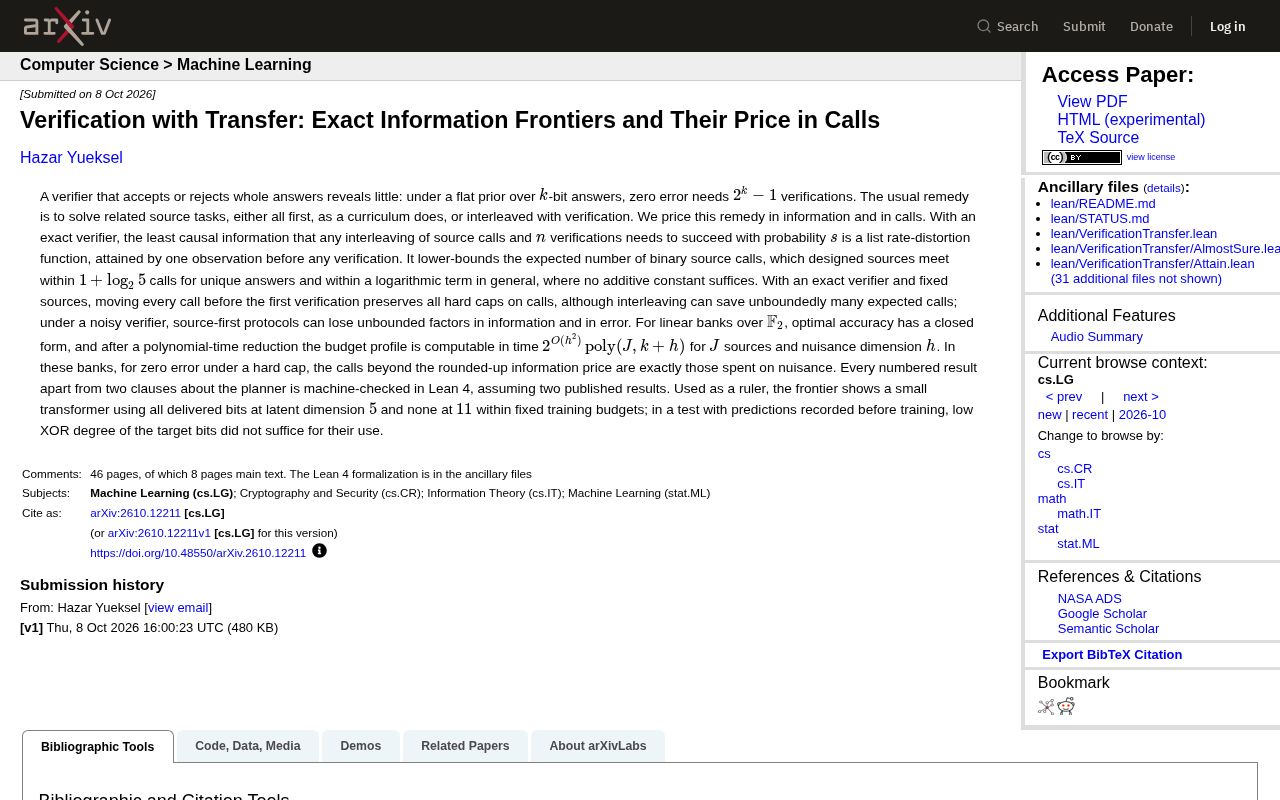
This article interprets the arXiv paper "Verification with Transfer," which uses information-theoretic tools to quantify the information and call costs of "verification plus transfer" systems. Key results include a list rate-distortion frontier for minimum causal information, bifurcation between exact and noisy verifiers, a closed-form solution for F₂ linear source banks, and machine verification in Lean 4.
Title
Verification and Transfer: Exact Information Frontiers and Their Price in Calls
Meta Description
The paper "Verification with Transfer" uses list rate-distortion functions to exactly characterize the information frontier and call cost of verification transfer, providing bifurcation conclusions under exact/noisy verifiers, a closed-form solution for F₂ linear source banks, and machine verification in Lean 4.
Article Content
A verifier can only accept or reject an entire answer, and this coarse-grained feedback has an inherent limitation in information efficiency. A paper from arXiv, "Verification with Transfer: Exact Information Frontiers and Their Price in Calls," uses information-theoretic tools to give an exact "information frontier" and systematically quantifies the feasible boundary for reducing verification cost through transfer from source tasks.
Starting Point: The Information Bottleneck of Whole-Answer Verification
Under a uniform prior over k-bit answers, if a verifier can only give binary pass/reject feedback on complete answers, then to achieve zero-error verification, the worst case requires 2^k - 1 verification calls. This conclusion directly points to the fundamental predicament of "whole-answer verification": once the answer space is slightly large, brute-force verification becomes information-theoretically unbearable.
The paper treats "transfer" as a natural means of breaking through this bottleneck—solving related source tasks, then using their results for target verification. There are two typical orchestration patterns for transfer: solving all source tasks first, as in curriculum learning, or interleaving source calls with verification. The information-theoretic advantages and disadvantages of these two orchestrations previously lacked an exact characterization.
Information Frontier: A List Rate-Distortion Function
The paper's core contribution is to give the "minimum causal information" required for any interleaved protocol of source calls and n verification calls to achieve success probability s under an exact verifier—it is a list rate-distortion function. This function gives a lower bound: making one observation before any verification achieves this frontier, and this frontier lower-bounds the expected number of binary source calls.
For well-designed sources, in the unique-answer setting this bound can be approached to within 1 + log₂5 calls; in the general case the gap is only a logarithmic term, but the paper points out that no additive constant-term bound exists. This result elevates "how much transfer can save" from an empirical question to a computable information-theoretic quantity.
Rate-distortion function is a core tool in Shannon information theory, describing the minimum information rate R(D) required to represent a source under an allowed distortion level D. The classical form targets lossy compression: given a source distribution and a distortion measure, R(D) characterizes the insurmountable trade-off curve between compression rate and reconstruction quality. This paper generalizes it to a "list" form—the output is no longer a single reconstruction point, but a candidate list, and success depends on whether the correct answer falls in the list. This modification directly matches the verification setting: the verifier need not reconstruct the answer exactly, but only judge whether some candidate is accepted. The list rate-distortion function therefore naturally characterizes "the minimum amount of causal information required to achieve success probability s under n binary verification feedbacks," becoming an exact ruler for quantifying the information cost of verification.
Interleaving or Source-First: Bifurcation under Exact and Noisy Verifiers
Under exact verifiers and fixed sources, the paper proves a counterintuitive conclusion: moving all calls before the first verification preserves all hard upper bounds on the number of calls. In other words, interleaved execution cannot break the hard upper bound, although it may save infinitely many calls in expectation.
But this picture changes completely under noisy verifiers. The paper shows that source-first protocols can lose unbounded factors in both information and error. This indicates that the curriculum-style intuition of "run source tasks first" is not safe in noisy verification settings, and the noise characteristics of the verifier substantially change the structure of the optimal transfer strategy.
The distinction between hard bound and expected number of calls is key to understanding the counterintuitive conclusion of this section. A hard bound refers to an upper bound on the number of calls consumed by the protocol in the worst case, that is, a guarantee that must hold for any source realization and any answer; the expected number is the number of calls averaged over random sources. The reason interleaved execution can "save infinitely many" calls in expectation is that it can terminate early after partial verification feedback shows that an answer has been ruled out, avoiding further source calls for hypotheses that are no longer valid. But when deterministic guarantees are required for all inputs, interleaving loses its early-termination advantage—because in the worst case one must prepare for all possibilities, which is equivalent to moving all calls up front at once. Noisy verifiers then destroy the premise that "one prior observation is enough to align with the frontier," because a single source observation may be misread under noise, and source-first protocols cannot correct this through subsequent verification feedback, leading to unbounded losses in information and error.
Linear Source Banks: Closed-Form Solutions and Computable Budget Profiles
For linear source banks over F₂, the paper gives a closed-form expression for optimal accuracy. Furthermore, via a polynomial-time reduction, the budget profile can be computed in time 2^{O(h²)}·poly(J, k+h), where J is the number of sources and h is the nuisance dimension.
Under this structure, zero-error verification under hard upper-bound constraints has a clear accounting interpretation: the number of calls beyond the "rounded information price" is exactly the number of calls spent on nuisance dimensions. This turns "nuisance dimension" from an abstract parameter into a measurable call overhead.
Linear source banks over F₂ mean that the solution space of source tasks is taken over the binary field F₂ (that is, arithmetic modulo 2 on {0,1}), and the relationships among sources are constrained by linear-algebraic structure. The advantage of choosing F₂ is that answer bits can be viewed as vectors, source calls are equivalent to imposing linear constraints on certain bits (such as XOR), and verification can be viewed as checking whether a vector satisfies a set of linear equations. In this setting, the information frontier degenerates into a linear algebra problem about vector-space dimension, allowing a closed-form solution to be written. The "nuisance dimension" h refers to degrees of freedom in the source bank that are irrelevant to the target answer but still occupy the call budget—they do not help determine the target, yet consume calls. The polynomial-time reduction shows that the computational complexity of the budget profile is dominated mainly by h and grows as 2^{O(h²)}, meaning that as long as the nuisance dimension is controlled, budget computation is polynomial-time tractable in both the number of sources J and the target bit count k.
Machine Verification and Empirical Calibration
All numbered results in the paper, except for two clauses concerning the planner, are machine-verified in Lean 4, conditional on two published results. This level of formalization is relatively rare in the intersection of information theory and verification, providing strong credibility for the conclusions.
The paper also uses the information frontier as a "ruler" for empirical work: under a fixed training budget, a small Transformer used all delivered bits when the latent dimension was 5, but used none at all when the latent dimension was 11. Another test that recorded predictions before training showed that low XOR degree of target bits is not sufficient to guarantee that those bits will be used. These two observations suggest that there is a nontrivial coupling between the model's ability to exploit delivered information and the latent dimension and target-function structure.
Lean 4 is an interactive theorem prover that can also be used as a functional programming language. Formalizing mathematical conclusions in Lean 4 means that every theorem is expanded into a machine-checkable proof term, and any logical leap or implicit assumption is rejected by the compiler. The authors encode information-theoretic conclusions—including lower bounds for frontier functions, preservation of hard upper bounds for interleaved protocols, and closed-form solutions for linear source banks—as Lean 4 theorems, relying on only two published results as external axioms. The value of this approach is that information-theoretic proofs often involve delicate operations with probability and limits, where manual review can easily miss boundary conditions, whereas machine verification provides near-zero-tolerance assurance. In the intersection of information theory and verification, such large-scale formalization is still rare, setting a high standard for the reliability of the conclusions.
Conclusion
This work precisely characterizes the information cost and call cost of "verification-transfer" systems within a single framework, giving frontier functions, lower bounds, closed-form solutions, and computable budget profiles, and reinforcing them with Lean 4 formalization. For researchers designing verification protocols, curriculum-style training pipelines, and evaluating whether models "really use delivered information," this toolkit provides an actionable ruler.
One-line Summary
The paper uses list rate-distortion functions to exactly characterize the information frontier and call-cost boundary of transfer verification.
Paragraph Summary
This article interprets the arXiv paper "Verification with Transfer," which uses information-theoretic tools to quantify the information cost and call cost of "verification plus transfer" systems. Core conclusions include: whole-answer verification under a uniform k-bit prior requires 2^k-1 queries for zero error; under exact verifiers the minimum causal information is characterized by a list rate-distortion function, and one prior observation achieves the frontier; interleaving and source-first are equivalent on hard upper bounds, but under noisy verifiers source-first may lose unbounded factors; for F₂ linear source banks the optimal accuracy has a closed-form solution and the budget profile is polynomial-time computable; most numbered results are machine-verified in Lean 4, and empirical work also reveals nontrivial coupling in how models exploit delivered information.
Related articles

Workbuddy for Absolute Beginners: How a Desktop AI Agent Fits Into Real Workflows
A beginner's guide to the Workbuddy desktop AI agent: installation, claiming credits, file management, and building automated workflows—compared with CodeX for fit and cost, helping professionals shift from AI question-askers to AI managers.

OpenAI's New Agent Stack: Computer Use, Decisions API, and Ultra-Fast Workflows
OpenAI Dev Day unveiled a new agent stack: Computer Use outperforms humans, Decisions API delivers ultra-low-latency classification via Luna, Agents API opens the same Computer Use capabilities, and GPT-6.1 Sol costs only one-seventh of Astra. Core updates, benchmark data, and developer insights.

Liang Wenfeng Open-Sources DeepInfo Inference Framework, Takes On U.S. Ban
DeepSeek open-sources its DeepInfo inference framework after its models, featuring GPU/CPU cross-pipelining, small-model prediction with large-model verification, and full Huawei Ascend and NVIDIA chip support—facing the U.S. federal ban head-on. This article analyzes its significance for AI deployment and open-source strategy.