VGGT's Self-Awareness: Frozen Features Predict Pose Failures, ROC-AUC 93.5%

A linear probe on frozen VGGT features predicts pose failures with 93.5% ROC-AUC, signal hidden in two-view fusion layers.
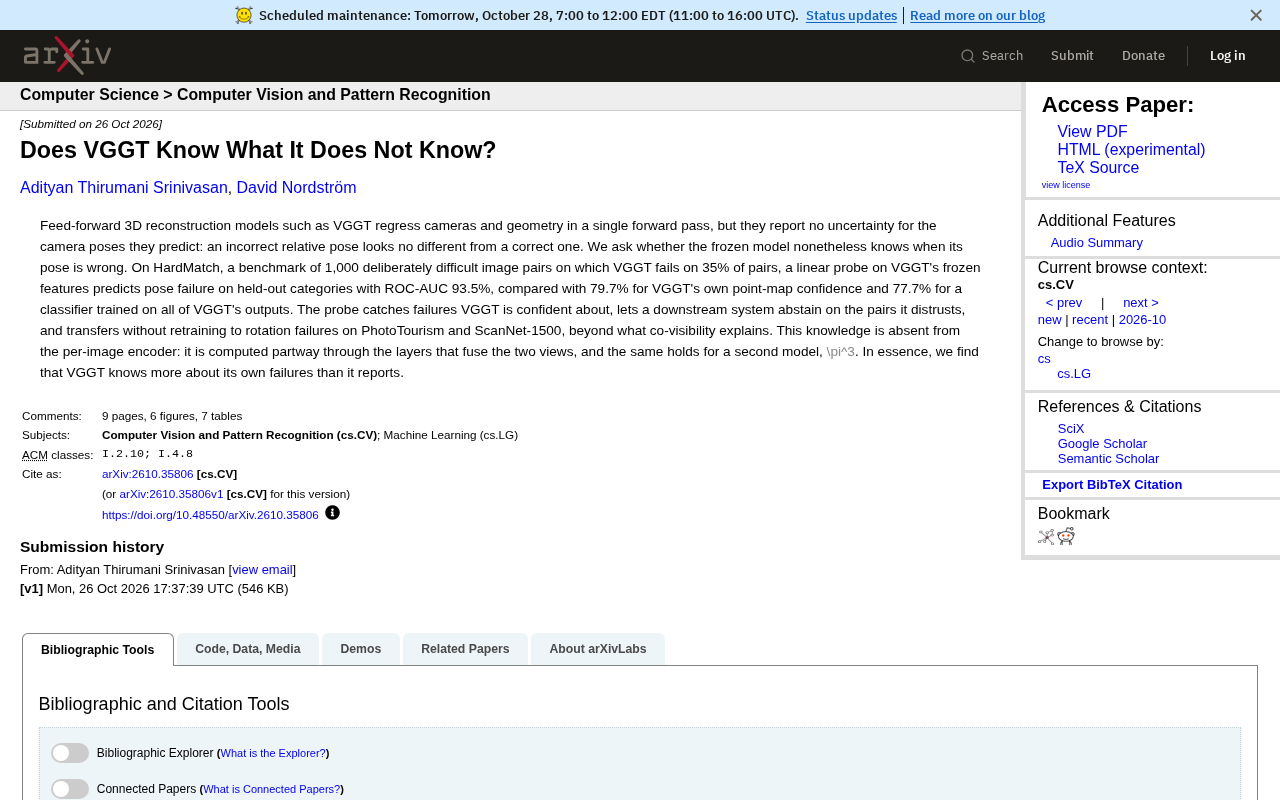
Feed-forward 3D reconstruction model VGGT outputs poses and geometry in one pass but gives no uncertainty, making errors indistinguishable from correct results. On the HardMatch benchmark (1,000 difficult image pairs), VGGT fails on 35% of pairs. A linear probe on VGGT's frozen features predicts pose failures with ROC-AUC 93.5%, beating the model's built-in point map confidence (79.7%) and a full-output classifier (77.7%). The signal enables downstream abstention, transfers without retraining to PhotoTourism and ScanNet-1500, and resides in the two-view fusion layers rather than the per-image encoder.
Feed-forward 3D reconstruction models (such as VGGT) can regress camera poses and geometry in a single forward pass, yet they provide no uncertainty estimates—an incorrect relative pose looks indistinguishable from a correct one. A recent study directly asks: does this frozen model internally "know" when its pose is wrong?
The Overlooked Blind Spot: Feed-forward Reconstruction Has No Uncertainty
Models like VGGT compress multi-view geometry into a single network inference, and their speed and convenience have attracted considerable attention. The cost is equally direct: the output consists only of poses and point maps, with no confidence scores. When a downstream system receives a relative pose, it has no way to judge whether it is reliable.
The research team built the HardMatch benchmark—1,000 deliberately selected difficult image pairs. On this benchmark, VGGT fails on 35% of image pairs. The question then arises: can the model signal failure before it happens?
A "Failure Detector" in Frozen Features
The answer tends toward yes. Using a linear probe on VGGT's frozen features to predict pose failures, researchers achieved ROC-AUC 93.5% on unseen categories. By comparison, VGGT's built-in point map confidence reaches only 79.7%, while a classifier trained on all of VGGT's outputs achieves 77.7%.
This contrast is worth pondering: the confidence the model reports itself is less accurate than the failure signal "read" from its intermediate features. What the probe captures is precisely those cases where VGGT appears confident but is actually wrong.
Linear probe is a common technique for evaluating the internal representations of pretrained models: freeze the backbone network's parameters and train only a simple linear classifier (or regressor) on top of features from a particular layer, to see whether that layer's features already encode the target task's information in a linearly separable way. If the linear probe performs well, the information is explicitly represented by the backbone without needing additional nonlinear mapping; if it performs poorly, the information is either not encoded or requires a stronger readout structure. In this case, the probe is attached to VGGT's fusion layer features and only needs to learn a weight vector to output a score for "whether this image pair will fail," so the 93.5% ROC-AUC directly reflects that VGGT's intermediate features themselves already contain the failure signal, rather than the probe's fitting capacity.
ROC-AUC measures a binary classifier's ability to distinguish positive from negative samples across all possible thresholds, equivalent to the probability that a randomly drawn positive sample scores higher than a randomly drawn negative sample. 0.5 corresponds to random guessing, and 1.0 to perfect separation; 93.5% means the vast majority of failing and succeeding image pairs can be correctly ranked by the probe, and this metric does not depend on the choice of a specific threshold, making it suitable for evaluating "failure signals"—scenarios where downstream systems must set their own thresholds.
Downstream Systems Can "Abstain"
With reliable failure prediction, downstream systems can choose to abstain on image pairs they do not trust, rather than forcing out a potentially incorrect pose. This has direct value for scenarios such as SLAM and 3D reconstruction pipelines—better to refuse than to quietly produce a wrong result.
The probe also demonstrates transferability: without retraining, it can transfer to rotation failure detection on PhotoTourism and ScanNet-1500, and this capability exceeds what co-visibility can explain.
Abstain in machine learning refers to introducing a third type of output into a system: "refuse to answer." When confidence falls below a threshold, the system does not produce a prediction but instead hands the sample to a human, another module, or subsequent frames. Its theoretical basis is the selective prediction framework—trading off coverage against accuracy, exchanging fewer valid outputs for higher output reliability. For SLAM and 3D reconstruction pipelines, incorrect poses pollute subsequent map building and optimization at a cost far higher than a brief missing frame; therefore, "detect a likely failure and skip that image pair, waiting for stronger constraints" is often more worthwhile than forcing an output. This also explains why the probe's absolute accuracy matters: the abstention threshold must be calibrated on difficult sets like HardMatch to keep false abstentions and missed abstentions within acceptable ranges.
Knowledge Lives in the Middle Layers, Not the Single-Image Encoder
A key finding is that this "knowing you're wrong" knowledge does not exist in the per-image encoder. It is computed in the middle of the layers that fuse two views. The researchers note that the second model, π³, exhibits the same pattern.
In other words, the failure signal is a byproduct of the two-view fusion process, not a property of a single image itself. This provides new clues for understanding the internal mechanisms of feed-forward reconstruction models and suggests that the entry point for improving uncertainty estimation may lie in the fusion layers rather than the output head.
Two-view fusion layers refer to the layers in feed-forward reconstruction models that interact the features of two (or more) images through attention or correlation operations to infer relative pose and geometry, as distinct from encoders that process only a single image and output per-image features. A single-image encoder sees only the content of one image and cannot judge whether two images match; the fusion layer, when computing cross-view correspondences, naturally exposes clues such as insufficient co-visibility, repeated textures, and severe occlusion that lead to failure. Thus the failure signal appears as a "byproduct" of the fusion process, in the same location where geometric reasoning occurs. This also means that to improve uncertainty estimation, a more effective approach may be to read out signals from the fusion layer's intermediate representations or regularize them, rather than attaching a confidence branch after the output head.
Key Conclusions
VGGT knows more about its own failures than it reports. A linear probe on its frozen features can predict pose failures with 93.5% ROC-AUC, significantly outperforming the model's built-in point map confidence and a full-output classifier. This signal is transferable, can be used for abstention decisions, and resides in the middle of the two-view fusion layers—opening a new path for uncertainty quantification in feed-forward 3D reconstruction.
One-line Summary
A linear probe on frozen VGGT features predicts pose failures with 93.5% ROC-AUC, with the signal hidden in the two-view fusion layers.
Paragraph Summary
Feed-forward 3D reconstruction model VGGT outputs poses and geometry in a single forward pass but provides no uncertainty, making incorrect and correct results indistinguishable. The research team built the HardMatch benchmark (1,000 difficult image pairs), found that VGGT fails on 35% of them, and asked whether the frozen model internally "knows" it is wrong. The answer tends toward yes: a linear probe trained on VGGT's frozen features predicts pose failures with ROC-AUC 93.5%, significantly outperforming the model's built-in point map confidence (79.7%) and a full-output classifier (77.7%), especially capturing cases where the model is confident but wrong. This signal lets downstream SLAM and reconstruction pipelines choose to abstain, and transfers without retraining to rotation failure detection on PhotoTourism and ScanNet-1500, beyond what co-visibility can explain. The key finding is that this knowledge does not exist in the per-image encoder but is computed in the middle of the two-view fusion layers—as with the π³ model—suggesting that the entry point for improving uncertainty estimation should be the fusion layers rather than the output head.
Related articles

Private Key Set to 4? CA's Elementary Mistake Leaves TLS Exposed
CA eMudra set private keys to tiny values like 4, making TLS certificates brute-forceable. A Computerphile video demonstrates the full process from extracting public keys to forging certificates, and explores the fragility of the PKI trust chain.

How Gen Turns Data into Decisions with ChatGPT Work
In an OpenAI user case, business leader Gen shares how ChatGPT Work turns data into decisions: within hours of launch, teams can judge whether integrations and onboarding flows work, shifting decision iteration from hundreds of trial-and-error attempts to a fast feedback loop.

ChatGPT vs. Claude In-Depth Comparison: Strong at Coding but Weak at Research — How to Bridge the Gap?
A user considers switching from ChatGPT to Claude, finding Claude stronger at coding but shallower at research. We analyze the differences and share tips to make Claude's research deeper.