Vibe Coding Beginner's Guide: A Complete AI Programming Playbook from Zero to Deployment
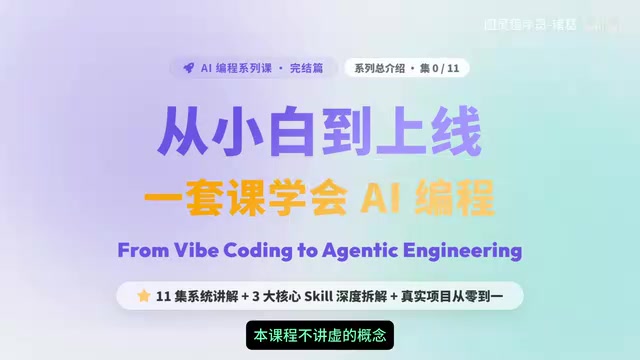
A complete guide to Vibe Coding: from AI programming basics to deploying real products with zero coding experience.
This guide breaks down Vibe Coding — the natural language-driven programming paradigm coined by Andrej Karpathy — covering core skills like brainstorming with AI, reading AI-generated code, and plugin collaboration. It spans major tools including Claude Code, Cursor, and Codex, with a structured learning path from foundational concepts to real-world deployment.
From "Looks Easy" to "Total Meltdown" — What You're Missing Isn't Coding Skills
Many people share the same experience when they first encounter AI programming: watching others use AI to write code effortlessly, only to face nothing but errors and infinite loops when they try it themselves. B-station creator Bai Li offers an insightful observation in his AI programming course series — if you're stuck here, the problem usually isn't a lack of coding fundamentals, but rather a lack of collaborative methodology with AI.
This perspective deserves deeper consideration. In traditional programming education, we're accustomed to building up layer by layer from syntax, data structures, and algorithms. But under the Vibe Coding paradigm (programming driven by intuition and natural language), the human role undergoes a fundamental transformation: you're no longer the writer of code, but the describer of requirements and the maker of directional decisions.
The concept of Vibe Coding was first coined by Andrej Karpathy — former Tesla AI Director and OpenAI co-founder — in early 2025. He described an entirely new way of programming: developers no longer write code line by line, but instead describe their intent in natural language and let AI handle the implementation. Karpathy described it as "fully immersing yourself in the vibes, embracing exponential growth, and forgetting that code even exists." The concept quickly sparked widespread discussion in the developer community because it fundamentally challenges traditional software engineering's basic assumption that one must "master a programming language."
This means that knowing how to write a for loop becomes less important, while being able to articulate requirements clearly and make the right choices when AI presents multiple solutions becomes the core competency. Research from institutions like MIT and Stanford confirms this: the effectiveness of AI-assisted programming is highly correlated with the user's "prompt engineering" ability — with the same AI tools, users who excel at describing requirements can achieve productivity gains several times greater than average users. This capability includes decomposing vague requirements into specific executable steps, providing sufficient context for AI to understand constraints, and precisely identifying problems and providing correction directions when AI output is unsatisfactory.
What Does This AI Programming Course Actually Teach? Four Hardcore Positions
Bai Li distills the course's positioning into four labels with remarkably clear logic:
Real-World Deployment, Not Toy Demos
The course explicitly states it won't stop at "Hello World" demonstrations — it aims to guide students through building a complete open-source project that can actually be deployed and accessed. This is the Achilles' heel of many AI programming tutorials — they abruptly end once a local demo runs successfully, leaving students forever unable to complete the "last mile" from code to live product.
This "last mile" involves the enormous gap in software engineering between development and production environments: domain configuration, server deployment, environment variable management, database migration, CI/CD pipeline setup, and a series of DevOps tasks. For non-professional developers, the complexity of these steps often far exceeds that of writing code itself. Modern deployment platforms (such as Vercel, Netlify, Railway, etc.) combined with AI assistance are dramatically lowering this barrier.
Deep Breakdown of Three Core Skills
The course focuses on three key skills:
- Brainstorming: How to collaborate with AI to clarify and define requirements — this is the starting point of the entire Vibe Coding workflow and the most easily overlooked step. In practice, Brainstorming isn't simply telling AI to "build me a website," but rather progressively clarifying key decisions about target users, core features, technology choices, data models, etc., through structured dialogue. Good Brainstorming makes the subsequent coding process exponentially more efficient, while vague requirement descriptions lead to AI repeatedly producing code that deviates from expectations.
- Read and Play: The ability to understand AI-generated content and make interactive adjustments. This requires learners to have basic code-reading skills — you don't need to write code from scratch, but you need to understand the general logic of AI-generated code, judge whether it meets expectations, and guide AI toward corrections using natural language when problems arise.
- Plugin Collaboration and Custom Plugin Creation: Not just using ready-made tools, but understanding how to extend the capability boundaries of AI programming environments. In AI editors like Cursor, plugins (also called Rules, MCP, etc.) can provide AI with additional contextual information and capability interfaces — such as connecting to databases, calling external APIs, following specific code conventions — greatly expanding the applicable scope of AI programming.
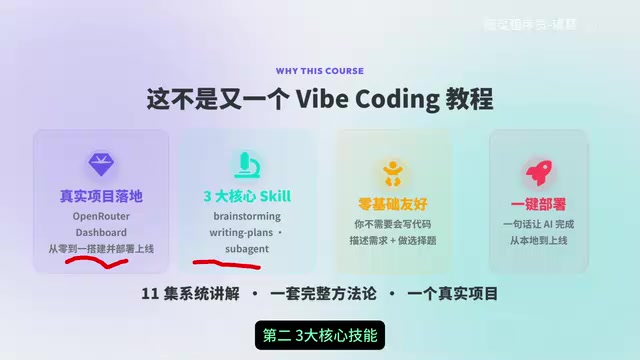
From these three points, it's clear that the course's core isn't teaching the operation of any single specific tool, but rather establishing a transferable AI programming workflow mindset.
Zero Technical Background Friendly
The course emphasizes: "You don't need to know how to write code — just describe your requirements and make multiple-choice decisions." This aligns perfectly with the essence of Vibe Coding — delegating complex technical implementation to AI while keeping decision-making authority and directional sense with humans.
One-Click Deployment
Beyond teaching how to build, it also teaches how to have AI help you complete deployment. This completes the full loop from development to delivery.
Covering Mainstream AI Programming Tools: Claude Code, Codex, Cursor, and Superpowers
Here's a notable detail: this course doesn't bet on a single tool but horizontally covers the most mainstream AI programming tools currently available:
- Claude Code: Anthropic's command-line AI programming tool, known for its ability to understand complex codebases. Claude Code runs directly in the terminal environment, capable of reading and editing files across an entire codebase, executing shell commands, and performing multi-step code refactoring. Unlike IDE plugin-style AI programming assistants, Claude Code is designed to exist as a "virtual colleague" within a developer's workflow, excelling particularly at handling complex cross-file dependencies and code architecture analysis.
- Codex: OpenAI's code generation capability, suitable for various programming scenarios. Codex was originally launched in 2021 as a code generation model and is the core technology behind GitHub Copilot. In 2025, OpenAI released a completely new agent version of Codex that can independently complete programming tasks in a cloud sandbox environment — including writing functional code, fixing bugs, running tests — and can handle multiple tasks in parallel, requiring developers only to describe their requirements.
- Cursor: Currently one of the most popular AI-native code editors, with deeply integrated conversational programming experiences. Developed by Anysphere, Cursor is a deep modification of VS Code that experienced explosive user growth during 2024-2025. Its core features include Tab-key intelligent completion (predicting the multiple lines of code a developer will write next), inline editing (selecting code and describing modification intent in natural language), and Chat functionality (conversing with AI about code issues). It supports connecting to multiple large language models, allowing developers to choose the most suitable model based on task characteristics.
- Superpowers Programming: A programming approach/tool combination highlighted as a course focus.
This multi-tool parallel teaching approach is highly valuable because in real development, no single tool can handle all scenarios — understanding the positioning and collaboration methods of different AI programming tools is itself a critical capability. For example, Cursor is suited for frontend development scenarios requiring frequent UI debugging, Claude Code is better for refactoring large backend codebases, and the Codex agent is ideal for parallel processing of multiple independent feature development tasks. For tech enthusiasts wanting a systematic understanding of the current AI programming ecosystem, this horizontal perspective is particularly rare.
Who Should Learn Vibe Coding? Four User Personas
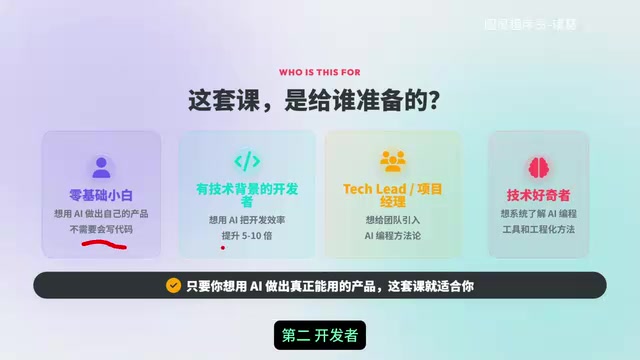
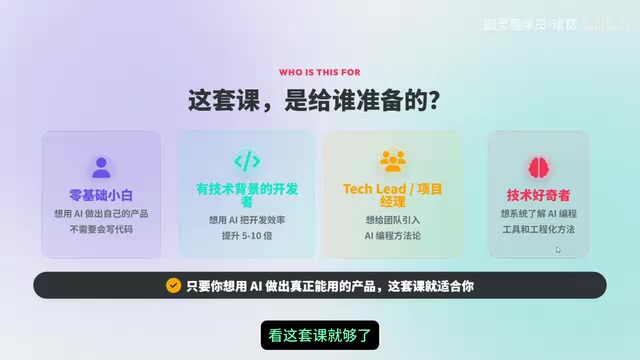
The course identifies clear target audiences, covering virtually all typical roles currently in need of AI programming:
- Complete Beginners: Want to build their own products with AI but lack any programming background. These users are the most disruptively benefited by Vibe Coding — product managers, designers, entrepreneurs, and similar roles who previously needed to rely on engineers to turn ideas into reality now have the opportunity to independently build prototypes or even MVPs (Minimum Viable Products).
- Developers: Looking to boost development efficiency 5-10x with AI. While this figure is a promotional expression, it does reflect the industry's general expectations for AI-assisted programming productivity gains. According to GitHub's 2024 research report, developers using Copilot completed tasks an average of 55% faster, with even more significant improvements in specific scenarios (such as boilerplate code writing and unit test generation). As AI model capabilities continue to evolve, 5-10x productivity gains are no longer an exaggeration for certain task types.
- Tech Leaders/Project Managers: Want to introduce AI programming workflows to their teams, focusing on process standardization and team collaboration. This involves the scaled application of AI programming at the team level: how to establish AI usage standards, how to conduct code reviews, and how to ensure code security and consistency.
- Tech Enthusiasts: Want a systematic understanding of the most cutting-edge AI programming tools and methods.
The thinking behind this audience segmentation actually reveals a trend: AI programming is evolving from "an efficiency tool for programmers" into "a universal product creation tool." When describing requirements can generate products, the barrier to product creation is dramatically lowered. This trend is in line with the No-Code/Low-Code movement, but Vibe Coding goes further than traditional low-code platforms — it's not constrained by preset components and templates, and can theoretically build applications of arbitrary complexity.
Course Structure: A Complete Learning Path from Cognition to Deployment
The entire course consists of 11 episodes, divided into four progressive stages:
- Foundational Cognition: Building a correct understanding of the AI programming paradigm and Vibe Coding philosophy. The core of this stage is helping learners complete a mental model shift — from "I need to learn to write code" to "I need to learn to drive AI to write code."
- Core Skills: Mastering key capabilities including Brainstorming, collaboration, and plugins.
- Practical Advancement: Building and iterating on real projects. In actual projects, learners will encounter real challenges such as AI output not meeting expectations, multiple modules needing coordination, and performance optimization — experiential knowledge that pure theoretical learning cannot cover.
- Deployment Finale: Completing deployment to get the product actually running.
This four-stage "Cognition → Skills → Practice → Deployment" structure aligns with how adults learn complex skills: first establish a mental model, then break down specific capabilities, integrate them in practice, and finally complete delivery to receive positive feedback. Educational psychology research shows that the sense of achievement and learning motivation from "completing a whole work" far exceeds isolated knowledge point exercises. This is why the course emphasizes ultimately producing "a product that actually runs" — it's not only validation of learning outcomes but also a source of motivation for continued learning.
Observations and Reflections on the Vibe Coding Trend
The design philosophy of this course reveals that AI programming education is maturing. Early AI programming content mostly stayed at the showcase level of "look how cool it is when AI writes code," while quality content today emphasizes methodology — especially how humans collaborate with AI, which is positioned as more important than the tools themselves.
This shift reflects the entire industry's deepening understanding of AI programming. In 2023, people marveled at the fact that AI could write code at all; in 2024, people began focusing on how to use AI programming tools well; by 2025, the discussion has shifted to systematic workflow design and best practices for human-machine division of labor. This evolutionary path closely mirrors the adoption curve of any new technology — from "usable" to "user-friendly" to "used effectively."
Bai Li's assertion that "the reason you're stuck is human-AI collaboration, not coding fundamentals" in some sense reveals the core proposition of the Vibe Coding era: once AI can write code, human value shifts to "asking the right questions," "making the right decisions," and "quality control." This also reminds every learner looking to get started with AI programming that rather than being anxious about not knowing how to code, it's better to first practice how to clearly express requirements and how to evaluate AI output.
It's worth noting that this doesn't mean programming knowledge is completely useless. People with some technical understanding still have significant advantages in Vibe Coding — they can more precisely describe technical constraints, more quickly identify problems in AI output, and make more reasonable architectural decisions. Vibe Coding lowers the "entry barrier," not the "capability ceiling."
For readers wanting a systematic introduction to AI programming, courses like this one — covering the complete workflow, emphasizing workflow methodology, and spanning multiple mainstream tools like Claude Code and Cursor — do provide a relatively comprehensive learning framework. Of course, whether you can truly build "a product that actually runs" ultimately depends on the learner's own hands-on practice and continuous iteration.
Key Takeaways
Related articles
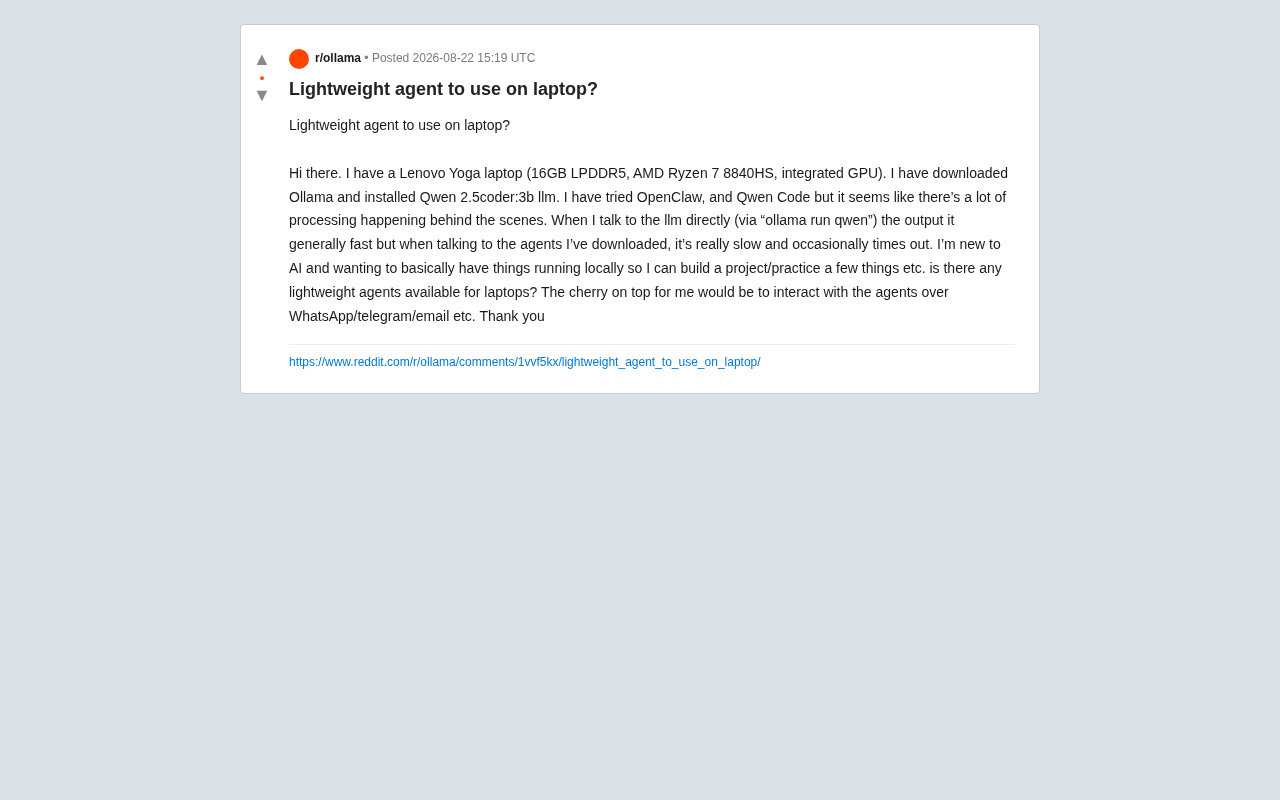
Local AI Agent Deployment Too Slow? A Lightweight Optimization Practical Guide
Local AI Agent deployment slow and timing out? This guide covers Agent framework overhead, hardware bottlenecks, and practical optimizations including context trimming, quantization, and Telegram Bot integration.

Choosing a Laptop for AI Studies: MacBook vs NVIDIA Laptop — An In-Depth Comparison Guide
In-depth analysis for AI students choosing laptops: MacBook Air M5 with remote GPU vs NVIDIA laptop, comparing CUDA support, portability, battery life, and value.

Self-Hosted LLM Tech Stack: A Complete Guide to Managing Your Local AI Cluster from the Terminal
A deep dive into self-hosting LLM tech stacks: inference engines, model management, vector databases, and how to manage your local AI cluster from the terminal.