Vibe Coding Beginner's Guide: Build Web Pages with AI — No Coding Experience Required

A beginner's guide to Vibe Coding: use natural language and AI to build a mobile web page with zero coding experience.
Vibe Coding is a new approach to programming through natural language collaboration with AI, shifting the barrier from "knowing how to code" to "knowing how to describe what you want" — making it accessible to designers, product managers, and non-technical creators. This article is based on a beginner-focused course covering the concept, a starter guide, and hands-on practice building a mobile web page. It emphasizes that Vibe Coding is best for entry-level and lightweight projects, encourages treating it as a creative "door into programming," and recommends building experience through continuous practice.
What Is Vibe Coding
Vibe Coding is a concept that has rapidly gained traction in the programming community. It represents an entirely new approach to writing code — one that no longer requires you to memorize syntax rules. Instead, you collaborate with AI using natural language to quickly turn ideas into working programs. For anyone who has been intimidated by the traditional barriers to programming, this is a genuine opportunity.
This article is based on an introductory Vibe Coding course designed for complete beginners. The course has a clear goal: not to turn you into a professional developer, but to help you understand what Vibe Coding actually is, what you can do with it, and how to get started. The curriculum is divided into three sections: understanding the concept, a beginner's guide, and hands-on practice.
At its core, Vibe Coding is about lowering the barrier to entry for programming. Traditionally, you had to learn a programming language, set up a development environment, and grasp various abstract concepts before writing a single line of working code. Now, with AI tools, you simply describe what you want — and let the tool handle the rest. This "what you envision is what you get" experience is exactly what the "Vibe" in Vibe Coding refers to.
The term "Vibe Coding" was coined by OpenAI co-founder Andrej Karpathy in early 2025. He described on social media a way of working that relies entirely on AI-generated code, where developers barely write any code themselves. The concept sparked widespread discussion because it challenges the traditional dependency on programming language proficiency at the heart of software development. Popular Vibe Coding tools today include Cursor, GitHub Copilot, Bolt.new, and Lovable. What they share in common is support for natural language conversation to drive code generation — some can even generate a fully functional application from a single sentence description.
Why Learn Vibe Coding
The value of learning Vibe Coding isn't about replacing traditional programming education — it's about dramatically expanding who can write code. Designers, product managers, marketers, and even creators with zero technical background can use it to turn ideas into working product prototypes.
From an efficiency standpoint, Vibe Coding dramatically accelerates prototype validation. An idea can go from concept to a tappable web page on your phone in a matter of minutes. That rapid feedback loop is incredibly appealing for anyone who wants to validate a business idea, build a personal portfolio, or simply enjoy the experience of creating something.
That said, it's worth being realistic: Vibe Coding is best suited for getting started and for lightweight projects. Complex commercial systems still require solid engineering fundamentals. Think of it as a "door into programming" rather than the ultimate answer — that's the right mindset.
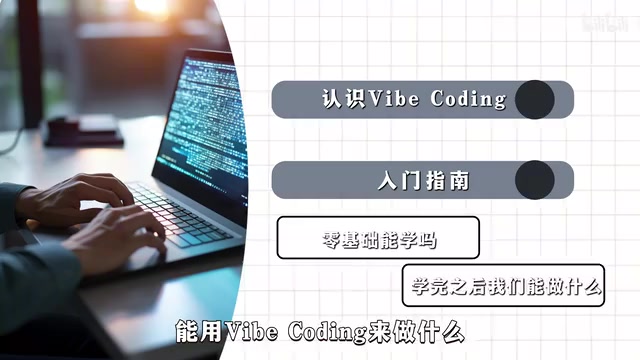
Can You Really Learn This With Zero Technical Background?
This is the question most beginners ask. The course gives a clear answer: yes — Vibe Coding is designed specifically for people with no technical background.
The reason this works is that AI tools handle the parts of traditional programming that are most discouraging: memorizing syntax, configuring environments, and debugging errors. You don't need to know how to write a tag or declare a function — just express your requirements clearly in natural language, and the tool generates the corresponding code and helps fix any issues.
That said, "you can learn it" doesn't mean "you don't have to think." To use Vibe Coding effectively, you still need the ability to clearly articulate what you want and the judgment to evaluate the result. In other words, the barrier shifts from "knowing how to code" to "knowing how to describe a problem." For people who are naturally good at communication and creative thinking, this is actually an advantage.
Hands-On Practice: Build a Mobile Web Page
The third section of the course is the most valuable — a real hands-on project. The instructor recommends a set of tools suited to Vibe Coding and guides students through building a mobile web page from scratch that they can open directly on their phone.
Choosing a mobile web page as the first project is a deliberate decision. Web projects don't require complex deployment processes, making it easy to see results quickly. And since the phone is the device everyone is most familiar with, seeing a page you "wrote" running on your phone screen delivers a powerful sense of accomplishment that fuels further learning.
In terms of learning approach, this "build first, understand later" method is entirely in the spirit of Vibe Coding. Traditional programming education tends to front-load a lot of theory, causing many people to give up before they ever see results. A practice-driven approach, by contrast, lets learners build a sense of mastery over the tools through positive reinforcement.
A mobile web page differs fundamentally from a native app in its runtime environment: it runs in a mobile browser, requires no installation from an app store, and can be shared and accessed via a simple link. For Vibe Coding beginners, this is one of the lowest-barrier forms of a "visible, tangible result." Technically, a mobile web page consists of three components: HTML (structure), CSS (styling), and JavaScript (interactivity) — and AI tools can generate all three at once. Once complete, you simply host the file on a free platform like GitHub Pages, Vercel, or Netlify to get a real link that opens in any mobile browser. No server management knowledge required.
Final Thoughts
Vibe Coding represents more than just a set of tools — it signals a shift in thinking: programming is no longer an exclusive skill for a select few, but a creative act that anyone can access through AI. For those looking to get started, rather than debating whether to learn a programming language first, the better move is to pick a suitable tool, set a small, concrete goal, and just try it.
Of course, an introductory course can help you take that first step, but truly mastering AI-assisted development requires accumulating experience in breaking down requirements, choosing the right tools, and evaluating results through ongoing practice. Stay curious, keep building — that's the real path from beginner to proficient.
Related articles

How Big Can Stars Really Get? The Physical Limits of the Largest Stars
Red supergiants are the largest stars by volume, with radii up to 2,000 times the Sun, engulfing the inner solar system. But there is no precise upper limit on stellar size—models predict up to 15,000 solar radii. The most massive blue stars are far smaller than red supergiants—biggest and heaviest are two different things.

Apple HomeView Smart Display Full Feature Breakdown: Wall-Mount or Desktop, $299
Apple launches HomeView, a $299 smart display with wall-mount and desktop options, 12MP camera for facial recognition, smart home control, music playback, and recipe step-by-step cooking. Full breakdown of watch faces, apps, privacy, and cooking integration.

Where Did the Promised New Studio Go? Craft Computing Answers After Five Years
Craft Computing's host responds to viewer questions: the new studio promised five years ago was shelved as construction costs soared from $30,000 to $75,000, and was replaced by a 168-square-foot garage conversion.