Vibe Coding Deep Dive: The Practical Path from Writing Code to Directing AI as a One-Person Company
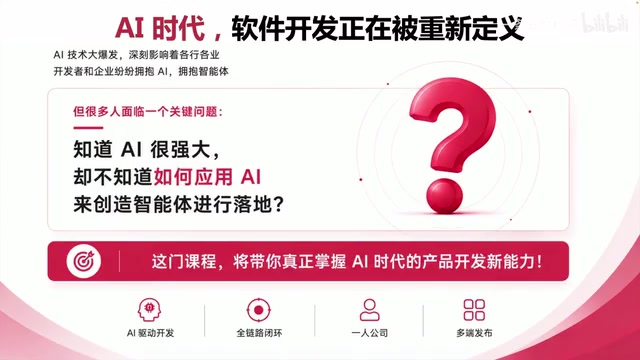
Vibe Coding shifts development from writing code to directing AI, but real success still demands engineering thinking.
The article explores Vibe Coding, a paradigm where developers direct AI to write code rather than writing it themselves. While tools like Claude Code, Cursor, and Codex dramatically lower execution barriers, the author cautions that true AI engineering goes far beyond low-code workflow platforms like Coze or Dify. Real product capability requires full-cycle closure — from requirements and UI design to cross-platform development, deployment, and AI-assisted operations. The piece ultimately frames this as the dawn of the "super individual" era, while noting that market judgment and product thinking remain irreplaceable.
From Tools to Productivity: AI Is Reshaping Software Development
Building a product used to require a full team — product managers, designers, frontend and backend developers, QA engineers, and marketers. The barrier to entry was enormous. Many people had great ideas but lacked the ability to bring them to life. Bilibili creator Fenjing Cinema highlighted a growing trend in a course walkthrough: AI is steadily erasing these technical barriers, shifting software development from "people adapting to code" to "code adapting to people."
This shift has given rise to a popular concept: Vibe Coding. Its core idea can be summed up in one sentence — instead of people writing code, people direct AI to write the code. You tell the AI what page you want, how a feature should work, and it generates the UI, writes the code, connects the database, runs tests, fixes bugs, and even produces documentation and marketing copy.
Vibe Coding Is Not the Same as Workflow Orchestration
There's a common misconception about AI development worth clearing up. Many people assume that building a few nodes in Coze, Dify, or n8n and running some automated flows means they've mastered AI development. The creator makes clear that these are relatively basic applications of AI — still a significant distance from industrial-grade deployment.
The truly valuable direction for building complex systems and future AI products is a complete stack: "AI + code + agents + software engineering." What will matter most isn't simple chatbots, but AI-native applications — AI-powered e-commerce, digital avatars, automation systems, enterprise AI platforms, and more. All of these ultimately come back to engineering capability.
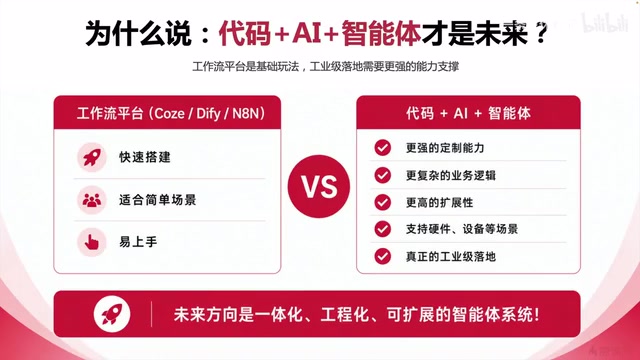
In other words, Vibe Coding lowers the barrier to execution, not to thinking. Knowing how to use a tool is not the same as knowing how to build a product. The ability to break down requirements, design systems, and structure data clearly remains the critical differentiator.
Coze, Dify, and n8n are the most common "low-code AI workflow" platforms, letting users orchestrate AI tasks by dragging and connecting nodes — no coding required. They excel at handling structured, predictable task chains, such as "receive form → call GPT to generate text → send email." However, their limitations are equally significant: the logic between nodes is highly rigid, making it difficult to handle complex conditional branching, state management, and error recovery; they can't flexibly integrate custom databases or proprietary business logic; and they lack professional-grade support for engineering concerns like concurrency, performance, and security. By contrast, the "AI + code + engineering" path means writing business logic in real programming languages like Python or TypeScript, with AI assisting in code generation while developers retain full architectural control. This approach has a much higher ceiling than pure workflow orchestration, enabling the construction of maintainable, scalable production-grade systems.
Full-Cycle Closure: A Complete Flow from Requirements to Operations
A real product is far more than just handwritten code. The creator emphasizes that the complete process includes requirements analysis, UI design, page development, backend logic, database setup, testing, deployment, and marketing — all of these stages need to be connected end to end.
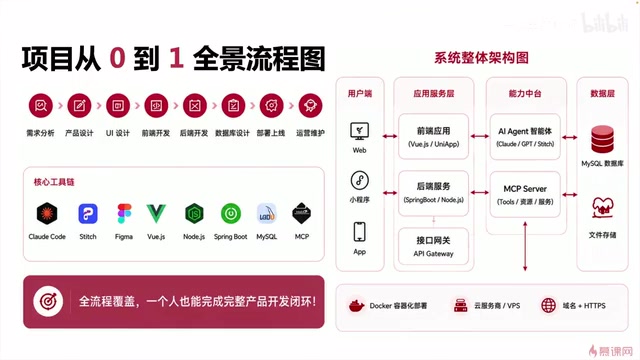
The defining characteristic of this approach is its emphasis on "full-cycle closure" rather than building a simple demo. Within an AI development architecture, tools like Claude Code, Stitch, MCP, Skills, and Figma work in coordination. AI is no longer just a chat assistant — it actively participates in design, development, testing, optimization, and operations. This model of "AI-collaborative development" is considered the future direction of software engineering.
Lowering the Bar for Cross-Platform Development
Building for multiple platforms used to be painful: one codebase for the web, another for mobile apps, yet another for mini-programs. The course covers using UniApp combined with AI code generation and component reuse to achieve "write once, run everywhere." This is one of the key technical prerequisites that makes the "one-person company" viable — a single developer can cover what used to require an entire team to deliver across multiple platforms.
Claude Code, mentioned in the article, is Anthropic's AI programming assistant designed for developers — capable of understanding and generating code, explaining technical documentation, and assisting with debugging. MCP (Model Context Protocol) is a standardized protocol that enables AI models to interact with external tools and data sources, allowing AI to perform real operations like database queries and API requests rather than just generating static text. Stitch is an AI tool focused on UI design and frontend generation, capable of rapidly producing interface prototypes from natural language descriptions. Each of these tools covers a different stage of the product development pipeline. The significance of "tool coordination" is this: AI is no longer an isolated Q&A window, but an "engineering participant" that can pass information between design files, code repositories, databases, and deployment environments. Connecting these tools together is what enables a fully automated path from a written description to a running product.
UniApp is a cross-platform frontend framework developed by DCloud. Using a single Vue.js-based codebase, developers can compile their code to run on WeChat Mini Programs, Alipay Mini Programs, H5 web pages, iOS apps, and Android apps simultaneously. Its core value lies in eliminating redundant development effort — traditional multi-platform development requires maintaining separate codebases for each platform, and UniApp abstracts away those differences at the compilation layer. Combined with AI code generation, developers can describe pages and interaction logic in natural language, and AI generates UniApp-compliant component code, further reducing the amount of hand-written code. This combination is especially critical for solo teams: a single developer cannot realistically maintain multiple separate codebases, but with UniApp's cross-platform capability and AI's code generation power, one person can potentially deliver a mini-program, a mobile app, and a web product all at once.
AI Has Already Moved Into Operations
Many people assume that once a product is built, the hard work is done. But the real challenge often lies in distribution. The creator points out that AI has already entered the operations space: automatically generating WeChat public account articles, promotional copy, video scripts, and even product demo videos. Products can, to a meaningful degree, "market themselves."
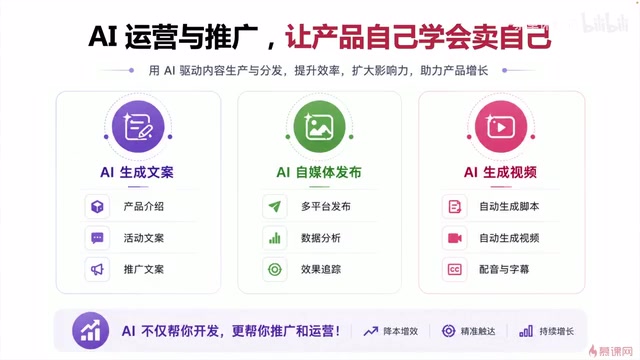
This leads to a clear conclusion: the truly competitive individuals of the future will be those who combine both "development" and "AI-assisted operations." The ability to ship technically and to communicate effectively forms a complete product capability loop.
A Generational Bet on the "Super Individual"
This course is positioned not merely as a tool tutorial, but more as a practical "one-person company" playbook for the AI era. The creator articulates two clear goals: first, to help learners genuinely master the ability to ship AI-engineered products — not just learn to use a handful of AI tools; second, to help them monetize. His thesis is that the future will see an explosion of AI companies, AI entrepreneurs, and super individuals — for many people, the path forward won't be finding a job, but building products with AI.
The tool stack covered in the course includes major AI coding tools like Claude Code, Codex, and Cursor. Learning objectives span independent product development, full-cycle AI collaboration, AI engineering capability, cross-platform development, and AI-automated operations.
A Balanced Take on This Narrative
It's worth noting that the perspectives above come primarily from a single course creator and carry an obvious promotional angle. "One person building a complete product" is technically feasible in demonstration settings, but in real commercial environments, product success also depends on market judgment, user growth, ongoing iteration, and many other non-technical factors. AI can dramatically lower the barrier to execution, but it cannot replace a deep understanding of user needs and business fundamentals.
For developers and entrepreneurs, Vibe Coding offers a new working paradigm worth paying attention to: delegate repetitive execution to AI, and concentrate your energy on product definition and decision-making. The opportunity belongs to those who prepare early — but the core of that preparation remains engineering thinking and product judgment, not simply accumulating tools.
Related articles

FastAPI: A High-Performance Python Framework and a Production-Ready API Development Powerhouse
FastAPI is a high-performance web framework based on Python type hints, supporting async and automatic OpenAPI docs. With over 100k GitHub stars, this article analyzes its core strengths, production readiness, and selection advice.

Tesla Optimus Begins Mass Production: Can the Goal of 20,000 Units Per Week Be Achieved?
Tesla Optimus officially begins mass production as Musk sets a target of 20,000 units per week. This article analyzes the supply chain challenges behind mass production, the real gap in capacity ramp-up, and the competitive landscape for humanoid robots.

PCL: A Minecraft Launcher with 8.5k Stars — Why Was It Written in VB.NET?
An in-depth analysis of PCL, the GitHub Minecraft launcher with 8,500+ stars: why it chose VB.NET, its features and China network advantages, and the limits of Windows-only.