Vibe Coding for Absolute Beginners: A Practical Guide to Claude Code and Cursor

A three-part Vibe Coding tutorial helping beginners enter programming with an AI mindset and deliver commercial projects.
This article introduces a systematic Vibe Coding tutorial for absolute beginners. Addressing the problem that most teaching only "teaches you to copy code, not to understand logic," the course is divided into fundamentals, advanced, and hands-on modules: fundamentals build an AI programming mindset and cover tools like Claude Code, Codex, and Cursor; advanced focuses on prompt tuning and multi-tool collaboration; hands-on trains commercial delivery via websites, scripts, mini-programs, and scrapers. It also offers free roadmaps, tool lists, 1000+ prompts, and source code.
What Is Vibe Coding? Why Even Beginners Can Learn It
Vibe Coding is lowering the barrier to learning how to program. In a newly released systematic tutorial, a Bilibili creator points out that over 85% of Vibe Coding teaching videos on the market are pieced together from fragmented content and lack hands-on breakdowns—they only teach you to "copy code," not to "understand the logic." This course, which took three months to produce, aims to use the most intuitive approach so that even absolute beginners can quickly absorb and flexibly apply AI programming.
The core idea is clear: say goodbye to the tedium of memorizing code, and enter programming through an AI mindset. The fundamentals section covers the core logic of Vibe Coding, building programming thinking from scratch, configuring AI programming tools, and writing universal prompts. In other words, you don't need to become a programmer first before you can start writing code with AI.
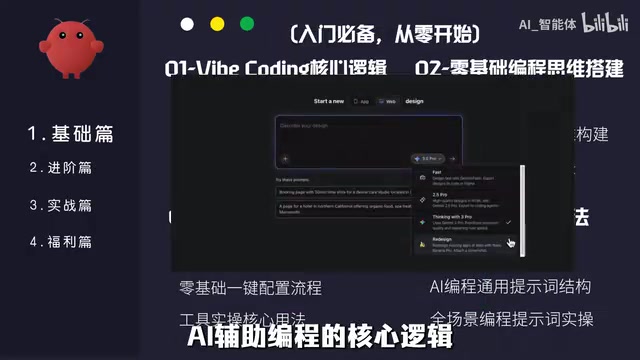
The course emphasizes that "every second delivers substance" and divides its content into three modules: fundamentals, advanced topics, and hands-on projects, forming a complete path from understanding to execution.
The Definition and Origins of Vibe Coding
The term Vibe Coding was coined by AI researcher Andrej Karpathy in early 2025 to describe a new programming paradigm: developers no longer hand-write code line by line, but instead describe their intent in natural language to a large language model, which generates the code, while the human only needs to steer direction and verify results. The "Vibe" here emphasizes "going with the feel"—you focus on "what I want to achieve," not "how to write this syntax."
Its technical foundation is large models with long context and code comprehension capabilities (such as the Claude and GPT series). Unlike traditional "low-code/no-code" platforms, Vibe Coding doesn't rely on pre-built components, but instead relies on the model to generate code for arbitrary logic on the fly, making it more flexible. For beginners, the barrier shifts from "memorizing syntax" to "clearly expressing needs and judging results"—which is precisely the underlying reason behind the article's claim that "knowing how to ask matters more than knowing how to write."
Fundamentals: Building an AI Programming Mindset and Toolchain
The goal of the fundamentals section is to let absolute beginners get started with zero barriers. The creator synthesizes all the core knowledge points of Vibe Coding, pairing engaging classroom-style explanations with real cases, in an attempt to solve a key problem: how to help people who don't understand code grasp the underlying logic of AI-assisted programming.
This stage involves the configuration and use of mainstream AI programming tools such as Claude Code, Codex, and Cursor. The tools themselves aren't difficult; what's difficult is building the habit of "deconstructing problems with an AI mindset." Through universal prompt-writing techniques, the course helps learners cross that first threshold—knowing how to ask matters more than knowing how to write.

The accompanying course documents, learning roadmap, and tool list reduce the cognitive load during learning, allowing attention to stay focused on hands-on practice itself.
Differences Between Mainstream AI Programming Tools
Claude Code is a command-line programming agent released by Anthropic, skilled at handling large codebases, long-context reasoning, and refactoring tasks; Codex originates from OpenAI's code generation models and excels at function completion and code snippet generation; Cursor is an AI editor built on a fork of VS Code that embeds model capabilities directly into the IDE, supporting conversational code editing and cross-file editing. The three have different positions: Cursor is a "workbench," Claude Code is a "heavy-lifting agent," and Codex is more like a "completion engine." Understanding this is what makes it clear why the advanced section emphasizes "multi-tool collaboration"—a single tool can hardly cover the entire workflow of requirements analysis, coding, debugging, and deployment.
Advanced: Prompt Tuning and Multi-Tool Collaboration
The advanced section focuses on high-level Vibe Coding techniques: precise prompt tuning, multi-AI-tool collaboration, complex code error correction and optimization, and batch automation programming. The shared goal of these skills is to use AI to quickly write high-quality, deployable code—not to produce "garbage code."
Multi-tool collaboration is the key to the advanced stage. Claude Code excels at long-context understanding and refactoring, Codex has unique advantages in code generation and completion, and Cursor provides a complete IDE integration experience. Only by combining them can you cover the full pipeline from requirements analysis to deployment.
The complete course documents compiled by the creator come with a full set of exclusive learning roadmaps and tool lists, ensuring learners don't need to be distracted taking notes and can keep up throughout.
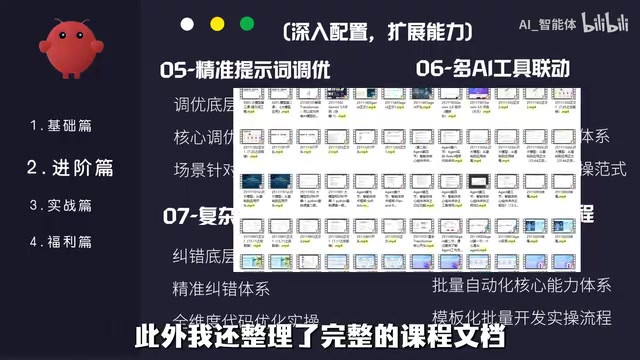
The learning curve at this stage is noticeably steeper than in the fundamentals, but it's also the watershed between "being able to use AI" and "using AI well."
What Is Prompt Tuning?
Prompt engineering/tuning refers to adjusting the structure, context, and constraints of a query so that the model's output is closer to the expected result. Common techniques include: giving clear role settings, providing input/output examples (few-shot), limiting the tech stack and code style, and requiring step-by-step reasoning (Chain-of-Thought). In Vibe Coding, prompt quality directly determines code quality—vague questions produce "garbage code" that appears to run but is actually hard to maintain, while structured prompts can significantly reduce rework. This is also why the advanced section lists "precise prompt tuning" as the core watershed from "being able to use AI" to "using AI well."
Hands-On: Delivering Commercial-Grade Projects
The hands-on section guides learners step by step through commercial-grade projects, including independently developing a personal website, office automation scripts, mini-program development, web scraping data collection tools, AI tool integration projects, and web feature development. These projects cover real-world scenarios such as side-hustle freelance work, workplace efficiency, and job-application bonuses.
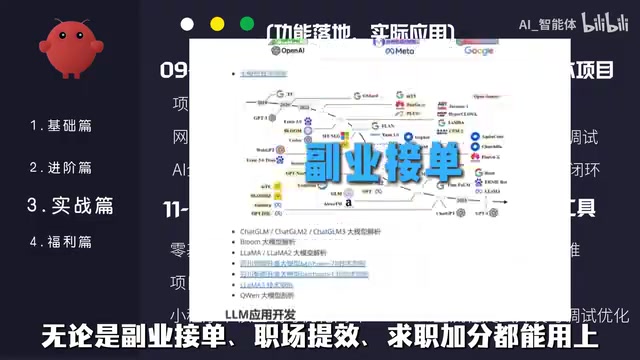
Applying what you learn is the core of this module. The value of Vibe Coding isn't in showing off skills, but in turning AI programming ability into tangible output in daily study and work. From automation scripts to complete product prototypes, the hands-on section tries to prove that absolute beginners can also deliver usable commercial-grade projects.
Compliance Reminders for Scrapers and Automation Scripts
The "web scraping data collection tools" mentioned in the hands-on section fall into a technically sensitive scenario. In actual development, you need to comply with the target website's robots.txt protocol, control request frequency, avoid scraping personal privacy or copyright-protected data, and pay attention to relevant regulations such as the Data Security Law and the Personal Information Protection Law. AI-generated scraping code also requires human review of its legality—you can't be exempt from responsibility just because "the model wrote it." Similarly, if automation office scripts involve a company's internal systems, you should first confirm the boundaries of your permissions. Only by incorporating compliance awareness into your Vibe Coding habits can projects truly be deployable and sustainable long-term.
Learning Resources and Getting-Started Advice
The course's accompanying materials include a full learning plan, AI programming tool installation packages, over a thousand universal programming prompts, a beginner e-book, and the complete set of courseware source code. The creator packages these resources and offers them for free, lowering the resource barrier at the entry stage.
For absolute beginners who want to get started with Vibe Coding, the recommended path is: first use the fundamentals to build an AI programming mindset, then master prompt tuning and multi-tool collaboration through the advanced section, and finally complete at least one full project in the hands-on section. A seven-day speedrun is possible, but real skill improvement comes from continuous project practice.
One-line Summary
A three-part Vibe Coding tutorial (fundamentals, advanced, hands-on) that helps beginners enter programming with an AI mindset and deliver commercial projects.
Paragraph Summary
This article introduces a systematic Vibe Coding tutorial for absolute beginners. Addressing the problem that most teaching only "teaches you to copy code, not to understand logic," this course was polished over three months and divided into three modules: fundamentals, advanced, and hands-on projects. The fundamentals build an AI programming mindset and cover configuring tools like Claude Code, Codex, and Cursor; the advanced section focuses on prompt tuning and multi-tool collaboration; the hands-on section trains commercial-grade delivery skills through projects like personal websites, automation scripts, mini-programs, and scrapers. The course also offers free learning roadmaps, tool lists, over a thousand universal prompts, and courseware source code, and provides a starting path of "mindset first, tools second, projects last," emphasizing that a seven-day speedrun is feasible but real improvement comes from continuous practice.
Related articles

Anchoring, Loss Aversion, and Nudges: 5 Psychological Tactics Retailers Use to Make You Spend
Behavioral economics reveals how retailers use anchoring, framing, loss aversion, and nudge theory to manipulate your spending decisions. This article breaks down 5 common psychological tactics and offers counterstrategies like slowing down decisions and setting your own anchors to see through the pricing design behind discounts.

5 Core Modules Every AI Engineer Must Know
Explaining the five core modules every AI engineer must know: LLMs, embedding models, RAG, agent harnesses, and world models, and how they combine into real AI products like ChatGPT, recommendation systems, and self-driving cars.

Feeding Data to Agents: MCP On-Demand Pull vs. Prefetching? A Practical Comparison
Reddit developers discuss whether lead review agents should prefetch or use MCP for external data. This article breaks down cost, latency, and controllability differences and offers a hybrid decision framework.