Vibe Coding for Absolute Beginners: Mastering AI Programming with Claude Code
Vibe Coding lets non-programmers drive AI development with natural language and launch web apps in three days.
The article introduces Vibe Coding, an emerging way of working: users don't need to be programmers but describe requirements in natural language to drive AI development. The course uses Claude Code as its core tool, covering environment setup, API integration, and project practice, emphasizing Agentic Engineering and the LLM loop mechanism to improve cache hit rates and reduce costs. For domestic users, it offers adaptation and package comparisons for DeepSeek, Zhipu GLM, and Tongyi Qianwen, with DeepSeek V4 Pro achieving a 98%–99% cache hit rate at about three yuan per day. Target students include zero-background individuals with business experience, students and career changers, and developers needing AI collaboration skills.
What Is Vibe Coding?
Have you ever had this experience: a brilliant app or website idea suddenly pops into your head, and within three seconds of excitement, reality crushes it—"I can't write code"? The high barrier of traditional programming stops countless ideas at the imagination stage. Vibe Coding is changing all of that.
According to the definition in a tutorial by a Bilibili creator, Vibe Coding is a whole new way of working—you no longer need to be a programmer, but rather an excellent communicator. The core idea is to describe requirements in natural language and drive AI to handle the development, no longer agonizing over function syntax and code details. You can get a simple web app online after just three days of learning. That sounds like a fantasy, but the development of AI programming tools has made it possible.
Core Tool: Claude Code and the Agent Methodology
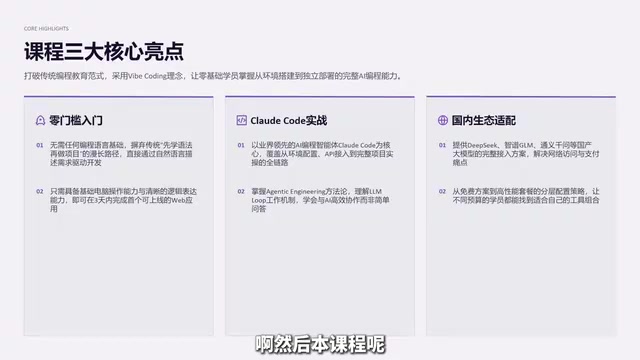
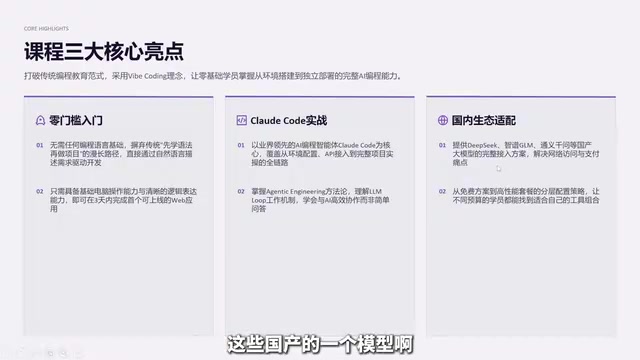
The course uses Claude Code as its core programming tool—it's a leading AI programming agent in the industry. The learning path covers the full chain from environment setup and API integration to complete project practice. But tools are just the surface; what matters more is mastering the Agentic Engineering methodology—understanding how the LLM loop works and learning to collaborate efficiently with AI rather than just asking simple questions.
Many users have used Claude Code but don't operate it the way officially recommended, resulting in low cache hit rates, diminished results, and higher costs. The course provides solutions for this problem. The creator reveals that many upcoming hands-on courses will use the DeepSeekAd model to drive development, where DeepSeek V4 Pro's cache hit rate can reach 98% to 99%, significantly optimizing costs.
LLM loop refers to the "observe—think—act" cycle that an AI agent repeatedly executes when completing a task: the model first reads the current context and tool return results, then decides which tool to call next (read file, execute command, search, etc.), appends the new results back to the context after execution, and loops like this until the task is complete. Unlike traditional one-shot Q&A, each round of the LLM loop accumulates context, so how the context is organized and how concise the tool return content is directly determines cost and effectiveness. Understanding this mechanism is essential to grasping why "cache hit rate" is so critical for agents like Claude Code—if the repeated system prompts and historical context in the loop can be cached and reused, token consumption and latency can be significantly reduced.
Cache hit rate (prompt caching) is a key concept in AI API billing and performance optimization. Major LLM service providers allow caching of repeated prefix content in requests (such as system prompts, long documents, conversation history). If subsequent requests hit the same prefix, that portion of tokens is billed at a price far below normal input, and responses are faster. A low hit rate means you pay full price for repeated content every time, and costs can multiply. The key to improving hit rate is keeping the prompt prefix stable, avoiding frequent changes to system prompts, and placing variable content at the end. The 98%–99% hit rate mentioned in the article is achieved through standardized invocation methods.
Adaptation Solutions and Cost Considerations for Domestic Users
For domestic users, directly using foreign models (such as GPT, Claude) may be inconvenient. The course provides domestic adaptation solutions that can connect to domestic models like DeepSeek, Zhipu GLM, and Tongyi Qianwen. The creator also compiled a recommendation table for different model packages to help choose based on budget:
- Claude and GPT recommend monthly packages, with tiers at $20, $100, etc.;
- Zhipu GLM 5.1 version costs 49 yuan per month, with quarterly and annual discounts;
- Tongyi Qianwen 3.7 Max costs about one to two hundred yuan per month, also with discounts;
- DeepSeek V4 Pro is billed by API usage, averaging about three yuan per day—the most cost-effective, but requires actual configuration to ensure cache hit rate.
This information provides clear selection references for learners with different budgets.
Who Is Vibe Coding For?
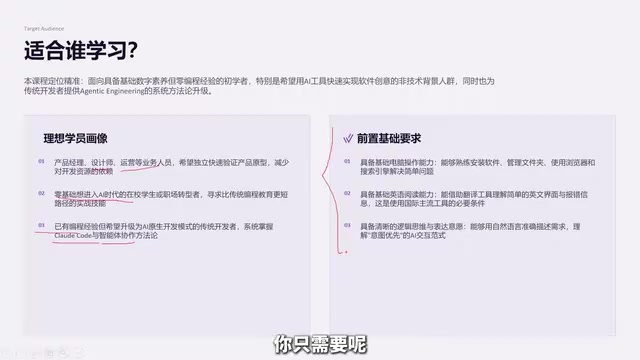
The course summarizes three types of ideal students:
- People with business experience but zero programming background: product managers, designers, operations staff, etc., who already understand complete business logic. With AI programming, they can reduce dependence on development resources and even complete projects independently.
- Students or career changers with zero background: they no longer need to write code line by line like in traditional programming education, but should leverage AI-assisted development.
- Developers already in the industry: those unfamiliar with AI programming who want to systematically master Claude Code and agent collaboration methodology through the course.
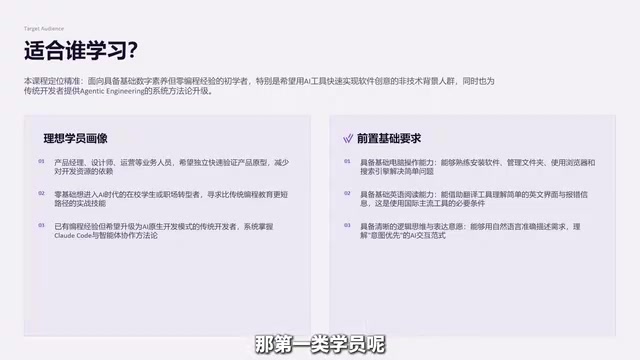
Prerequisites are simple: basic computer operation skills (turning on/off, installing software, managing folders, using a browser), basic English reading ability (being able to understand English interfaces and error messages with translation tools is enough), and clear logical thinking. The creator particularly emphasizes maintaining humility and trust when communicating with AI, avoiding meaningless arguments, which only waste tokens and money.
PRD (Product Requirements Document) is a standardized document that product managers use to describe "what to build, why build it, and to what extent" to the development team. It typically includes target users, core scenarios, feature lists, interaction flows, and acceptance criteria. In the context of Vibe Coding, the role of the PRD has changed: it's no longer just a handover material for human developers, but becomes a high-quality prompt carrier that drives AI to generate code. The more structured the requirements and the clearer the boundaries, the closer the AI-generated code is to expectations, and the less rework is needed. Therefore, the course lists "writing PRDs" as one of the core capabilities after completion, which essentially trains learners to translate vague ideas into AI-executable specifications.
What Will You Gain After Learning?
After completing the course, you will be able to clearly explain concepts like Vibe Coding and agent-paradigm programming, and master the entire process of Claude Code environment setup, model integration, project development, debugging, and deployment. More importantly, you'll have the ability to independently build and deploy complete web applications, including writing PRD requirement documents, code review, and deployment confirmation. The course also covers the use and customization of Skills, allowing you to flexibly extend the boundaries of AI capabilities.
Vibe Coding is not a silver bullet, but it does lower the barrier to creation. When programming is no longer the preserve of a few, the value of creativity itself becomes more prominent.
One-line Summary
Vibe Coding lets non-programmers drive AI development with natural language and launch web apps in three days.
Paragraph Summary
The article introduces Vibe Coding, an emerging way of working: users don't need to be programmers but describe requirements in natural language to drive AI development. The course uses Claude Code as its core tool, covering the full chain from environment setup and API integration to project practice, emphasizing the importance of mastering Agentic Engineering and the LLM loop mechanism, and pointing out that standardized usage can improve cache hit rates and reduce costs. For domestic users, the article provides adaptation and package comparisons for domestic models like DeepSeek, Zhipu GLM, and Tongyi Qianwen, where DeepSeek V4 Pro achieves a 98%–99% cache hit rate at about three yuan per day. Target students include zero-background individuals with business experience, students and career changers, and developers needing to supplement AI collaboration skills. After completion, you can independently build and deploy web apps and master PRD writing and code review skills.
Related articles

Michael Nielsen Takes Down His Classic Neural Network Textbook, Sparking Community Discussion
Michael Nielsen's classic free textbook Neural Networks and Deep Learning has been taken offline, sparking discussion on Hacker News about the reasons and impact.

Inside the AI Training Data Market: The Trade-off Between Exclusivity and Discounts
G2i founder Gabe Greenberg reveals the dual-track pricing of the AI training data market: labs pay a premium for exclusive data or accept discounts that allow others to buy it.

SessionGraph: Unifying All Coding Agent Sessions in One Interactive Graph
SessionGraph aggregates coding agent sessions into an interactive graph, helping developers review, debug, and manage AI coding workflows across sessions. This article examines its positioning, value, and open questions.