Vibe Coding for Beginners: Build Real Apps with AI — No Coding Skills Required

Vibe Coding lets anyone build real apps with AI using plain language — no coding required.
Vibe Coding, coined by Andrej Karpathy in 2025, is a development paradigm where natural language drives AI to generate all the code. With tools like Cursor and Claude Code, anyone can build real applications by simply describing what they want. Real-world cases — from a singer's fan app to a viral App Store hit — show what's possible, even without any programming background.
What Is Vibe Coding?
In an era of exploding AI programming tools, a brand-new software development paradigm is emerging — Vibe Coding. It completely upends the traditional reliance on syntax, algorithms, and computer science knowledge, turning "have an idea, ship a product" from a slogan into reality.
Origin of the concept: The term "Vibe Coding" was formally coined by OpenAI co-founder Andrej Karpathy in early 2025. He described a new kind of programming experience on social media: being fully immersed in the "vibe" of creation, delegating code generation entirely to AI, and focusing only on expressing intent and experiencing the results. The concept quickly resonated across the global developer community, because it accurately captured the new form of human-AI collaborative development made possible by breakthroughs in large language model (LLM) coding capabilities.
Simply put, Vibe Coding is a development approach centered on natural language intent, fully relying on AI to generate code, and iterating on software purely by running it, observing results, and going with your gut. Developers don't need to read or write code logic line by line — the focus shifts entirely to "what do I want?" and "does this feel right?"
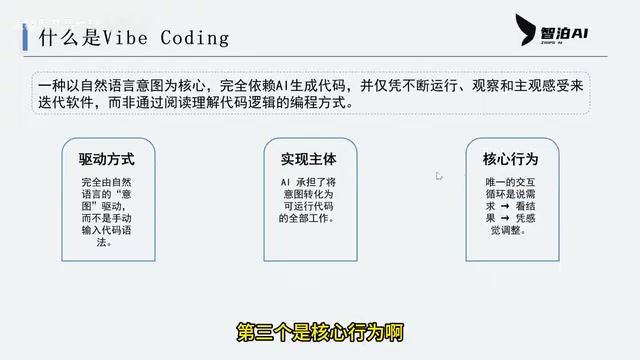
We can break this definition down along three dimensions:
The Three Core Characteristics of Vibe Coding
First, the driver: natural language intent. Traditional programming requires manually typing code that conforms to syntax rules. Vibe Coding is driven entirely by natural language intent. You simply describe clearly "what kind of feature I want to build" — no programming language knowledge required.
Second, the implementer: AI handles everything. The entire transformation from requirements to runnable code is handled by AI. This is made possible by the leap in code generation capabilities from frontier large language models like GPT-4, Claude 3.5/3.7, and Gemini — their scores on professional coding benchmarks like HumanEval and SWE-Bench already far exceed most human programmers. On the tooling side, AI coding IDEs and plugins like Cursor, GitHub Copilot, Windsurf, and Claude Code integrate code generation, error fixing, and codebase understanding into a single workflow, making the translation from natural language to runnable code an everyday operation. You don't need to write a single line of code — AI is your on-demand engineer.
Third, the core loop: describe, run, feel, and adjust. This is the only interaction required — describe what you want, run it to see the effect, and if you're not happy, keep telling the AI what to change. The barrier to entry is extremely low; you can get started immediately.
In other words, Vibe Coding lets you stay immersed in the creative vibe, outsourcing all the heavy lifting to AI — you can even temporarily forget that code exists.
Why Is Vibe Coding Generating So Much Buzz?
A striking idea is spreading: the truly competitive skill is the ability to turn an idea into a product, instantly, at any time.
While others are still in meetings discussing timelines, someone who has mastered Vibe Coding might already have a product live and iterated three times. It dramatically amplifies individual productivity — no need to hire engineers to independently run a full business loop, truly enabling a "one-person army."

The rise of the indie developer ecosystem: Vibe Coding aligns closely with the "Indie Hacker" movement. Indie hackers are individual entrepreneurs who build and sell software products without venture capital, either solo or with a small team. In the past, the bottleneck for this group was often technical execution — a product manager with sharp business instincts might be unable to bring an idea to life simply because they couldn't code. Vibe Coding directly removes that barrier, making the "Solo Founder" business model technically viable, and further fueling explosive growth in indie developer communities worldwide.
Reports indicate that several top domestic internet companies have already begun adopting Vibe Coding at scale, with some teams even evaluating candidates' AI programming abilities during interviews. This confirms that the paradigm is moving from "tech toy" to genuine productivity tool.
Of course, a dose of realism is warranted: while Vibe Coding dramatically lowers the development barrier, the architecture design of complex systems, along with security and maintainability concerns, still require professional engineering expertise.
Real-World Cases: How Ordinary People Built Breakout Apps with AI
The following real cases illustrate what's possible when non-technical users bring products to life through Vibe Coding.
Singer Hu Yanbin's "Flame App"
Singer Hu Yanbin posted a photo of his computer screen on social media with the caption "Vibe Coding, learning to fix bugs on the go." Curious followers discovered that Hu — a professional musician who had never formally learned to program — used Vibe Coding to build a fan community platform app called "Flame," which was described by observers as a "production-grade application."

The Viral "Kitten Fill Light" App
Another widely circulated case is the "Kitten Fill Light" app. Not only did it rack up millions of views on Xiaohongshu, it topped the App Store paid charts within just two weeks. The developer had never written a single line of code before, relied entirely on AI programming tools, and completed the entire process from design to launch in roughly one hour — ultimately generating substantial revenue.

The Bigger Picture: A Mass App-Building Movement
The broader picture is a genuine "everyone builds apps" movement:
- A 70-year-old grandfather built a bookkeeping app to manage his pension;
- An e-commerce seller created a multi-platform order sync inventory management tool;
- A middle school teacher built an assistant that automatically recognizes handwritten answers and grades them;
- A stay-at-home mom built a baby food app that recommends recipes based on her child's age in months.
None of these developers had a computer science background, yet they used Vibe Coding to build practical applications that improved their lives and work efficiency.
The Core Idea: Ideas Are Worth More Than Code
Boris, the founder of Claude Code, once made a striking observation: the best software builders may not even be engineers — they might be great communicators. Because in the AI era, writing code has become the easiest part. "Knowing clearly what you want to build" is the real challenge.
This captures the essence of Vibe Coding: when AI drives the cost of writing code toward zero, the truly scarce skill shifts from "technical execution" to "product insight." There's a deep economic logic here — the theory of comparative advantage explains this transition well. When AI brings the marginal cost of code writing close to zero, technical execution is no longer a scarce resource; instead, industry know-how, user empathy, and product judgment become amplified in their scarcity. This mirrors the pattern of previous waves of technological democratization — when the printing press became widespread, writing ability became scarce; when the internet became widespread, content creation became scarce; when AI coding becomes widespread, the product ability to "know clearly what to build" becomes the new core competitive moat. Your understanding of an industry, and your insight into user needs, are what ultimately determine success.
A Closing Note: Opportunity and Realism in Equal Measure
For beginners with no technical background, Vibe Coding is undeniably a compelling entry point: no programming language knowledge, no math prerequisites, no computer science degree — just curiosity and the drive to turn ideas into products.
That said, rational judgment is equally important. The "launched in one hour" and "monetized quickly" stories in these cases are often curated success samples, and likely represent significant trial-and-error and optimization behind the scenes. More importantly, Vibe Coding has clear engineering boundaries at the technical level: AI-generated code can still harbor hard-to-detect vulnerabilities in scenarios involving large-scale concurrency, database transaction consistency, and network security (e.g., SQL injection, XSS attacks); complex system architecture design, microservice decomposition, and API contract design still rely heavily on experienced engineers. The industry consensus is that Vibe Coding is best suited for prototype validation (MVPs) and lightweight tools for niche use cases, rather than high-reliability systems carrying core business logic.
Vibe Coding lowers the barrier to starting, not the barrier to product success. Those who actually close the loop on a business are still the ones who truly understand user needs and continuously refine their products.
If you're looking to get started, try picking one small problem, and use an AI coding tool to build your first runnable application — experience firsthand the real power of this shift in the programming paradigm.
Related articles

Disaster and Glory of the Apollo Program: The History We Must Revisit Before Returning to the Moon
From the fatal Apollo 1 fire to Apollo 8's daring lunar orbit to Apollo 11's successful landing—revisiting the disasters, fears, and compromises of the Apollo program and their lessons for today's return to the Moon.

Netflix Trust Exercise Turns Into Firing Trap: Where Are the Boundaries of Corporate Trust?
A Netflix employee was fired after sharing private info in a trust exercise. We analyze the risks of corporate trust exercises and how employees can protect themselves.

AMD CDNA5 Architecture Deep Dive: Technical Evolution and the AI Computing Competition Landscape
Deep analysis of AMD's CDNA5 architecture covering Chiplet packaging upgrades, HBM memory evolution, and low-precision compute optimization, examining how AMD challenges NVIDIA's AI chip dominance.