Vibe Coding for Beginners: Expressing Intent Instead of Handwriting Code

Vibe Coding replaces handwriting code with expressing intent, lowering the barrier to making software to the floor.
The article introduces a 137-episode Vibe Coding hands-on course on Bilibili, noting that AI programming is shifting from "assisting with code writing" to "understanding what you want": users only need to describe their intent, the AI writes and runs simultaneously, and the human nods or shakes their head. The course argues that large models have brought real productivity, with typical scenarios being a beginner building an app in half a day and a programmer compressing a month's work into half a day. Compared to the traditional path of "learn the language first, then do projects," it's more like "describe the project first, fill in knowledge as you go," analogous to "everyone can run their own media." The course targets beginners and covers everything from introduction to enterprise-level practice, but the article reminds that intent expression and engineering judgment still determine the ceiling of effectiveness, and a reasonable expectation is to first build a small thing that runs, then understand why it runs.
AI programming is shifting from "assisting with code writing" to "understanding what you want." A 137-episode Vibe Coding hands-on course on Bilibili explains this concept plainly: you just tell the AI what you want, it writes and runs alongside you, and you nod yes or shake your head no. This logic is lowering the barrier to creating software to the floor.
What Exactly Is Vibe Coding
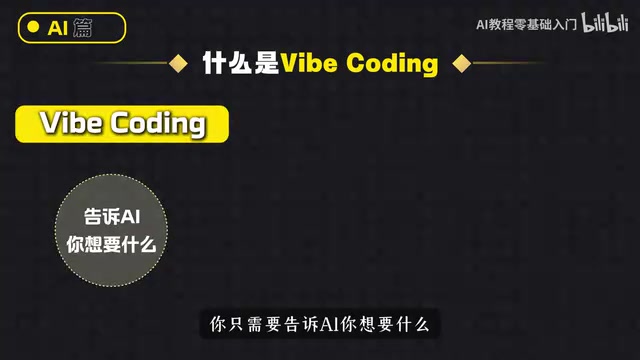
The word "vibe" emphasizes a "sense of atmosphere"—you don't need to type code line by line; instead, you clearly describe your intent, goals, and expected behavior, and let the AI implement and run it in real time. The course's definition is: the core of Vibe Coding is not writing code, but expressing your intent.
The significance of this shift is that in the past, learning programming required clearing hurdles like syntax, frameworks, and environment setup. Now the AI takes over these steps, freeing human energy to focus on "what do I want to build." The course describes this state as the barrier to creating software being lowered to the floor.
Why It's Worth Learning Now
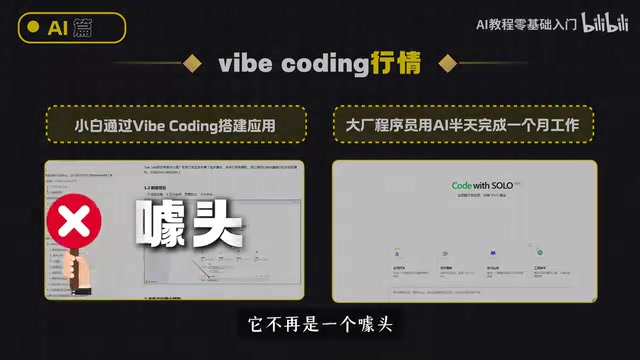
The course's rationale is based on productivity change: large AI models have already brought real productivity, and Vibe Coding is a powerful tool under this new productivity. The video mentions two recurring scenarios—a beginner builds an app in half a day with Vibe Coding, and a Big Tech programmer uses AI to compress a month's work into half a day.
These claims come from the course itself and are the instructor's observations rather than rigorous statistics, but the trend they point to is worth noting: AI is no longer just a toy to chat with, but real productivity. For beginners, this means the timing cost of entry is decreasing.
Differences from the Traditional Programming Path
The traditional path is "learn the language first, then do projects," while Vibe Coding is more like "describe the project first, fill in knowledge as you go." The course positions the latter as the main way of working in the future programming field, and offers an analogy: in the future, everyone can develop software, just as everyone can run their own media.
Not everyone may agree with this analogy, but it accurately describes a new group of people—those with ideas, no engineering background, and a desire to quickly validate product hypotheses. For them, the value of Vibe Coding is not replacing professional development, but greatly shortening the time from idea to a runnable prototype.
The term Vibe Coding was first coined by Andrej Karpathy in early 2025 to describe a programming style of "being fully immersed in the vibe, barely looking at the code": hand the requirements to a large model, accept the implementation it generates, and when errors occur, paste the error message back and keep iterating. It differs from the GitHub Copilot-style "completion assistant"—the latter is still primarily human-written with AI completion as a supplement, while Vibe Coding gives the model more control over generation and execution, with humans stepping back into review and decision-making roles. This also explains why the course emphasizes "writing and running simultaneously": seeing running results quickly is the prerequisite for this workflow to work.
Who It's For, and What to Watch Out For
The course is explicitly aimed at complete beginners, with a teaching style that is easy to understand. The 137-episode volume shows it covers the full chain from introduction to enterprise-level practice, not just a few demos.
It's worth noting that expressing intent is itself a skill. The vaguer you are, the higher the chance the AI goes off track; whether you can break down requirements clearly and judge whether the AI's output is correct still depends on basic engineering judgment. The course describes Vibe Coding as the entry point to benefiting from the AI era, but the benefits ultimately go to those who can express their intent clearly and are willing to debug repeatedly.
For newcomers, a reasonable expectation is: first use it to build a small thing that runs, then gradually understand why it runs.
Getting ideas running quickly usually relies on infrastructure like "scaffolding + instant preview": AI generates the project skeleton, the dev server hot-reloads so changes take effect in seconds, and error messages can be fed back to the model as-is. Understanding this chain helps judge tool boundaries—Vibe Coding performs best on prototypes, scripts, internal tools, and static sites; for systems involving complex state management, performance sensitivity, or strong compliance requirements, human involvement in design and review is still needed. Additionally, the license provenance of generated code and the security risks of introduced dependencies are also parts beyond intent expression that you need to oversee yourself.
One-line Summary
Vibe Coding replaces handwriting code with expressing intent, lowering the barrier to making software to the floor.
Paragraph Summary
The article introduces a 137-episode Vibe Coding hands-on course on Bilibili, noting that AI programming is shifting from "assisting with code writing" to "understanding what you want": users only need to describe their intent, the AI writes and runs simultaneously, and the human nods or shakes their head. The course argues that large models have brought real productivity, with typical scenarios being a beginner building an app in half a day and a programmer compressing a month's work into half a day. Compared to the traditional path of "learn the language first, then do projects," it's more like "describe the project first, fill in knowledge as you go," analogous to "everyone can run their own media." The course targets beginners and covers everything from introduction to enterprise-level practice, but the article reminds that intent expression and engineering judgment still determine the ceiling of effectiveness, and a reasonable expectation is to first build a small thing that runs, then understand why it runs.
Related articles

AI Coding Enters the Team Collaboration Era: Interpreting Three Major Moves from Meta, GitHub, and Mistral
Meta acquires Conductor, GitHub Copilot Fusion becomes available, Mistral opens Large 4 weights—three moves show AI coding shifting from code generation to organizing development workflows. This article explains task orchestration, model collaboration, and cost control for developers.

Building a RAG Assistant with Dify: A Practical Guide to Knowledge Bases, Workflows, and Agent Nodes
How should knowledge bases, workflows, and Agent nodes connect in a Dify RAG assistant? We break down the division of labor and wiring logic for a shippable app.
 Tech Frontiers
The AI Industry Doesn't Lack Marketing—It Lacks Good Products
AI faces market selloffs and public skepticism—is marketing really the problem? This analysis of market signals and product experience argues the core困境 is incomplete products and a gap between promises and experience; the only way to change perceptions is to ship better products.