Vibe Coding for Beginners: Launch a Web App in Three Days with AI-Assisted Development

No coding background needed — Vibe Coding lets you build web apps by describing what you want in plain language.
Vibe Coding is a development approach where you describe requirements in natural language and AI tools like Claude Code handle the actual coding. This guide covers a practical learning path for users in China, including domestic model options (DeepSeek, Zhipu GLM, Qwen), cost breakdowns, and the critical importance of cache hit rate optimization. DeepSeek V4 Pro offers the best value at ~¥3/day. The real prerequisite isn't technical skill — it's clear logical thinking and the ability to express requirements precisely.
What Is Vibe Coding: From Writing Code to Describing What You Want
Vibe Coding represents a fundamentally new approach to software development. Traditional programming courses teach you how to write functions and master syntax rules, but the core idea behind Vibe Coding is simple — you no longer need to worry about how code is written. Instead, you describe what you want in plain language, and AI tools handle the entire development process.
This shift is driven by the exponential growth in AI coding tool capabilities. According to a tutorial by Bilibili creator Mengge, learners with zero programming background can skip the long learning curve entirely. As long as you can operate a computer and express your ideas clearly, you can theoretically ship a simple web application within three days.
That said, a realistic note: "three days to launch" applies to simple web apps and depends heavily on how clearly you can articulate your requirements. Vibe Coding lowers the barrier to coding, not to requirements analysis or logical thinking.
The Core Toolchain: Claude Code, Codex, and Cursor
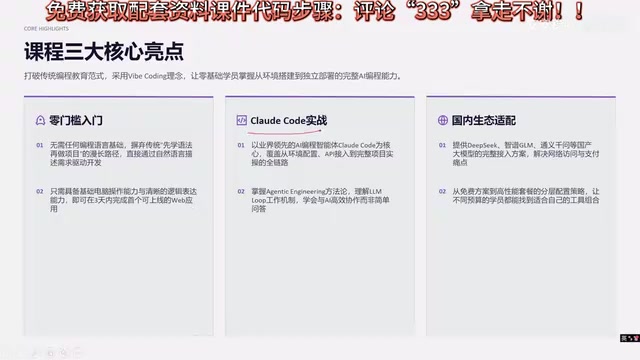
The course uses Claude Code as its primary programming tool, positioning it as the industry-leading AI coding agent. The learning path covers everything from environment setup and API integration to full end-to-end project development.
The Agentic Engineering Methodology
Using AI as a simple Q&A assistant barely scratches the surface of what it can do. The course emphasizes mastering an "Agentic Engineering" methodology — understanding how the LLM-Loop (Large Language Model Loop) works, where AI autonomously executes tasks across multiple iterations rather than responding one question at a time.
One particularly practical detail worth highlighting is cache hit rate optimization. Many people have already tried Claude Code but achieved poor results at high cost, simply because they weren't following the officially recommended workflow — which leads to low cache hit rates on the underlying model. Optimizing cache hit rates is a critical cost-control lever. According to the tutorial, a properly configured DeepSeekAd V4 Pro setup can achieve cache hit rates of 98–99%.
LLM-Loop (Large Language Model Loop) is the foundational mechanism of agentic engineering and deserves a closer look. Traditional AI conversations follow a simple request-response pattern: you ask, the AI answers, the conversation ends. The LLM-Loop, by contrast, places the AI inside a continuous execution environment where it can autonomously plan subtasks, invoke tools (such as file I/O, terminal commands, or browser operations), observe the results, and adjust its next action accordingly — looping until the goal is achieved. This fundamentally transforms the AI from a "responder" into an "executor." Claude Code is built around this paradigm: you describe the end goal, and it breaks the work into steps, executes them sequentially, automatically fixes errors, and requires almost no manual intervention at each stage. Understanding this mechanism explains why the right prompting style (clearly describing goals rather than issuing step-by-step instructions) produces dramatically better results than traditional conversational usage.
Domestic Model Compatibility: Low-Cost Options for Users in China
For users who prefer not to rely on overseas models like GPT or Claude, the course provides compatibility configurations for domestic Chinese models, including DeepSeek, Zhipu GLM, and Qwen (Tongyi Qianwen).
From a cost perspective, the tutorial offers the following pricing reference across different budgets:
- Claude Code (Sonnet 4.6): Monthly subscription recommended, ranging from $20 to $100/month
- GPT: Monthly subscription recommended
- Zhipu GLM (version 5.1): ~¥49/month, with discounts for quarterly or annual plans
- Qwen (3.7 Max): ~¥100–200/month, with discounts available
- DeepSeek V4 Pro: Pay-as-you-go API, averaging ~¥3/day — best overall value
One important caveat: DeepSeek may have the lowest unit price, but only if you correctly configure it to maximize cache hit rates. Poor cache performance can still lead to surprisingly high costs — which reinforces the importance of cache optimization mentioned earlier.
Cache hit rate is a technical metric that directly affects API costs in large language model usage, and understanding it helps you avoid expensive mistakes. LLM APIs typically charge separately for input tokens and output tokens. When a request contains large amounts of repeated content — such as system prompts, lengthy background documents, or code context — the provider caches that content in fast-access storage. Subsequent requests that hit the cache are billed at a significantly lower rate for those tokens. With DeepSeek, for example, cached input tokens can cost roughly one-tenth the price of uncached ones. When using Claude Code on larger projects, the system prompt and already-loaded code files can consume a large share of input tokens. If every request invalidates the cache due to format changes or context reordering, costs can multiply quickly. This is why the officially recommended practices — such as keeping the system prompt format consistent and avoiding arbitrary restructuring of context — aren't just stylistic preferences. They're engineering decisions with direct cost implications.
Who Should Learn Vibe Coding
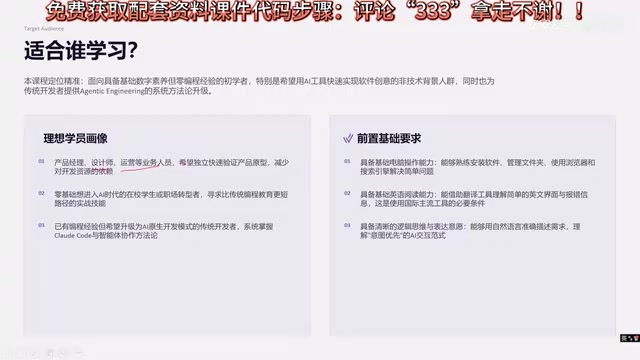
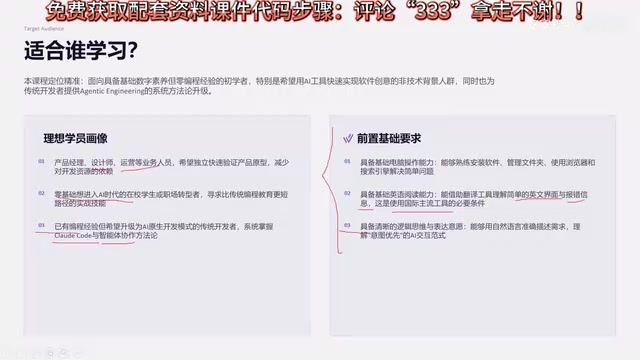
According to the tutorial, there are three ideal learner profiles:
Profile 1: Business professionals with domain expertise but no coding background — product managers, designers, operations staff, and similar roles. They already understand the full business logic. With AI coding, they can reduce their reliance on engineering resources or even implement projects directly by describing requirements to the AI.
Profile 2: Complete beginners — students or career changers — who want to enter the AI era without having to start from writing code line by line. AI-assisted development offers a faster on-ramp.
Profile 3: Developers with some technical background who haven't yet explored AI coding deeply and want to systematically learn Claude Code and agentic collaboration workflows.
Prerequisites: Logical Thinking Matters More Than Technical Skills
The barrier to entry for Vibe Coding looks low, but a few foundational requirements still apply:
- Basic computer literacy: turning a computer on and off, installing software, navigating folders, using a browser
- Basic English reading ability: being able to understand simple English interfaces and error messages with the help of translation tools, and browse official documentation for international tools
- Clear logical thinking: this is the most critical requirement
On that third point, the tutorial offers a refreshingly practical piece of advice: arguing with AI accomplishes nothing except wasting tokens and money. The clearer and more cooperative your communication style, the more accurate the AI's output. This implicitly reveals the true competitive edge in the Vibe Coding era — not technical knowledge, but the ability to express requirements clearly and organize your thinking logically.
What You'll Be Able to Do After Completing the Course
After working through the full curriculum, learners should be able to:
- Clearly understand concepts like Web Coding, agentic paradigm programming, and SSD paradigm, along with their appropriate use cases
- Master Claude Code's full engineering workflow: environment setup, model integration, project development, debugging, and deployment
- Demonstrate hands-on proficiency: using and customizing Skills, independently building and deploying complete web applications, writing PRD documents, conducting code reviews, and managing production releases
PRD (Product Requirements Document) is a standard document traditionally written by product managers to communicate feature requirements to development teams. In the context of Vibe Coding, the role of the PRD shifts in an interesting way — it's no longer just a communication artifact between humans, but a structured input through which a person gives instructions to an AI. A well-written PRD helps the AI accurately understand feature boundaries, interaction logic, and data structures, dramatically reducing the number of revision cycles. This explains why the course lists "writing PRD documents" as a core hands-on skill: for learners without a technical background, it's the key skill for translating vague ideas into actionable instructions for AI — arguably as important as learning to use any specific tool.
Closing Thoughts: People Who Use AI Are Replacing Those Who Don't
"It's never AI that replaces you — it's another person who knows how to use AI." This opening line from the course captures the real stakes of AI coding. In the age of AI Agents, Vibe Coding isn't about replacing all programming knowledge. It's about shifting the focus of development from how to implement something to what you want to build.
For non-technical professionals, this is a shortcut to bringing ideas to life quickly. For developers, it's a new tool for boosting productivity and expanding the boundaries of what they can build alone. Regardless of your background, getting hands-on with AI-assisted development sooner rather than later is far more valuable than sitting on the sidelines.
Related articles

Chain of Thought Isn't Just for AI: How Humans Can Use CoT to Improve Thinking Quality
Chain of Thought isn't just a prompt trick for large models. Starting from a Hacker News discussion, this article analyzes why CoT works for human thinking too, breaks down actionable ways to transfer it, and highlights the key differences between human CoT and machine CoT.
Cloudflare Teams Up with OpenAI: Closi…
Cloudflare Teams Up with OpenAI: Closing the Loop from Vulnerability Discovery to Defense with AI
Cloudflare uses OpenAI Daybreak to investigate security vulnerabilities and generate reviewable remediation plans, while developers use Codex to boost coding efficiency and quality.

Orca Multi-Agent Orchestration in Practice: A Guide to Parallel Collaboration with Claude and Codex
Orca is Stable AI's free open-source agent workbench supporting 34 agents like Claude Code and Codex in parallel. Learn its Git worktree isolation, multi-model orchestration, and mobile management.