Vibe Coding in Practice: A Complete Guide for Non-Developers Building Business Tools with AI

A practical guide to Vibe Coding for non-developers using Claude Code, Lovable, Replit, and Cursor.
Vibe Coding enables non-developers to build complete business software using AI tools like Claude Code, Lovable, Replit, and Cursor. This guide covers how each tool works, why basic technical concepts still matter, and how to build AI Agent workflows — helping business practitioners go from idea to working product without a coding background.
What Is Vibe Coding?
The explosive growth of AI coding tools is fundamentally lowering the barrier to software development. Entrepreneur Rasmus, in his Udemy course, puts forward a compelling proposition: non-developers can build complete commercial software platforms with the help of AI.
"Vibe Coding" refers to a style of development where you no longer write code line by line. Instead, you collaborate with AI through natural language — describing what you need, iterating on feedback, and letting the AI handle the bulk of the actual coding. The term was coined by OpenAI co-founder Andrej Karpathy in February 2025. He described a mode of programming where developers stay fully immersed in the "vibe" — expressing intent in plain language, and when errors appear, simply pasting the error message back to the AI to fix. The concept quickly resonated widely, capturing the new shape of human-AI collaborative programming made possible by the leap in large language model (LLM) capabilities. This approach is particularly well-suited for practitioners who have no coding background but have clear business needs.
Rasmus himself is the best proof of concept: with zero development experience, he built a software platform entirely with AI assistance. The platform supports filtering data from 2 million companies and automatically fetches information through AI workflows — including complex backend functionality built entirely by AI.

Comparing the Leading AI Coding Tools
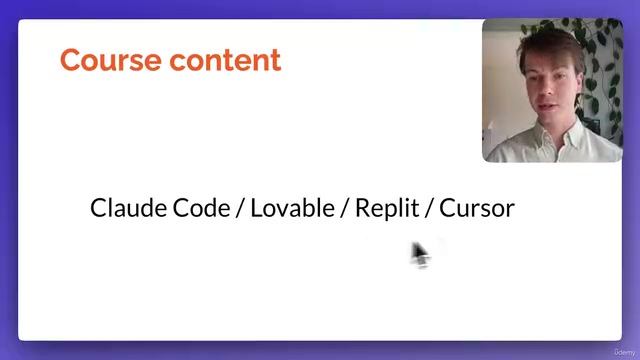
One of the course's key contributions is its systematic breakdown of the major AI coding platforms and their ideal use cases. Rasmus focuses on four tools:
Claude Code
The course emphasizes that Claude Code is currently the most sought-after AI coding skill in the job market. For business owners, mastering this tool is described as an almost unequivocal first choice.
Claude Code is a command-line AI coding tool developed by Anthropic, built on the Claude 3 model family. Unlike code completion tools such as Copilot, Claude Code operates in an "agentic" mode — it can autonomously read the file system, execute terminal commands, call external APIs, and maintain context across multi-step tasks. This makes it especially well-suited for advanced scenarios like refactoring entire codebases or debugging complex dependencies. It represents the high end of AI-assisted coding in command-line environments, and is ideal for users who need deep customization of business logic.
Lovable, Replit, and Cursor
Beyond Claude Code, the course dives into three other mainstream tools, each with its own focus, representing different tiers of the AI coding toolchain:
- Lovable: Built on models like GPT-4, it excels at turning natural language descriptions directly into React frontend components. It's focused on rapidly building frontend applications and landing pages, with core strengths in design quality and deployment speed.
- Replit: A cloud-based integrated development environment (IDE) with AI deeply embedded throughout code completion, debugging, and deployment. Users can go from writing to shipping without configuring any local environment — making the barrier to entry extremely low.
- Cursor: A desktop IDE deeply forked from VS Code, supporting multi-file context awareness and codebase-level questioning and refactoring. It has very high adoption among professional developers and suits users with some existing technical foundation.
The course walks through a detailed comparison of these platforms — how they differ and how they work — helping learners determine which tool fits their specific business scenario.
Why Learn Technical Fundamentals at All?
A key insight worth noting: even when AI can do the vast majority of the work for you, understanding basic technical concepts remains essential.
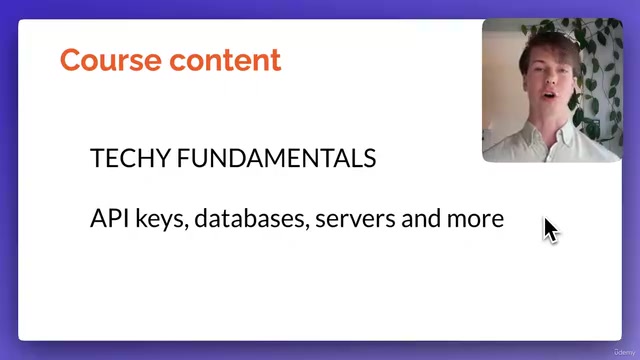
The course covers foundational concepts like API keys, databases, and servers. Understanding these is critical to truly mastering AI-assisted development: API keys are digital credentials used for authentication between software services — essentially a "pass" you present when calling third-party services. Databases come in two major types: relational (like PostgreSQL, which organizes data in structured tables) and non-relational (like MongoDB, which stores data in flexible document formats). Servers are the computing nodes that respond to user requests and run business logic — they can be cloud virtual machines or serverless functions. Even if AI can automatically generate code that calls these resources, understanding how they work lets you quickly pinpoint the root cause when permission errors or connection timeouts appear.
Rasmus's logic is straightforward: when AI is generating code for you, you need to understand the surrounding environment in which that code runs — so you can make the right call when something goes wrong, and so you can describe your needs more precisely to the AI and get better results.
This reveals a key truth about Vibe Coding: AI lowers the barrier, but it doesn't eliminate the need for understanding. The truly effective AI collaborator is someone who grasps the basic principles and can articulate their needs precisely — not someone who treats the whole thing as a black box.
AI Agents and Agentic Workflows
Another major focus of the course is building and applying AI Agents. When constructing web applications, AI agents are the key component for automating business processes.
What Is an AI Agent?
An AI Agent is an autonomous execution system built on large language models. Its core architecture typically consists of three elements: perception (receiving external information), reasoning (formulating an action plan), and execution (calling tools or APIs to carry out operations). Unlike a single-turn LLM interaction, an agent can perform multiple "think-act" cycles (the ReAct framework), dynamically adjusting its strategy at each step based on the result of the previous one. Different platforms implement this differently — agents on Claude Code, Lovable, and Replit each have distinct capability boundaries and user experiences.
Building Your Own Agentic Workflow
An agentic workflow chains together multiple agents or tools to form an automated pipeline capable of handling complex business processes. For example, a sales intelligence workflow might sequentially call a data-scraping agent → a data-cleaning agent → an email-drafting agent, all without any human intervention. The course doesn't just explain how to use existing AI agents — it teaches learners step by step how to build their own AI agents or agentic workflows from scratch, embedding AI capabilities directly into their own business processes to achieve true end-to-end automation.
What Will You Be Able to Build?
After completing the course, learners will have the skills to independently build:
- Apps: Functional tools that address specific business needs
- Websites: Complete with user login, admin dashboards, and more
- Business Dashboards: Data visualization and business monitoring interfaces
- Automations: Intelligent workflows that reduce repetitive manual work
The course also walks through a full end-to-end demo project: building a complete website with Google sign-in, a built-in admin dashboard, and integrated AI business tools — from zero to launch.
Conclusion: Bridging the Gap Between Knowing and Doing
Rasmus sets a clear and pragmatic goal for the course: closing the distance between "this seems too complicated" and "I can actually do this."
He acknowledges that what AI can achieve in development today represents a genuine paradigm shift compared to what was possible before. For business practitioners and entrepreneurs, AI-assisted coding is no longer a distant technical domain — it's a practical skill that can be applied directly to daily work to meaningfully improve efficiency.
Of course, as a marketing-oriented online course, some of its claims naturally lean optimistic — actual outcomes will still depend on individual business needs and the level of effort invested. But what is undeniably true is that the trend Vibe Coding represents — AI democratizing software creation — is happening in real time, and will continue to reshape how non-technical practitioners participate in building digital products.
Key Takeaways
Related articles

The Truth Behind Codex 'Build a Website in 5 Minutes': AI Isn't Creating Sites—It's Helping You Copy Them
Exposing the truth behind viral Codex 5-minute website videos: creators aren't building original sites with AI—they're copying shared prompts or scraping others' work. Learn AI coding tools' real limits.

Getting Started with AI Agent Development: A Complete Guide from Concept to Practice
A comprehensive guide to AI Agent architecture and development, covering automated marketing, intelligent customer service, and investment analysis scenarios with single and multi-agent collaboration.

The Truth Behind Codex 'Build a Website in 5 Minutes': AI Isn't Creating Sites — It's Helping You Copy Them
Exposing the truth behind viral Codex 5-minute website videos: creators aren't building original sites with AI — they're copying shared prompts or scraping others' work.