Vibe Coding in Practice: Building a One-Person Company with Full-Stack AI Development

In the Vibe Coding era, one person can use AI to handle the full product lifecycle — from design and dev to marketing.
The article explores "Vibe Coding" — the shift from humans writing code to humans directing AI to write it. It distinguishes between surface-level AI tool use (like workflow orchestration with Coze or n8n) and genuine AI engineering capability (AI + code + agents + engineering). Tools like Claude Code, Cursor, MCP, and UniApp lower the bar for full-stack and multi-platform development, while AI now extends into operations, auto-generating copy and video scripts. The author argues that AI will eliminate repetitive labor but create massive opportunities for solo builders who develop engineering depth early.
From "Humans Writing Code" to "Humans Directing AI to Write Code"
AI is evolving from a tool into an entirely new kind of productivity engine. Building a product used to require collaboration across multiple roles — product managers, designers, frontend and backend developers, QA engineers, and marketing teams. The technical barrier kept countless people with great ideas on the sidelines. Now, one person can potentially handle the entire chain — and that's exactly the context driving the widespread discussion around "Vibe Coding."
To put it simply: Vibe Coding means you no longer write code yourself — you direct AI to write it for you. You just tell the AI what page you want to build or how a feature should work, and it generates the UI, writes the code, connects the database, automatically tests and fixes bugs, produces documentation, and even drafts marketing copy and short-video scripts. The core interaction model of software development is shifting from "humans adapting to code" to "AI understanding human language."
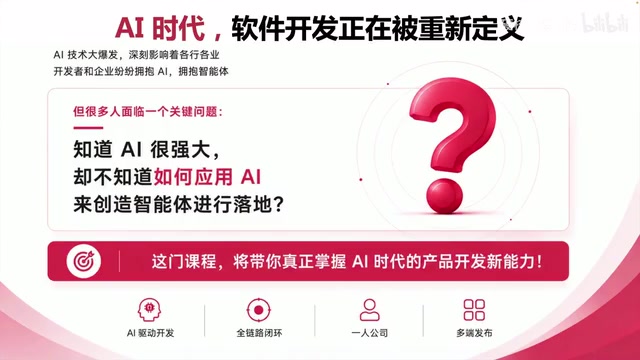
A Common Misconception: Workflow Orchestration ≠ AI Development
Many people still equate AI development with tools like Coze, Dify, or n8n — thinking that wiring together a few nodes and running some automated flows means they've "mastered" AI development. That's a significant misconception.
Node-based orchestration is just the entry-level layer of AI development. The core direction that can actually deliver production-grade results, power complex systems, and build complete products is the combination of AI + code + agents + software engineering. What will truly hold value in the future isn't simple chatbots — it's AI-native applications: AI-powered e-commerce platforms, digital humans, automation systems, enterprise AI tools, and more. All of these ultimately come back to engineering capability.
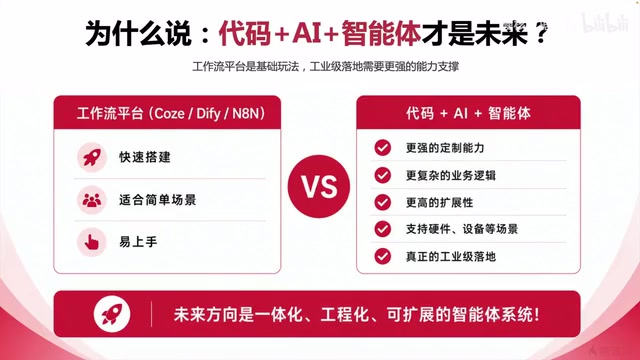
In other words, knowing how to use a few AI tools and truly having AI engineering capability are two very different things. The former is a taste of the experience; the latter is the moat that lets you consistently ship products and generate real business value.
Workflow orchestration tools (like Coze, Dify, and n8n) work by wrapping API calls, conditional logic, and data passing into visual nodes, letting you build automated pipelines via drag-and-drop. These tools have a low learning curve, require no coding background, and are great for quickly validating business processes. But at their core, they're just a "glue layer" between existing AI capabilities — they can't handle complex state management, custom algorithms, or high-concurrency engineering requirements. The AI + code + engineering path, by contrast, requires developers to understand code structure, database design, and service deployment at a deeper level — AI accelerates writing and debugging code, but doesn't replace the need to understand system architecture. The rough boundary between the two: workflow orchestration solves "process automation" problems, while engineering capability solves "product building" problems.
Full-Stack Closed Loop: A Product Is More Than Just Code
A real product involves far more than writing code. From requirements analysis, UI design, page development, backend logic, and databases, to testing, deployment, and marketing — every link in the chain needs to connect.
This is the key insight behind full-stack development thinking: don't just build a simple demo — walk the complete 0-to-1 product journey and close the loop. Within this methodology, development tools work in concert: Claude Code, Codex, and Cursor handle code generation and engineering implementation; Figma and Stitch handle design; MCP and Skills handle capability extension and tool invocation. AI is no longer just a conversational partner — it's genuinely participating in the full lifecycle of design, development, testing, optimization, and operations.

The Cost of Multi-Platform Development Has Dropped Dramatically
Building for multiple platforms used to be painful: separate codebases for Web, native App, and mini-programs meant enormous redundant effort. By combining UniApp with AI code generation and component reuse, you can achieve "write once, run everywhere." Reduced multi-platform costs are one of the key reasons the "one-person company" has moved from an idea to a real possibility.
A few tools mentioned here are worth briefly clarifying: Claude Code is Anthropic's command-line AI coding assistant that can read and write files and execute commands directly in a terminal environment — well-suited for engineering workflows. Cursor is an AI code editor deeply built on VS Code, supporting multi-file context awareness and conversational code generation. Codex is OpenAI's code generation model, integrated into ChatGPT and available via API.
MCP (Model Context Protocol) is an open protocol proposed by Anthropic that allows AI models to invoke external tools and data sources in a standardized way — essentially giving AI a "skill slot" system, enabling it to operate browsers, query databases, call third-party APIs, and more. This expands AI's capability boundary from conversation to real system interaction.
UniApp is a cross-platform development framework built on Vue.js by DCloud. Developers write a single codebase that the compiler outputs as H5 web pages, iOS/Android native apps, WeChat mini-programs, Alipay mini-programs, and more. Its core value is abstracting away platform-specific API differences so developers don't need to maintain separate codebases for each platform. Combined with AI code generation tools, developers can describe component requirements in natural language and have AI generate page code that conforms to UniApp's specifications — dramatically compressing the time and effort required for multi-platform development. This is the technical foundation that enables a one-person team to ship products across multiple platforms.
AI Enters Operations: Products That "Market Themselves"
Many people assume that once a product is built, the job is done. In reality, distribution is often the harder challenge. AI has now extended deep into the operations domain — it can automatically generate WeChat article drafts, marketing copy, video scripts, and even produce promotional videos.
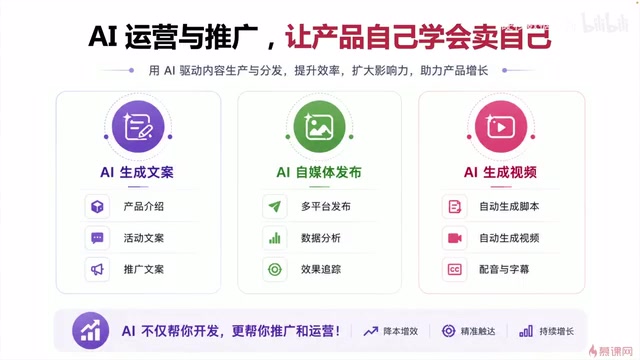
This means AI can help a product drive a significant portion of its own distribution. The people who will be truly competitive in the future are almost certainly those who combine development + AI-powered operations — not specialists who only cover one side of the equation.
The Window of Opportunity for the Solo Powerhouse
Following this framework, the goal is for an individual to simultaneously develop the ability to build products independently, collaborate across the full AI stack, apply AI engineering practices, develop for multiple platforms, and run AI-automated operations — ultimately forming a comprehensive "one person, complete product" capability.
It's reasonable to expect that AI will eliminate a large amount of repetitive labor, while simultaneously giving rise to many solo powerhouses, one-person companies, and AI entrepreneurs. Opportunity tends to go to those who prepare early. For anyone looking to enter the era of AI development, the move isn't to stay at the tool-tinkering level — it's to build real engineering capability as early as possible.
This article is based on course materials from the Bilibili creator "分镜影院" and focuses on methodology and strategic direction. For specific technical implementation details, refer to the actual course content and official tool documentation.
Related articles

Chain of Thought Isn't Just for AI: How Humans Can Use CoT to Improve Thinking Quality
Chain of Thought isn't just a prompt trick for large models. Starting from a Hacker News discussion, this article analyzes why CoT works for human thinking too, breaks down actionable ways to transfer it, and highlights the key differences between human CoT and machine CoT.
Cloudflare Teams Up with OpenAI: Closi…
Cloudflare Teams Up with OpenAI: Closing the Loop from Vulnerability Discovery to Defense with AI
Cloudflare uses OpenAI Daybreak to investigate security vulnerabilities and generate reviewable remediation plans, while developers use Codex to boost coding efficiency and quality.

Orca Multi-Agent Orchestration in Practice: A Guide to Parallel Collaboration with Claude and Codex
Orca is Stable AI's free open-source agent workbench supporting 34 agents like Claude Code and Codex in parallel. Learn its Git worktree isolation, multi-model orchestration, and mobile management.