Vibe Coding in Practice: The Right Way to Build Enterprise-Grade AI Projects with Codex + Claude Code

AI coding boosts speed, but enterprise projects still need engineering methodology to stay maintainable.
Based on a hands-on course by Bilibili creator Teacher Zhu, this article argues that the viral "beginners replacing developers with Vibe Coding" narrative has real limits — it works for simple projects, but complex enterprise systems involving high concurrency and microservices remain out of reach. AI coding's speed hides risks like non-standard code, security gaps, and poor maintainability. The course contrasts two projects — an e-commerce site (Vibe Coding) and an OpenRouter aggregation platform (AI engineering) — to demonstrate why methodology matters. The toolchain centers on Claude Code and Codex, with LLM selection based on task complexity.
Starting From "Even Non-Techies Can Replace Programmers"
A popular narrative has been making the rounds on social media lately: complete beginners with zero technical background can build impressive websites and applications using Vibe Coding (AI-assisted programming) — no developers needed. It sounds appealing, but a seasoned instructor (Bilibili creator Zhuge/Teacher Zhu) offers a more grounded take in his hands-on course.
His advice: anyone with even a modest technical background should form their own judgment. Take a close look at what those content creators have actually built — it's usually a simple website, an API wrapper, a mini-program, or a casual game. For projects with straightforward business logic and low technical complexity, AI-assisted coding does the job fine. But their commercial viability and long-term sustainability are quite limited.
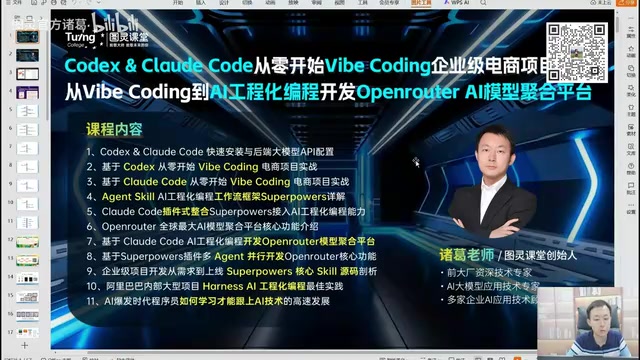
The real dividing line comes down to four words: "enterprise-grade projects." These are scenarios with genuinely complex business logic and serious technical demands — high concurrency, microservices architecture, distributed systems, and massive-scale data infrastructure. Getting a non-technical user to generate such systems purely through Vibe Coding? There's no credible precedent for that, at least not yet.
Terms like high concurrency, microservices, and distributed architecture represent the core complexity of enterprise systems. High concurrency means the system must handle massive simultaneous user requests, requiring rigorous performance tuning, locking mechanisms, and caching strategies. Microservices architecture breaks a large application into independent, separately deployable services, introducing coordination challenges like service discovery, load balancing, and cross-service transactions. Distributed architecture goes further, spreading computation and data across multiple nodes, and introduces problems around data consistency and fault tolerance under network partitions. The real challenge in these systems isn't "writing code that runs" — it's making system design decisions: how to define service boundaries, which consistency model to adopt, how to handle single points of failure. These decisions require a deep understanding of the overall architecture. AI-generated code lacks global awareness of business context and non-functional requirements, which is precisely why it falls short in enterprise settings.
The Hidden Pitfalls Behind AI Coding's "Speed"
Developers who've used AI coding tools have likely experienced a familiar contradiction: code gets generated at lightning speed, but confidence steadily erodes. Live audience feedback during the stream vividly illustrated these pain points.
Security uncertainty was the most frequently mentioned concern. Code gets written so fast that developers never have time to review it line by line — and there's no real confidence about whether it's safe to ship. If a serious bug hits production, who's responsible? The LLM certainly won't take the blame. The person who shipped the code will.
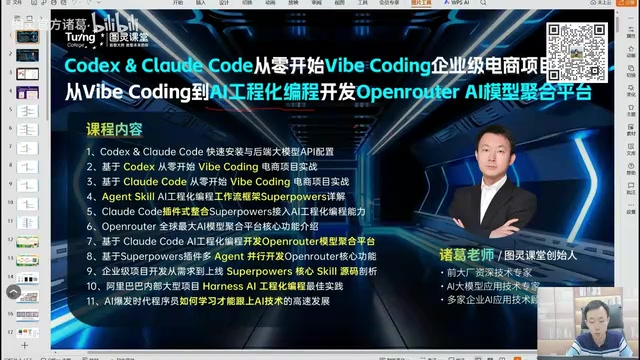
Beyond security, viewers repeatedly flagged several other common issues: non-standardized code, potential hidden bugs, and token consumption ballooning into a cost problem. These issues may seem tolerable when you're building something for fun, but they get amplified in team collaboration and long-term maintenance scenarios.
The instructor offered a pointed analogy: if every person on a team uses a different AI coding tool with no shared standards, the more code they write, the more likely the project is to "die" — the codebase becomes unmaintainable, and one day it just collapses. Once a production bug surfaces that the LLM can't seem to fix no matter how many attempts, that project is essentially finished.
The Divide Between Vibe Coding and AI Engineering
The core of this course is precisely this distinction: casual users building websites with Vibe Coding versus using an AI engineering mindset to build projects in a professional setting.
The instructor takes a hands-on teaching approach, walking through two projects from scratch to illustrate the contrast:
- An e-commerce project: built using the Vibe Coding approach, suitable for scenarios with relatively simple business logic and technology.
- An OpenRouter AI model aggregation platform: built using the AI engineering approach — the kind of development methodology actually being adopted by companies today.
Engineering, in this context, means standardization, team collaboration, and long-term sustainability. It directly addresses the problems mentioned earlier — non-standardized code, security gaps, bugs, and maintainability nightmares. The instructor's argument is that AI engineering can resolve the vast majority of these issues.
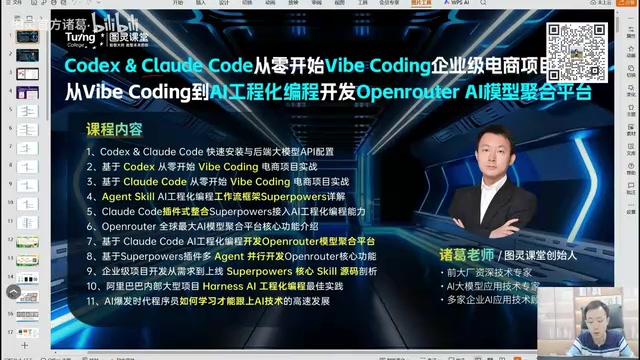
In other words, AI coding tools aren't the problem — the lack of an engineering methodology is. When a manager with no technical background and no reliable architect just lets employees "vibe" their way through a project with AI, that "swim blindfolded" approach can't hold up a team over the long haul.
Vibe Coding was coined by OpenAI co-founder Andrej Karpathy in early 2025. It describes a style of programming where developers rely entirely on AI to generate code, rarely read through the output in detail, and accept results on "feel" alone. It's characterized by a low barrier to entry and rapid prototyping — but also by dramatically weakened developer understanding and control over the codebase. AI engineering is its counterpart: embedding AI as an efficiency tool within existing software engineering practices, including code review, test coverage, documentation, and unified code style standards. The fundamental difference is that Vibe Coding treats AI as an "outsourced contractor," while AI engineering treats it as an "intelligent co-pilot." For teams, the value of the latter is that AI accelerates development without degrading the codebase's readability and evolvability — which is what determines whether a large project survives long-term.
Practical Tool and Model Selection
The course demo environment centers on two tools: Codex and Claude Code, with Claude Code as the primary tool. The instructor's assessment: Claude Code is more professional and is the tool of choice for many professional developers in enterprise settings; Codex is more accessible to a broader audience and, when backed by the latest GPT models, is equally capable.
The discussion around "Claude Code being unavailable" is worth addressing. The instructor clarified that Claude Code itself is usable — the issue is that accessing Claude models is comparatively difficult, since Anthropic has stricter restrictions for users in China. If your account gets flagged for switching network environments, recovering it is a major headache. Meanwhile, Codex backed by GPT, along with domestic Chinese model alternatives, has become a solid option.

On the IDE side, the instructor personally favors VS Code with the Claude Code plugin, plus Codex for writing code. He also noted that Cursor, ByteDance's Trae, and Tencent's offerings are all perfectly valid — it comes down to personal preference.
For backend LLM selection, the instructor shared a practical task-based strategy:
- Highly complex problems go to Claude, since its capabilities are genuinely strong — but it requires a stable network environment and carries account suspension risks.
- Medium-complexity problems can be handled by Zhipu GLM (GLM) or the latest version of DeepSeekAd.
- Bug fixing leans toward GPT + Codex, since you can directly paste a screenshot for fast diagnosis — extremely convenient.
He specifically noted that model rankings aren't static — the leaderboard shifts over time, so flexible switching is the right approach. Since using a VPN during this session risked account issues, the demonstration primarily used Zhipu's GLM domestic model.
OpenRouter — the core concept behind the second hands-on project — deserves its own explanation. OpenRouter is an AI model aggregation platform that unifies API access to large models from Anthropic, OpenAI, Google, Meta, and others under a single interface. Developers don't need to integrate each vendor's SDK separately; a single API call can route to any supported model. The business logic behind such platforms: different models vary in price, capability, and latency, so the aggregation layer can dynamically select the best model based on task type or cost constraints. The course chose this as its engineering project partly because it's a quintessential AI-era application scenario, and partly because its backend — involving API authentication, request forwarding, billing, and rate limiting — carries enough engineering complexity to demonstrate why a proper methodology matters. Claude Code is Anthropic's command-line AI coding tool for developers. It operates directly on local codebases, executes terminal commands, and integrates deeply with IDEs like VS Code — distinguishing it from AI-embedded IDEs like Cursor.
Closing Thoughts: A Rational View of AI Coding's Limits
The core message of this course is clear: AI coding is neither a magic bullet nor useless. It can dramatically boost productivity — but "speed" has to be paired with an engineering methodology to actually land in enterprise-grade, collaborative, maintainable projects.
For developers, rather than getting swept up in social media narratives about "beginners overthrowing programmers," it pays to honestly understand where Vibe Coding and AI engineering each belong — and to use the right tool in the right context.
Related articles

AI Agent Deployment: Three Things Developers Should Do
AI Agent deployment doesn't require rushing into multi-agent systems. This article outlines an actionable deployment path and engineering acceptance thresholds for developers, covering human baselines, bounded single-agent scope, and a controlled code-modification loop.

From Human-in-the-Loop to Out-of-the-Loop: A Hands-On Guide to Automated News Curation with Durable Agents
IndieDevDan shows how Durable News Agent uses durable agents and triggers to curate news automatically, filtering hype, facts, and signals with feedback weights.

AI-Powered SRC Vulnerability Hunting: A Hands-On Guide to Building the Hermes Agent Workbench
Based on a hands-on Bilibili video: how to build an AI-powered SRC vulnerability hunting workbench—three-step method, four report elements, Agent mode vs web chat, and tool selection.