Vibe Coding on a Budget: The Brain-vs-Hands Multi-Agent Strategy for Saving Tokens

Save AI coding tokens by assigning planning to premium models and execution to cheap ones like DeepSeek.
This article breaks down a token-saving Vibe Coding workflow where expensive models (ChatGPT) handle only planning and task decomposition, while low-cost models (DeepSeek via Codex + ccswitch) handle all code writing and execution. Combined with a subscription-quota-first usage strategy, this brain-vs-hands approach helps beginners ship their first AI project at minimal cost.
When AI-assisted programming (Vibe Coding) moves from experimentation to real projects, almost everyone hits the same wall: subscription quotas run out way too fast. Bilibili creator Su Yi, while sharing his AI learning notes, proposed a workflow he calls "heretical practice" — a token-saving strategy built around one core idea: let the most expensive model do only the thinking, and hand off execution to cheaper models. This article breaks down that workflow to help newcomers get their first project off the ground at the lowest possible cost.
Why a $20 Subscription Is Never Enough
Most people getting started with Vibe Coding subscribe to a $20/month plan (Claude or Codex, for instance). The experience feels fine at first — but once you start an actual project, the cracks show quickly.
What are Vibe Coding and Tokens? Vibe Coding is a development paradigm where natural language serves as the primary programming interface and AI models take the lead in code generation. Tokens are the basic unit large language models use to process text — roughly every 750 English words or 500 Chinese characters equals about 1,000 tokens. Each time a model responds, it doesn't just process your current message; it also includes the full conversation history (the context window) in the billing calculation. This means token consumption grows linearly — or even super-linearly — as a conversation progresses.
Real project work is an iterative loop: specify requirements, revise code, debug, repeat. As the conversation grows, the context window balloons and token costs visibly accelerate. This isn't because you're writing slowly — it's because every exchange sends an ever-longer history back to the model.

Su Yi also tried popular techniques like using open-source skills to compress context or standardizing prompt workflows. These do help tighten context usage to some extent, but they don't actually save a large number of tokens — because no matter what, the most expensive model is still doing all the work. That realization is what prompted him to rethink the approach entirely.
The Core Idea: Separate the Brain from the Hands
The essence of Su Yi's approach can be summed up in one line: separate the brain from the hands.

His question is blunt: why does the most expensive model have to do everything?
Reasoning Capability Gaps and Cost Tiers Among LLMs Today's leading large language models differ significantly in both reasoning capability and cost. In the 2024–2025 market, top-tier models like Claude Opus or GPT-4o can cost tens of dollars per million tokens, while open-source or low-cost models like DeepSeek V3 run at 1/10th that price or less. Research suggests that for execution-type tasks — structured code generation, single-function edits — the quality gap between budget and premium models is relatively small. However, for planning-type tasks requiring multi-step reasoning or cross-domain synthesis, premium models hold a clear advantage. This is the theoretical foundation for cost-tiered model usage.
In a complete development workflow, tasks fall cleanly into two categories:
- Thinking tasks: requirements analysis, solution planning, task decomposition. These demand the highest reasoning ability and are worth sending to the strongest model.
- Execution tasks: writing code, making edits, running tests. These are repetitive, lower complexity per step, and entirely manageable by cheaper models.
Routing these two task types to models at different price points is the underlying logic of this "heretical" approach. It's fundamentally a cost-tiering philosophy: spend your budget where real intelligence is required, and cut costs everywhere else.
The Workflow in Practice: Who's the Brain, Who Are the Hands
Su Yi breaks the full process into a few clear steps.
Step 1: Use the ChatGPT Web Interface as the Brain
He assigns the "brain" role to the ChatGPT web interface, using a powerful model for requirements analysis and task planning. The strongest model does only the thinking — it never touches direct execution.
There's an obvious limitation here: ChatGPT, unlike Codex or Claude Code, can't automatically execute code. Su Yi's solution is refreshingly simple — if it has no hands, give it a pair.
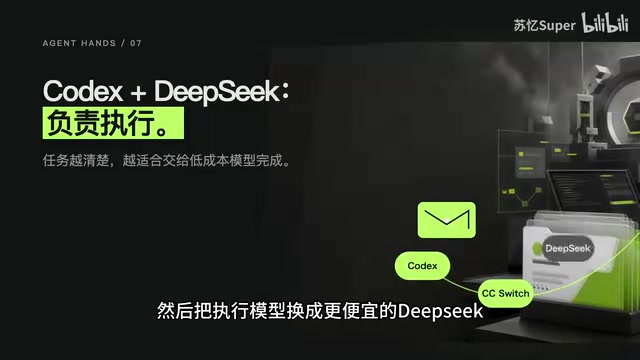
Step 2: Use Codex + DeepSeek as the Execution Layer
Execution goes to Codex, with a proxy tool like ccswitch swapping the backend model to the much cheaper DeepSeek.
How ccswitch and Model Proxy Tools Work ccswitch is representative of a class of model-routing proxy tools. The core mechanism intercepts API requests and replaces the endpoint or model identifier, redirecting calls that would have gone to an expensive model to a specified lower-cost one. These tools typically conform to the OpenAI API format (the industry de facto standard), so they integrate seamlessly with Codex, Cursor, and other mainstream AI coding tools. One important caveat: data privacy risk. Requests are forwarded through third-party servers, so projects involving sensitive code or commercial IP should evaluate compliance implications carefully.
DeepSeek Technical Background DeepSeek is a large language model series developed by Chinese AI company DeepSeek. Its V3 and R1 versions have achieved near-GPT-4-level performance on major coding benchmarks (such as HumanEval and SWE-bench), while API pricing sits at roughly 5–10% of leading premium models. DeepSeek's use of a Mixture-of-Experts (MoE) architecture and efficient training strategies gives it a strong cost advantage for inference. For execution-type tasks like code completion and function-level rewrites, its price-to-performance ratio is especially compelling — which is why Su Yi chose it as the "hands" layer.
With this setup, high-frequency operations like writing, editing, and testing code are all handled by the low-cost model. The full pipeline becomes a clean assembly line:
ChatGPT (Brain — handles thinking, task decomposition)
        ↓  dispatches tasks
Codex + DeepSeek (Hands — writes code, makes edits, runs tests)
Advanced: Adding a Multi-Agent Framework
For a more complete system, Su Yi suggests integrating an Agent framework like Hermes to enable parallel multi-agent collaboration.
How Multi-Agent Collaboration Frameworks Work A Multi-Agent System consists of multiple AI units with independent decision-making capability working together on complex tasks. In AI coding contexts, a typical division of labor looks like this: a "planning agent" breaks requirements into subtasks and assigns them to multiple "execution agents," which work in parallel on code generation, testing, documentation, and so on. A "verification agent" then consolidates results and checks for consistency. Frameworks like Hermes, AutoGen, and CrewAI provide the infrastructure for this kind of collaboration. The core advantages are efficiency gains from parallelization and shorter per-call context windows through role specialization — enabling both higher capability and controlled overall cost.
With multiple execution units handling different tasks in parallel, the overall automation level of the development system improves substantially. That said, for newcomers, this step can wait — getting the basic pipeline working is the higher priority.
Quota Strategy: Use Your Subscription First, Then Switch to API
Beyond model division of labor, Su Yi highlights another easy-to-overlook detail: the order in which you consume your quota.
His principle: always use the subscription-included quota first. Burn through the usage that refreshes every 5 hours before switching to pay-as-you-go DeepSeek API calls. This ensures you're not wasting the fixed allowance you already paid for, and only incurring extra costs when you genuinely need to.
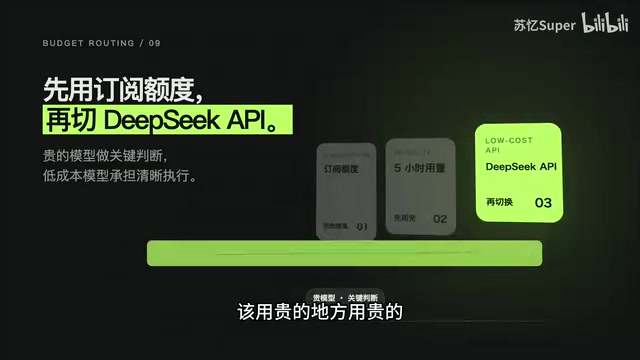
One-line summary of this strategy: spend on premium where it counts, cut hard everywhere else — don't waste a cent. The logic is simple, but the practical impact is real.
Why This Matters for Beginners
The value of this approach isn't that it's technically sophisticated — it's that it lowers the barrier to entry for newcomers.
For people just getting into Vibe Coding, the biggest obstacle usually isn't technical skill; it's the anxiety of "running up a bill before I've built anything." By combining brain-vs-hands separation, subscription-quota-first usage, and cheap-model fallback, beginners can get their first project working at minimal cost.
Su Yi's own first project was an SEO content optimization plugin — he had a resource website that wasn't performing well in search, so he used AI to automatically rewrite and optimize content. That example neatly illustrates the point he keeps coming back to: shipping a product matters more than agonizing over which tools to use.
Summary
At its core, this "heretical" token-saving approach is a straightforward and effective engineering mindset: match tasks of different value to resources of different cost, rather than letting one expensive model do everything.
For individual developers and Vibe Coding newcomers on a limited budget, instead of grinding away with a single expensive model, consider a tiered architecture — one brain orchestrating multiple agents. Spend the minimum, and get your first AI project built.
Related articles

The Truth Behind Codex 'Build a Website in 5 Minutes': AI Isn't Creating Sites—It's Helping You Copy Them
Exposing the truth behind viral Codex 5-minute website videos: creators aren't building original sites with AI—they're copying shared prompts or scraping others' work. Learn AI coding tools' real limits.

Getting Started with AI Agent Development: A Complete Guide from Concept to Practice
A comprehensive guide to AI Agent architecture and development, covering automated marketing, intelligent customer service, and investment analysis scenarios with single and multi-agent collaboration.

The Truth Behind Codex 'Build a Website in 5 Minutes': AI Isn't Creating Sites — It's Helping You Copy Them
Exposing the truth behind viral Codex 5-minute website videos: creators aren't building original sites with AI — they're copying shared prompts or scraping others' work.