Vibe Coding Practical Guide: AI Full-Stack Development for Building a One-Person Company
A practical guide to using AI-powered Vibe Coding to build products solo from development to marketing.
This guide explores Vibe Coding—a development paradigm where natural language directs AI to write code—covering the full product lifecycle from requirements analysis and UI design through multi-platform deployment and AI-automated marketing. It explains how tools like Claude Code, MCP, and Figma form a collaborative AI development architecture that enables individual developers to build and promote complete products independently.
AI Is Evolving from a Tool into a Productive Force
In the past, developing a complete software product was an incredibly heavy undertaking. You needed product managers to sort out requirements, designers to create interfaces, front-end and back-end engineers to collaborate on code, QA to ensure quality, and operations to handle marketing. Any missing link could kill a good idea before it ever saw the light of day.
But this logic is being completely rewritten. AI is no longer just an auxiliary tool—it's becoming an entirely new productive force. Many people don't lack ideas; they lack the ability to bring those ideas to life. And AI is precisely what's leveling these technical barriers.
It used to be "people adapting to code." Now it's gradually becoming "code adapting to people," as AI begins to understand natural human language. A brand-new development paradigm has emerged from this shift, and it has a name that's rapidly gaining traction—Vibe Coding.
What Is Vibe Coding: Directing AI to Write Code Using Natural Language
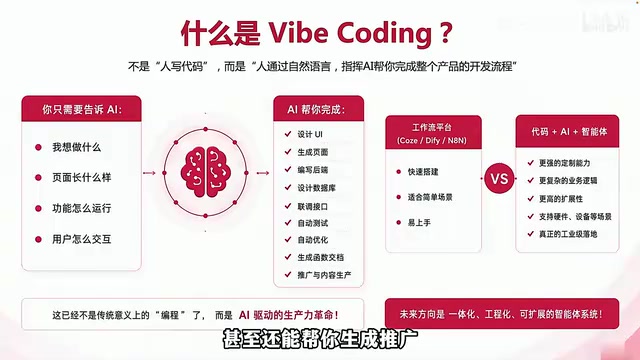
In one sentence: Instead of humans writing code, humans direct AI to write code.
The concept of Vibe Coding was first introduced by OpenAI co-founder Andrej Karpathy in February 2025. He described a completely new way of programming: developers fully immerse themselves in the "vibe," completing coding through natural language conversations with AI, barely writing any code manually. The reason this concept went viral so quickly is the rapid advancement of Large Language Model (LLM) code generation capabilities—from GPT-4 to Claude 3.5 to Gemini 2.5, these models have reached practical-level proficiency in understanding complex programming intent, generating multi-file project code, and debugging errors.
All you need to do is tell AI what you want to build, what the pages should look like, and how the features should work. AI can then generate pages, write code, connect databases, run automated tests, fix bugs, generate documentation, and even produce marketing copy and short video content.
This means the boundaries of development are extending from "code" to "content production." When one person can leverage AI to complete the entire process from product to promotion, the "one-person company" is no longer a fantasy—it's a viable path.
How Vibe Coding Differs from Traditional AI Development
Many people have misconceptions about AI development. Some think AI development is limited to workflow orchestration platforms like Coze, Dify, and n8n—connecting a few nodes and running a few processes.
Let me clarify the positioning of these tools: Coze is ByteDance's AI application building platform that allows users to orchestrate AI workflows visually. Dify is an open-source LLM application development platform offering Prompt orchestration, RAG (Retrieval-Augmented Generation) pipelines, and Agent frameworks. n8n is an open-source workflow automation tool, similar to Zapier but with self-hosting support. What these three have in common is building AI applications through "drag-and-drop nodes and connecting flows," which lowers the entry barrier. However, they fundamentally remain at the orchestration level of predefined processes and struggle to handle industrial-grade scenarios requiring complex business logic, custom data models, and high-concurrency processing.
But this is actually just a basic way of using AI. The core direction that can truly achieve industrial-grade deployment, develop complex systems, and build future AI products must be the complete system of AI + Code + Intelligent Agents + Engineering. What will truly have value in the future isn't simple chatbots, but applications like AI e-commerce, digital humans, automation systems, and AI enterprise platforms—all of which ultimately come back to engineering capabilities.
The Full-Stack Development Loop from Zero to One
The core value of Vibe Coding lies in the full-stack closed loop, not just building a simple demo. A real product requires connecting all stages: requirements analysis, UI design, page development, back-end logic, database, testing, deployment, and marketing.
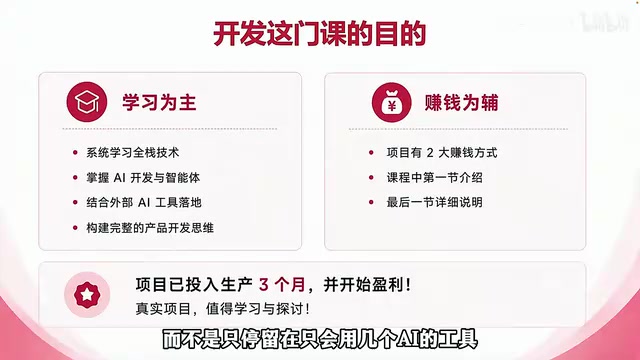
This methodology has two objectives: first, helping developers truly master AI-engineered product delivery capabilities rather than just knowing how to use a few AI tools; second, achieving commercialization—because the future will inevitably see a massive wave of AI entrepreneurs, super individuals, and one-person companies.
It's worth noting that "super individuals" and "one-person companies" aren't entirely new concepts born in the AI era—as early as 2017, Paul Jarvis systematically articulated this business model in his book Company of One. But AI has transformed this model from theory into large-scale viable practice. Before the AI era, one-person companies were typically limited to light-asset fields like consulting, content creation, and design. Now, with AI tool chains, individual developers can independently build SaaS products, e-commerce systems, and data platforms that previously required teams of dozens. The essence of this change is: AI has driven the marginal cost of software development toward zero, creating a qualitative leap in the input-output ratio for solo entrepreneurs.
From this perspective, Vibe Coding is more like a "one-person company practical methodology" for the AI era.
The Technical Architecture of AI Collaborative Development
Future software development is no longer about standalone capabilities—it's about AI collaborative development. In this system, tools like Claude Code, Stitch, MCP, Skills, and Figma form a complete collaboration network.
These tools each serve different roles: Claude Code is Anthropic's command-line AI programming tool that can directly understand the context of an entire codebase in the terminal, performing code modifications, refactoring, and debugging. MCP (Model Context Protocol) is an open standard protocol released by Anthropic in late 2024, designed to establish a unified connection method between AI models and external tools and data sources. Through MCP, AI can directly call databases, APIs, file systems, and other external resources rather than being limited to pure text conversations. Figma is the world's leading UI design collaboration tool, and through its open API and plugin ecosystem, AI can directly read design files and automatically generate corresponding front-end code. This architecture upgrades AI from a "conversational assistant" to a "system participant" that can truly embed into the complete software development workflow.
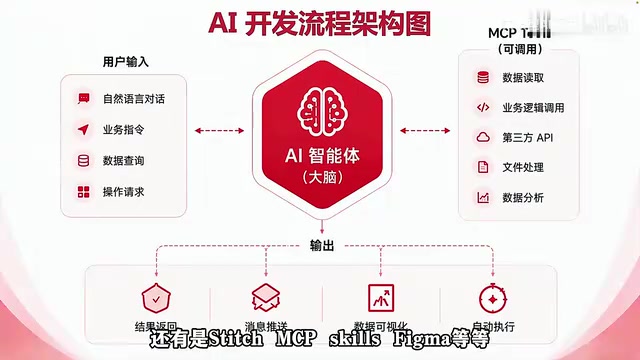
In this system, AI is no longer merely a chat partner—it genuinely participates in every stage of design, development, testing, optimization, and operations. This is precisely the direction of "AI Engineering"—embedding AI capabilities into the complete production pipeline of software.
It's important to understand that AI Engineering doesn't aim to replace traditional software engineering but rather introduces AI as a core productivity factor on top of it. Traditional software engineering emphasizes requirements management, architecture design, version control, CI/CD (Continuous Integration/Continuous Deployment), code review, and other standardized processes. AI Engineering adds new dimensions including Prompt engineering, model selection and tuning, AI output quality assessment, context management, and token cost optimization. The fusion of both means: AI can accelerate code output, but software maintainability, security, and performance optimization still require the professional judgment of human engineers.
Dramatically Lowering the Barrier to Multi-Platform Development
Multi-platform development used to be painful: one codebase for Web, another for apps, and yet another for mini-programs. Now, with uni-app combined with AI code generation and component reuse, it's entirely possible to achieve "develop once, run everywhere."
uni-app is a cross-platform development framework based on Vue.js created by DCloud. Its core philosophy is exactly "one codebase, multiple platforms," supporting compilation to iOS, Android, Web, and mini-programs for WeChat, Alipay, Baidu, ByteDance, and other platforms. Under the hood, it uses conditional compilation and platform adaptation layers to handle differences between platforms. In the AI era, uni-app's value is further amplified: since AI code generation tools only need to learn one set of syntax and component specifications to produce code covering multiple platforms, this dramatically reduces the technical cost and time investment for individual developers building multi-platform products.
This is one of the key technical prerequisites that makes the "one-person company" viable. When multi-platform adaptation costs are drastically compressed by AI, it's no longer unrealistic for a single developer to independently cover Web, app, and mini-program platforms.
AI-Automated Operations: The Complete Loop from Product to Promotion
Many people think the job is done once the product is built, but the real challenge is often promotion. And now AI has penetrated deeply into the operations domain.
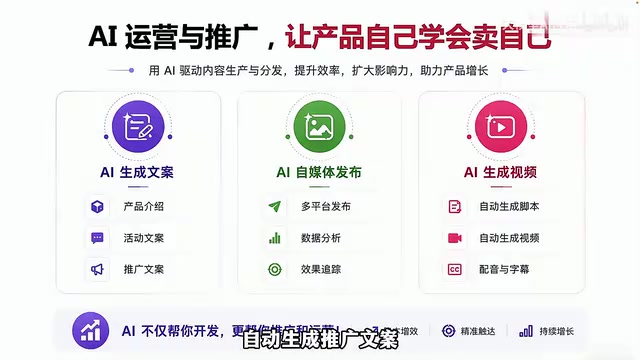
AI can automatically generate articles, promotional copy, video scripts, and even produce product promotional videos directly. In other words, AI can not only help you build products but also help products "promote themselves." This relies on the maturation of multimodal AI models—text generation models (like GPT-4o, Claude) handle copywriting and script creation, image generation models (like Midjourney, DALL·E 3) produce visual assets, and video generation models (like Sora, Kling) can directly output promotional clips. When these capabilities are chained together through APIs or workflows, content production from product launch to omnichannel promotion can be completed automatically in extremely short timeframes.
This leads to a clear trend: The truly formidable people of the future will be those with dual capabilities in both "development + AI operations." Being able to code alone or do operations alone isn't enough—only by connecting both can you form a complete product loop.
Core Capabilities Gained by Mastering Vibe Coding
Through systematic learning of Vibe Coding full-stack development, you should acquire the following key capabilities:
- Independent product development: No longer dependent on large teams—one person completes the journey from idea to launch
- Full-stack AI collaboration: Spanning every stage from requirements analysis, design, development, and testing to deployment
- AI engineering capabilities: Moving beyond workflow orchestration into true system-level development
- Multi-platform development: Develop once, run on Web, app, and mini-programs
- AI-automated operations: Auto-generated content creation and promotion
The most fundamental takeaway is possessing the complete ability to "build a product solo."
Final Thoughts: Opportunities and Challenges in the Vibe Coding Era
From an industry trend perspective, AI will certainly eliminate a massive amount of repetitive labor, but it will simultaneously give rise to vast numbers of super individuals, one-person companies, and AI entrepreneurs. When code generation, multi-platform adaptation, and content operations can all be connected by AI, the leverage available to individual developers has been amplified to an unprecedented degree.
Of course, a rational perspective is needed—Vibe Coding lowers the "hands-on barrier," but actually raises the bar for "engineering thinking" and "product judgment." AI can help you rapidly produce code, but building a sustainable, maintainable complex system still requires human oversight of architecture and logic. The "engineering thinking" mentioned here includes but isn't limited to: system architecture design capabilities (how to split microservices, how to design data models), technology selection judgment (when to use relational databases vs. NoSQL), and the ability to anticipate performance bottlenecks and security vulnerabilities. AI-generated code is already quite reliable in terms of functional correctness, but still requires careful human oversight in areas like edge case handling, concurrency safety, and permission control. In other words, the core competitive advantage in the Vibe Coding era isn't "being able to write code" but "knowing what code should be written" and "knowing whether the code AI wrote is good enough."
Regardless, the era of AI development has arrived. Opportunity always belongs to those who prepare in advance.
Related articles

Transitioning to AI Agent Development: A Complete Three-Stage Learning Path for Programmers
Why do programmers keep failing at AI Agent development? This guide breaks down a 3-stage learning path: ReAct & Tool Calling fundamentals, LangChain engineering, and production-grade project delivery.

Getting Started with Agent Skills: A Complete Guide from Prompts to Intelligent Skills
Deep dive into AI Agent Skills' four components (skill.md, references, scripts, assets), explaining how Skills differ from prompts and how to build reusable intelligent skill systems.

Codex Beginner's Guide: Installation, Configuration & Connecting Chinese LLM APIs
Complete guide to installing OpenAI Codex, how it differs from Claude Code, and how to connect Chinese LLMs like DeepSeek via API keys with full setup steps and limitations.