Vibe Coding Practical Guide: From Zero to AI Programming Mastery

Vibe Coding lets beginners direct AI to build web projects via natural language.
Based on a Bilibili creator's tutorial, this article systematically introduces Vibe Coding, a new development paradigm. Development is shifting from "builder mode" to "owner mode," where developers define goals in natural language and AI handles implementation. Agents now offer L3-level automation with multi-step execution and closed-loop feedback. Codex is recommended for its domestic user friendliness and DeepSeek adaptation. The article also highlights prompt templates (SQL skills) and provides a complete learning path from environment setup to project practice, ideal for zero-basis learners.
Vibe Coding Practical Guide: From Zero to AI Programming Mastery
In today's rapidly evolving AI landscape, the barrier to programming is being redefined. A product manager with zero coding experience built a launch-ready knowledge base system to rival Feishu in just three days by conversing with AI in natural language. This is no fantasy — it's the real transformation brought by Vibe Coding. Based on a step-by-step tutorial from a Bilibili creator, this article breaks down the core philosophy, tool selection, and practical roadmap of Vibe Coding, guiding you from scratch to master this new development paradigm.
From Builder to Owner: A Fundamental Shift in Development Paradigm
Traditional programming, dubbed "old-school coding," requires developers to learn complex syntax rules, algorithmic logic, and low-level principles, while coordinating across frontend, backend, database, and DevOps roles — handwriting every line of code from scratch. This "builder mode" demands multi-role collaboration, long project cycles, and extremely high individual capability.
Vibe Coding introduces the "owner mode." Developers simply define goals, describe requirements, and set boundaries in natural language, while AI handles technical implementation, code writing, and framework scaffolding. Developers become evaluators and feedback providers, reviewing AI output and continuously adjusting instructions based on results. The creator uses a vivid analogy: it's like renovating a house — you have the designer produce blueprints, approve them, then construction proceeds according to plan, and upon completion you inspect the work, rejecting anything unsatisfactory until it meets your standards.
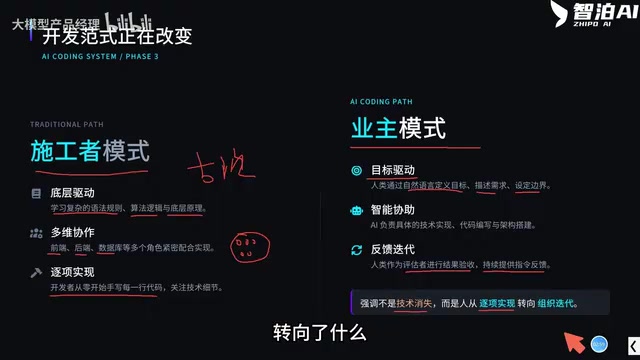
In this mode, technology doesn't disappear — it shifts from "item-by-item implementation" to "organizational iteration." Developers no longer need to hand-write every line of code, but they must be able to organize AI, define problems, and validate results. This marks AI's leap from a conversational tool to an intelligent agent.
Agent: From Conversational Tool to Task Executor
Early AI like ChatGPT primarily served as a Q&A assistant — answering questions, generating scattered text, and aiding thinking, remaining at the level of information provision and suggestions. Today's Agent deeply participates in work as an executor driving tasks to closed-loop completion. Agentic coding tools like Codex, Claude Code, and Cursor can understand complex goals, perform multi-step execution (e.g., build the frontend page first, then write backend APIs), and continuously adjust through feedback loops to deliver complete, usable tasks.
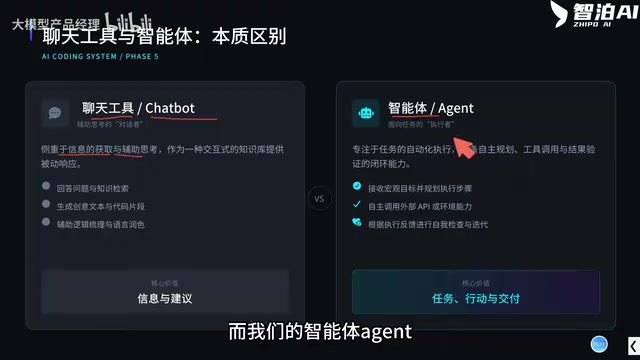
The creator summarizes the essential difference between chat tools and agents: Chatbots focus on information retrieval and assisted thinking, while Agents focus on automated task execution with autonomous planning, tool invocation, and result validation in a closed loop. Using autonomous driving as an analogy, current AI programming has reached L3 — hands off the wheel, it can genuinely do the work for you — even though L3 in the automotive industry itself isn't fully widespread.
Multi-step execution and feedback loops are the core features of Agent. Unlike traditional chat models' "one question, one answer," an Agent decomposes a complex goal into sub-tasks, calls tools (code editor, terminal, browser) in sequence to complete each step, and decides the next action based on intermediate results. For example, to develop a login feature, the Agent first creates the frontend form, then writes the backend validation API, and finally runs tests and fixes errors. This "plan—execute—validate—adjust" cycle enables the Agent to advance projects independently without step-by-step human guidance.
Who Is This Course For? What Prerequisites Are Needed?
This tutorial is designed for zero-basis learners with no programming experience required. The basic terminology covered is straightforward and won't be obscure. It's suitable for: zero-basis programming learners, product managers and designers, workplace skill explorers, and independent developers who want to build web sites, mini-programs, or apps on their own.
Learning conditions are accessible: ability to operate a computer and install software; basic English literacy (at least knowing ABCs, with online translation tools as backup); logical thinking and requirements expression ability; a computer (phone operation is difficult). The creator emphasizes that while English isn't mandatory, learning some is recommended — it helps with understanding technical documentation and error messages.
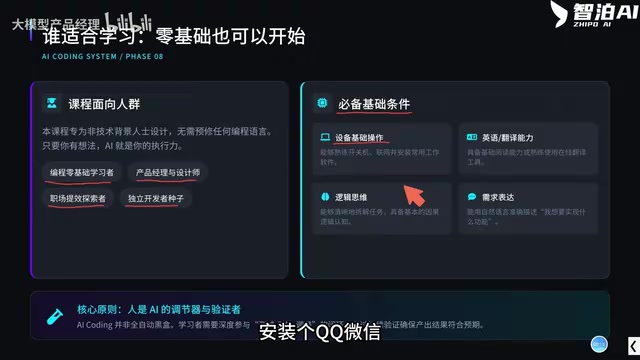
After completing the course, you'll gain: deeper understanding of Vibe Coding and Agent application capabilities, understanding how AI moves from conversation to task delivery; ability to select models based on task complexity and cost (chat models for simple tasks, reasoning models for complex ones); and independent completion of a zero-to-one web project loop.
Core Tools and Model Selection: Why Codex Is the Top Choice
For tool selection, the creator recommends Codex as the core development tool rather than Claude Code. The reason: Claude Code's parent company Anthropic is extremely unfriendly to domestic users, while Codex is very friendly. More importantly, the DeepSeekAd model has official Codex adaptation, allowing domestic developers to easily use domestic models without complex configuration.
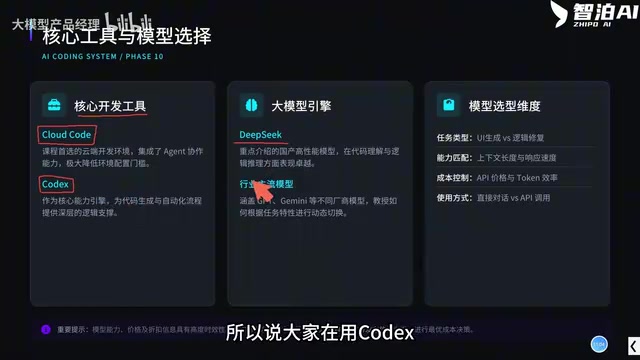
For model selection, Codex as a tool can connect to multiple models including DeepSeek, GPT, Gemini, Claude, etc. Based on task complexity and cost, use chat models for simple tasks and reasoning models for complex ones. This flexibility lets developers balance efficiency and cost.
The difference between chat models and reasoning models lies in task processing approach. Chat models (like GPT-3.5, DeepSeek-V2) excel at quickly generating natural language and simple code snippets with fast response and low cost — suitable for requirement clarification, copywriting, and other lightweight tasks. Reasoning models (like GPT-4, DeepSeek-R1) possess stronger logical reasoning and multi-step planning capabilities, handling complex algorithms and architecture design, but with slower response and higher cost. In Vibe Coding, developers can flexibly switch models based on task complexity to balance efficiency and cost.
Prompt Engineering: Standing on the Shoulders of Giants
Beginners often describe requirements vaguely, lacking structure and ignoring boundaries and technical constraints. The creator's solution is "SQL skills" — here SQL doesn't mean database query language, but rather instruction templates with contextual structure packaged by senior developers (possibly referring to "Skill" or "Prompt"). These templates encapsulate mature experience into reusable collaboration patterns that beginners can directly apply without thinking from scratch. The creator emphasizes that SQL doesn't replace your thinking — it packages mature experience into reusable collaboration patterns for quick onboarding.
Contextual structure refers to key information explicitly provided in prompts, including role setting (e.g., "You are a senior frontend engineer"), task goals, input/output formats, technical constraints (e.g., "Use React and TypeScript"), and examples. Structured prompts significantly reduce AI misunderstanding probability and improve output quality. The "SQL skills" the creator mentions are exactly these elements packaged into reusable templates — beginners just fill in variables to get stable results, avoiding writing prompts from scratch each time.
Course Structure: A Closed Loop from Theory to Practice
The course design follows a closed loop: "theoretical understanding → tool mastery → experience encapsulation → project practice." Specifically: environment preparation (getting familiar with the PowerShell command-line terminal), core concept understanding (mainstream AI programming tools and models, Token, context, etc.), tool mastery (how to use Codex), SQL construction (writing and reusing prompt templates), and finally project practice — from requirement definition to deployment, independently completing a fully functional web project.
The creator concludes: master Vibe Coding and you too can easily build the products you want. We don't need to become traditional programmers — we need to learn to articulate goals clearly, break down problems, and validate results. Let AI be your development partner and embark on your creative journey.
Token and context window are foundational concepts for understanding AI programming costs and limits. Token is the smallest unit of text a model processes; one Chinese character corresponds to roughly 1-2 tokens. Context window refers to the maximum number of tokens a model can process in a single pass, including input and output. The larger the window, the more code and documents the model can reference — but the higher the cost. In Vibe Coding, reasonably controlling context (e.g., providing only relevant code snippets) effectively reduces costs and improves response speed.
Related articles

Anthropic's IPO Crisis: Why $16.8B in Revenue Can't Buy a High Valuation
Anthropic posted $16.8B in Q3 revenue with 85% gross margin yet faces a cut to its IPO valuation. A deep dive into halved growth, the token price war, circular financing, and the clash between safety ideals and capital reality.

Anthropic Races Toward the Largest IPO in History: Can a $100 Billion Raise Ignite the AI Investment Boom?
Anthropic may file its prospectus as early as October 23, aiming to raise up to $100 billion at a valuation of up to $2 trillion, potentially the largest IPO ever. Q3 revenue hit $16.8 billion, up nearly 50% quarter over quarter, with adjusted profitability, but slowing growth has led some investors to cut valuation to $1.5 trillion. The IPO is a key test of whether the AI investment boom can continue.

Bessemer Partner on Anthropic IPO: The Public's First Direct Investment in AI Software
Bessemer partner Byron Theta on the Anthropic IPO: why it's called the moment everyone's been waiting for, the $650M four-round investment, the LP liquidity bind, and expectations of a 2027 IPO wave—plus open-source model pricing pressure, existential risk disclosures, and what the founders' 50.1% voting structure means for ordinary investors.