Vibe-Trading: Making AI Trading Agents Traceable, Reproducible, and Governable
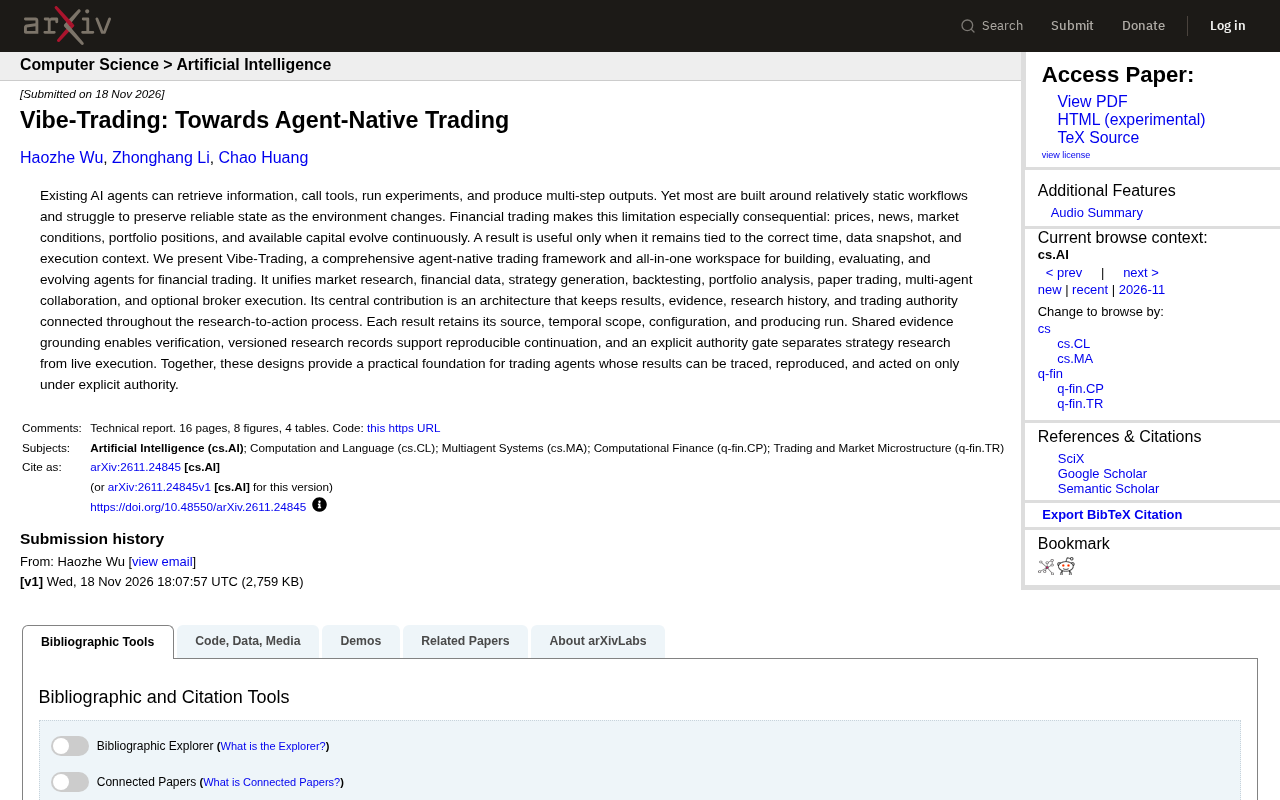
Vibe-Trading proposes an agent-native trading framework that solves state reliability in dynamic environments through traceable, reproducible, and authorizable design.
Vibe-Trading is an agent-native framework for financial trading that addresses the difficulty AI agents face in maintaining reliable state in dynamic environments. It argues that trading results are only valid when bound to the correct time, data snapshot, and execution context. The framework integrates market research, financial data, strategy generation, backtesting, portfolio analysis, paper trading, multi-agent collaboration, and optional broker execution into one workspace, achieving coherence through three design choices: every result retains its source, time range, configuration, and run record; a shared evidence base and versioned research records support validation and reproducible research; and explicit permission gates separate strategy research from live execution. These designs give trading agent outputs traceability, reproducibility, and authorizability—offering a reference paradigm for AI trading moving from demos to production.
Existing AI agents can already retrieve information, call tools, run experiments, and produce multi-step outputs, but most are built around relatively static workflows and struggle to maintain reliable state when the environment keeps changing. Financial trading amplifies this limitation: prices, news, market conditions, portfolio positions, and available capital are all constantly evolving, and a result is only meaningful when it is bound to the correct time, data snapshot, and execution context. Vibe-Trading is an agent-native trading framework proposed to address exactly this problem—it integrates market research, financial data, strategy generation, backtesting, portfolio analysis, paper trading, multi-agent collaboration, and optional broker execution into a single workspace.
Why Trading Scenarios Need Agents with "Reliable State"
The core tension traditional agents face in trading scenarios is that the validity of a result is highly context-dependent. The same strategy may backtest well at one point in time, but if the data snapshot, configuration parameters, or execution timing change, the conclusion may be entirely different. The original article notes that trading results are only useful when bound to the correct time, data snapshot, and execution context. This means an agent cannot simply output an isolated number or recommendation—it must carry a complete evidence chain showing where the conclusion came from, what data it was based on, and under what configuration it was produced. This is the fundamental problem Vibe-Trading attempts to solve.
Data Snapshot refers to a complete, consistent record of market data (such as prices, volume, news, and financial metrics) captured at a specific moment in time. In trading research and backtesting, data snapshots are critical because market data is continuously updated; if data pulled at different times is mixed together, it can lead to look-ahead bias or irreproducible results. Vibe-Trading's emphasis on binding results to the correct data snapshot is precisely to ensure that any strategy conclusion can be traced back to the exact data state used at the time, thereby supporting auditing and reproduction.
Core Architecture: Connecting Results, Evidence, Research, and Permissions
Vibe-Trading's central contribution is an architecture that spans the entire "research to action" process, keeping results, evidence, research history, and trading permissions consistently connected. This is reflected in three design choices:
Every result retains its source, time range, configuration, and the run record that produced it. This turns results from black-box outputs into objects that can be interrogated and audited.
A shared evidence base supports validation, and versioned research records support reproducible continuation. The research process is recorded and versioned like a code repository, so others can continue along the same evidence chain rather than starting from scratch.
Explicit permission gates separate strategy research from live execution. There is a clear authorization checkpoint between strategy generation and backtesting in the research phase and execution with real capital—only after explicit authorization can results be used for actual trading. This design directly addresses the most sensitive trust and control issues when deploying AI trading in practice.
Versioned Research Record draws on the concept of version control from software engineering, recording every configuration change, data version, backtest parameter, and result in the strategy research process like code commits. This way, researchers can trace back through historical versions, reproduce past experiments, or continue building on a specific version without worrying about environment drift causing inconsistent results. In financial trading, this mechanism helps meet compliance audit requirements and supports knowledge transfer in team collaboration.
Permission Gate is an explicit authorization checkpoint in the system used to control the permissions of an agent or user transitioning from the research phase (such as strategy generation and backtesting) to live execution (real-capital trading). In AI trading scenarios, permission gates ensure that any automatically generated strategy or recommendation can only trigger real trading orders after explicit human or rule-based authorization. This reduces the risk of capital loss due to model errors or unexpected behavior, and is a key design for achieving the core property of "authorizable."
An Integrated Workspace Covering the Full Trading Lifecycle
Vibe-Trading consolidates steps that are typically scattered across multiple tools into a single platform: market research and financial data acquisition, strategy generation, backtesting, portfolio analysis, paper trading, multi-agent collaboration, and optional broker execution.
The value of this integration lies in reducing information loss caused by context switching. In traditional workflows, a researcher might pull data on a data platform, backtest in a scripting environment, and perform portfolio analysis in yet another tool—with configuration and data versions potentially disconnected at each step. Through a shared evidence base and versioned records, Vibe-Trading enables every step in the chain to be traced back to the same evidence source, thereby supporting reproducible, continuous research.
Implications for Deploying AI Trading in Practice
What financial trading fundamentally demands from AI agents is not "smarter recommendations" but traceable, reproducible, and authorizable results. The architecture proposed by Vibe-Trading treats these three properties as first-class citizens: traceability comes from binding results to their source, time range, and configuration; reproducibility comes from versioned research records and a shared evidence base; authorizability comes from explicit permission gates between research and execution.
For teams building trading agents, this design provides a pragmatic foundation: strategy research can iterate quickly, but only touches real execution when the evidence chain is complete and authorization is explicit. This may also serve as a reference paradigm for agent-native applications moving from demos to production—giving every conclusion an agent reaches its own "birth certificate."
The original title is Vibe-Trading: Towards Agent-Native Trading; more details can be found in the original paper.
One-line Summary
Vibe-Trading proposes an agent-native trading framework that addresses state reliability in dynamic environments through traceable, reproducible, and authorizable design.
Paragraph Summary
Vibe-Trading is an agent-native framework for financial trading, designed to address the difficulty existing AI agents face in maintaining reliable state in dynamic environments. The article notes that the validity of trading results is highly context-dependent and must be bound to the correct time, data snapshot, and execution context. The framework integrates market research, financial data, strategy generation, backtesting, portfolio analysis, paper trading, multi-agent collaboration, and optional broker execution into a single workspace, achieving coherence through three design choices: every result retains its source, time range, configuration, and run record; a shared evidence base and versioned research records support validation and reproducible, continuous research; and explicit permission gates separate strategy research from live execution. These designs give trading agent outputs three key properties—traceability, reproducibility, and authorizability—offering a reference paradigm for AI trading moving from demos to production.
Related articles
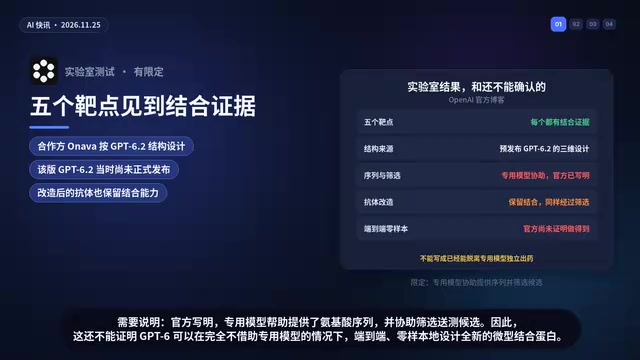
GPT-6 Designs Proteins, Claude Creations Become Apps with One Click, DeepMind Releases New Benchmark
OpenAI says GPT-6 can design protein 3D structures, Anthropic lets Claude creations install as desktop apps, DeepMind's HIP benchmark tests stability on simple questions, Google Workspace opens agent MCP interfaces.
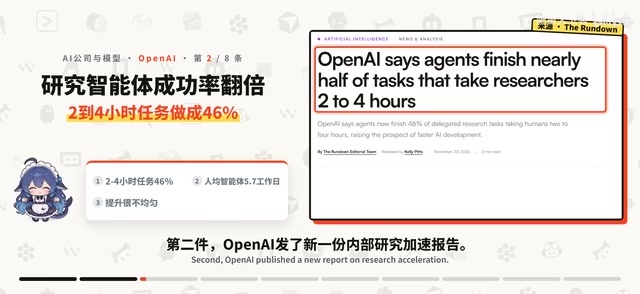
OpenAI Weekly Roundup: GPT-6.2 Rolls Out to ChatGPT, GPT-6 Designs Proteins
OpenAI's week: GPT-6.2 rolls out to ChatGPT, GPT-6 claims independent protein design, agent research share surges, perplexity proposed as a shared metric, and internal safety concerns surface.

Is the Crypto Industry About to "Turn Blue"? The Truth Behind Tech and Politics' Shifting Allegiances
Vergecast discusses whether the crypto industry will shift from the right to the Democrats, revealing the pragmatic nature of tech's politics and the costs of a crypto pivot.