VibeCodeArena Leaderboard Revealed: Why Humans + AI Can Beat the Strongest Models

VibeCodeArena leaderboard reveals: a high eval score doesn't equal Elo ranking, and human-AI collaboration can outperform top models.
Based on HackerEarth's VibeCodeArena data, the article notes that Eval score and Elo ranking are not synchronized in LLM coding arenas, and Elo comes from pairwise battles closer to human preference. Top human users, through human-AI collaboration, achieve about 99.5 eval score and 1641-1642 Elo, outperforming the strongest models. It also stresses that confidence and trend matter more than rank, the top model has Low confidence, and high-scoring apps may still hide many correctness issues.
Title
VibeCodeArena Leaderboard Revealed: Why Humans + AI Can Beat the Strongest Models
Meta Description
VibeCodeArena leaderboard reveals several counterintuitive AI coding facts: a high eval score doesn't equal a top ranking, Elo comes from pairwise battles; top human users, through human-AI collaboration, surpass the strongest models in both eval score and Elo; reading the leaderboard requires attention to confidence and trend, and fast doesn't equal correct.
Article Content
VibeCodeArena is an LLM coding arena built by HackerEarth, where models and human users solve the same coding challenges on the same stage and share a single leaderboard. A consultant working on the platform, while fixing AI-generated apps, drew several counterintuitive conclusions from the leaderboard data: a high eval score doesn't equal a top ranking, and "human-AI combinations" formed by human users can even outperform top-tier models.
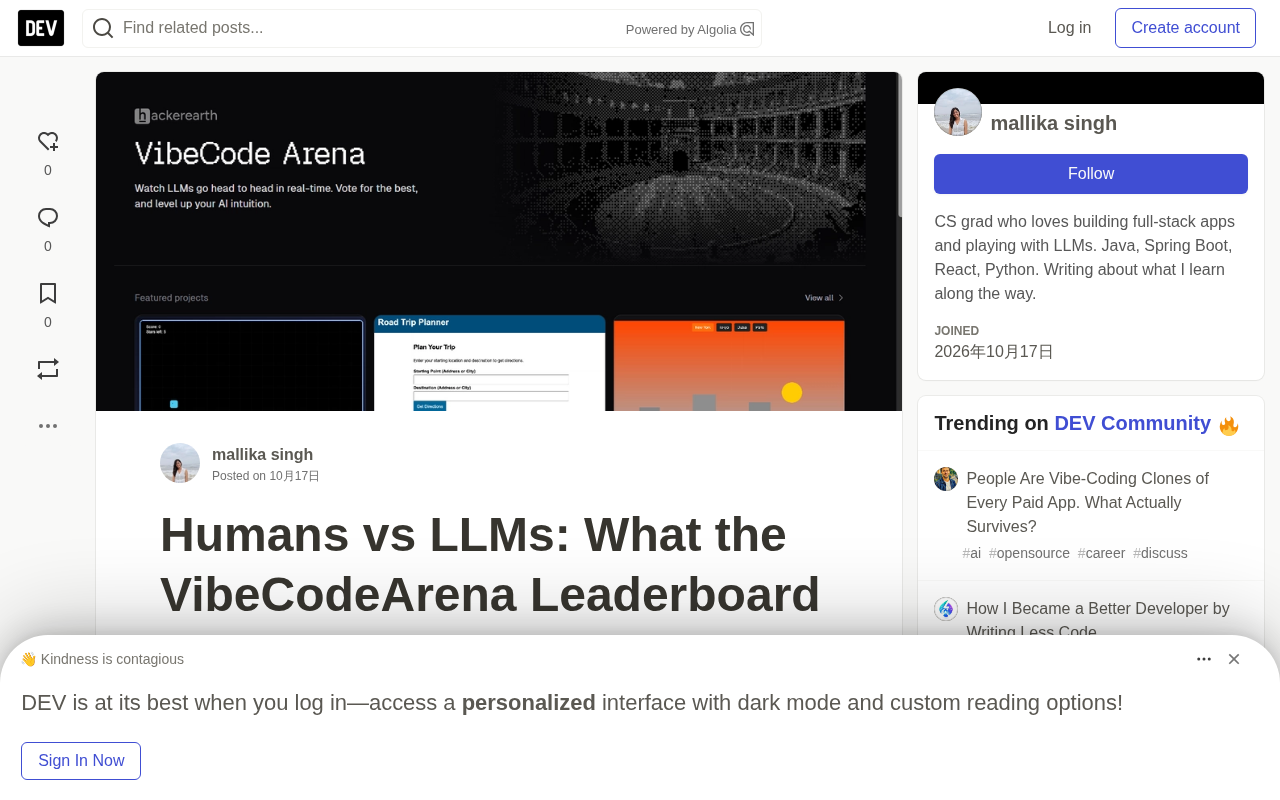
What Is VibeCodeArena
Each challenge starts from an app that an AI has already built. You click Challenge, enter the sandbox, select an LLM, and then improve the app through prompts or by directly editing the code. After submission, your version is uniformly evaluated and enters voting.
Because all submissions go through the same evaluation process, models and users ultimately end up compared on the same leaderboard. The leaderboard has three tabs: All, Models, and Users. Each entry contains five data points:
- Eval score: the score from evaluation, covering security, code quality, correctness, performance, and accessibility
- Elo rating: a win-loss score similar to chess—win and it rises, lose and it falls
- Win % vs avg: how often it beats the average level
- Confidence: Low / Medium / High, depending on how much battle data is behind it
- Trend: whether the trajectory is rising or falling
The snapshot the consultant observed contained 46 models and 100 users. It is precisely these columns that are the source of all the counterintuitive findings that follow.
Elo rating originates from the chess rating system, originally designed by physicist Arpad Elo to dynamically adjust player scores based on match wins and losses. Its core logic is: if a high-rated player beats a low-rated player, the score gain is small; conversely, an upset win causes a larger score change. In LLM arenas, Elo is usually updated through anonymous pairwise battles between models, with humans (or judge models) voting for the better response, so it reflects relative preference rather than absolute capability.
Win % vs avg indicates how often the model or user defeats an "average-level" opponent across all battles, and can be understood as a win-rate metric. Unlike Elo, it is not weighted by opponent strength—more intuitive but less informative. Combining the two gives a more comprehensive assessment: high Elo but low win rate may mean it has only beaten strong opponents; low Elo but high win rate may mean good stability but a lack of high-end validation.
High Eval Score ≠ Ranked First
The most surprising thing to the author was that Eval score and final ranking are not synchronized. On the leaderboard, Claude 3.5 Sonnet has an eval score of only 87.5 but ranks 3rd; Claude Opus 5 has an eval score as high as 94.0 but can only rank 4th. A Llama-4-Maverick entry gets 91.3 points but drops to 9th place.
The top-ranked DeepSeekAd-v4-Flash has an eval score of 95.3 and Elo of 1639, but its Confidence is marked as Low.
The reason is that Elo comes from the results of pairwise battles and is closer to humans' real preferences when comparing two apps side by side. A model can perform excellently on metrics yet lose in a head-to-head matchup—because the app "feels wrong" or doesn't truly understand what the prompt asks for.
The author saw the same phenomenon in specific challenges: on the Metrics tab, an app had an overall score of 94% yet still had 36 major correctness issues. Numbers are useful, but you have to look one level deeper.
Eval score is usually generated by an automated evaluation pipeline, covering dimensions such as security, code quality, correctness, performance, and accessibility. Each dimension is scored by rules or static analysis and then weighted and aggregated. This kind of evaluation is good at catching hard violations (such as security vulnerabilities or syntax errors) but struggles to quantify "whether the app truly understands user intent" or "whether the interaction experience is natural." Therefore, a high Eval score only means good performance on preset checks; it does not mean it is more favored in side-by-side human comparison—which is exactly what Elo measures.
Confidence reflects the amount of battle data behind the score. Low means few samples and large ranking volatility; High means validated by a large number of matches and more stable results. Platforms usually set thresholds: below a certain number of matches is marked Low, medium is marked Medium, and above the threshold is marked High. If you ignore confidence when reading the leaderboard, you may be misled by an accidental high score.
Why Human Users Can Outperform the Strongest Models
This is the author's favorite finding. On the Users tab, top users have eval scores around 99.5 and Elo between 1641 and 1642. Compared with the strongest model DeepSeek-v4-Flash (95.3 eval score, 1639 Elo), human users are not only not inferior—on the combined All leaderboard they are even right next to and in some cases above the best models.
The key difference is: users' submissions are not "humans taking on AI alone," but "humans working with AI." Users start from the version the model built, read the metrics, find what's broken, and then steer the model in the right direction. This combination beats the model working alone.
This confirms the author's real-world experience: LLMs write code extremely fast, but someone always has to find problems, explain them clearly, and verify whether the fix actually works.
Human-AI teaming refers to human users starting from a model-generated initial app and iterating through reading evaluation metrics, locating defects, modifying prompts, or directly editing code. This approach combines the model's generation speed with human judgment: the model quickly produces runnable code, while humans are responsible for verifying correctness, understanding requirement boundaries, and spotting rules the model missed. User entries on the leaderboard are essentially the collaborative output of "human + selected model," which is why they can exceed the model working alone.
This collaboration pattern is called the "AI-assisted development loop" in software engineering: generate → evaluate → fix → verify. The key is that humans cannot blindly trust model output; they need to establish a feedback loop, translate the problems pointed out by the evaluator into specific modification instructions, and re-verify the fix.
Don't Just Look at Ranking: Confidence and Trend Matter Too
Many entries on the leaderboard are Low confidence, including the top-ranked model. This means there is not yet enough data behind the score, and the ranking may fluctuate significantly. Conversely, some lower-ranked models have High confidence because they have more battles.
So the right way to read the leaderboard is to look at three things: ranking, confidence, and trend. A model with High confidence and an upward trend is more informative than a model sitting at the top with Low confidence.
Fast Doesn't Equal Correct
The author used DeepSeek V4 Flash heavily in the sandbox, and its responses were indeed fast. But a fast response is only valuable when the fix is in the right direction. A model that answers in seconds but fixes the wrong place wastes more time than a slower model that gets it right the first time.
This also explains why the leaderboard mixes so many dimensions together: fast, correct, clean code, and truly matching the prompt are four different capabilities.
How the Leaderboard Changed the Author's Prompting Habits
Based on these observations, the author adjusted his way of working:
- Read Metrics before writing prompts—major issues indicate where to start
- Prioritize correctness over appearance—an app that looks beautiful but violates prompt rules will still lose
- Reread the original prompt—small rules like "don't charge when the balance is insufficient" are exactly what models tend to miss and evaluators will definitely catch
- No longer trust "fixed" blindly—go back to Preview and re-verify every time
- Treat the model as a fast-handed teammate, not an oracle—give clear instructions and then review its output
What This Means for Developers
Before this, the author basically regarded LLM leaderboards as marketing material. After actually working on the platform and staring at the numbers for a few days, that view changed. The most interesting thing on the leaderboard is not who ranks first, but that the best results come from collaboration between humans and models.
For students and junior developers, this is a fairly positive signal: AI has not devalued your skills; instead, it has made abilities like debugging, reading requirements, and explaining problems clearly more valuable.
Incidentally, when reading this kind of leaderboard, the signals provided by confidence and trend are often more honest than that shiny rank.
One-line Summary
VibeCodeArena leaderboard reveals: a high eval score doesn't equal Elo ranking, and human-AI collaboration can outperform top models.
Paragraph Summary
Based on data from HackerEarth's VibeCodeArena platform, the article points out that in LLM coding arenas, Eval score and Elo ranking are not synchronized, and Elo comes from pairwise battles and is closer to human preference. Top human users, through the "human-AI collaboration" model—starting from model output, reading metrics to locate problems, and verifying fixes—achieve about 99.5 eval score and 1641-1642 Elo, outperforming the strongest models. The author also emphasizes that confidence and trend are more critical than rank: the top-ranked model has Low confidence, and high-eval-score apps may still hide many correctness issues. Finally, the article gives practical advice for adjusting prompting habits and argues that AI makes abilities such as debugging and reading requirements more valuable.
Related articles

Workbuddy for Absolute Beginners: How a Desktop AI Agent Fits Into Real Workflows
A beginner's guide to the Workbuddy desktop AI agent: installation, claiming credits, file management, and building automated workflows—compared with CodeX for fit and cost, helping professionals shift from AI question-askers to AI managers.

OpenAI's New Agent Stack: Computer Use, Decisions API, and Ultra-Fast Workflows
OpenAI Dev Day unveiled a new agent stack: Computer Use outperforms humans, Decisions API delivers ultra-low-latency classification via Luna, Agents API opens the same Computer Use capabilities, and GPT-6.1 Sol costs only one-seventh of Astra. Core updates, benchmark data, and developer insights.

Liang Wenfeng Open-Sources DeepInfo Inference Framework, Takes On U.S. Ban
DeepSeek open-sources its DeepInfo inference framework after its models, featuring GPU/CPU cross-pipelining, small-model prediction with large-model verification, and full Huawei Ascend and NVIDIA chip support—facing the U.S. federal ban head-on. This article analyzes its significance for AI deployment and open-source strategy.