VibeCoding for WeChat Mini Programs: Two Zero-Code Launch Routes Fully Explained

Two VibeCoding routes for launching a WeChat Mini Program with zero coding experience — fully explained.
Using VibeCoding, anyone without a programming background can build and launch a WeChat Mini Program. The self-hosted route gives you full code ownership through a 6-step process (planning, tech stack, development, debugging, filing, and publishing) using AI tools like Cursor — flexible but with a steeper learning curve. The managed route lets platform multi-agents handle everything in 4 steps, trading control for speed. Both routes share one critical constraint: accepting payments requires ICP filing, WeChat Mini Program filing, and a registered business entity. The real choice is between deep control and fast execution.
Want to build and launch a WeChat Mini Program without writing a single line of code? Is that actually possible today? The answer is yes. Bilibili creator 极客林学长 (Geek Lin) shared two complete routes for taking a Mini Program from zero to launch using VibeCoding (vibe coding). Each route targets a different type of user and set of needs — understanding the difference can save you a lot of time and frustration.
Two Routes: Self-Hosted vs. Managed
Lin maps out VibeCoding-based Mini Program development as a fork in the road. The traditional path requires writing code — that's the programmer's lane, not for everyone. AI-assisted VibeCoding, however, opens up two different approaches.
The left branch is called the self-hosted route, where you keep control of the code yourself. The right branch is the managed route, where the platform handles everything for you. The former offers flexibility but means you carry the heavy lifting; the latter is faster but puts the underlying control in the platform's hands. Understanding this fundamental difference is the foundation for every decision that follows.

One Non-Negotiable Prerequisite: Payment Eligibility
Before diving into the workflows, there's a critical constraint to address upfront. No matter which route you take, if you want an officially registered Mini Program under your own name that can accept payments, ICP filing is unavoidable — and individual accounts cannot integrate WeChat Pay. To accept payments, you must register as an individual business (个体工商户) or a corporate entity. This directly affects your pre-launch planning, so think it through before you start building.
VibeCoding is an AI-assisted development paradigm that emerged in recent years. The core idea is to describe your requirements in natural language, have AI generate and iterate on the code, and ship a product through "conversation" rather than line-by-line coding. The concept was introduced by OpenAI co-founder Andrej Karpathy in early 2025 and quickly gained traction among non-technical founders and product builders. It lowers the barrier to development, but it doesn't eliminate it entirely — understanding basic project structure, debugging directions, and platform rules is still a prerequisite for actually shipping something.
Self-Hosted Route: Six Steps, Maximum Control
The self-hosted route has six steps and is best suited for developers who want deep customization and plan to operate their product long-term.
Step 1: Plan your product. Trim features down to the minimum viable set, and decide upfront whether you need payment functionality — this determines what type of entity you'll need to register.
Step 2: Choose your tech stack. UniApp, Taro, or the native WeChat framework? Lin's recommendation for non-developers is to start with UniApp — it has a relatively friendlier learning curve.
Step 3: Build. This is the main battlefield. You can use AI coding tools like Cursor, Codex, or Trae — whatever feels most natural to you.
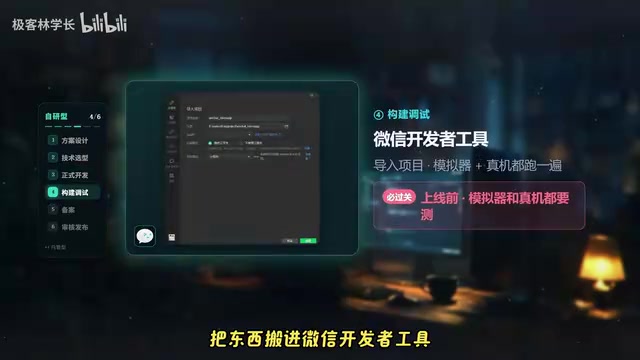
Step 4: Build and debug. Move the project into WeChat DevTools and run it on both the simulator and a real device to confirm compatibility.
Step 5: File for registration. Mini Program filing and ICP filing are hard requirements before launch — there's no skipping this step.
Step 6: Submit for review and publish. Submit the code to WeChat for review, then click publish once approved. Only then is your Mini Program officially live.
The biggest advantage of this route is flexibility — you can change anything you want, and both the code and data are entirely yours. The trade-off is that tech stack decisions, debugging, and filing all fall on you, which carries a real learning cost for non-technical users.
UniApp is a cross-platform development framework by DCloud that lets developers write one codebase and compile it to WeChat Mini Programs, Alipay Mini Programs, H5 web pages, iOS/Android apps, and more. Taro is a similar open-source framework from JD.com with a mature ecosystem and community. By contrast, the native WeChat framework (WXML + WXSS + JS) only runs within the WeChat ecosystem but offers the most direct integration with WeChat-native features like payments and subscription messages. For solo developers targeting WeChat Mini Programs without a team, UniApp offers the best overall value — and AI coding tools like Cursor and Trae have solid code generation support for it.
Managed Route: Four Steps, Fast Launch — But on the Platform's Terms
The managed route compresses the process into four steps, with AI multi-agent systems handling the technical work on your behalf.
Step 1: Describe your idea in plain language — just say what you want in everyday terms.
Step 2: The platform's multi-agent system generates everything — frontend, backend, and database all produced in one go.
Step 3: Preview and iterate — if you're not satisfied, keep the conversation going until the AI gets it right.
Step 4: Publish. This is where the most important distinction in the entire route lies — read carefully.
Two Publishing Modes That Define What You Can Do
The first mode is publishing directly inside the platform's own Mini Program (e.g., within Miaoda's official Mini Program). You don't need to register, verify, or file anything — once it's done, you can share it right away. The trade-off: the app lives under the platform's name, not yours. It's not an independent Mini Program, it can't use WeChat Pay, and it can't be shared to Moments.
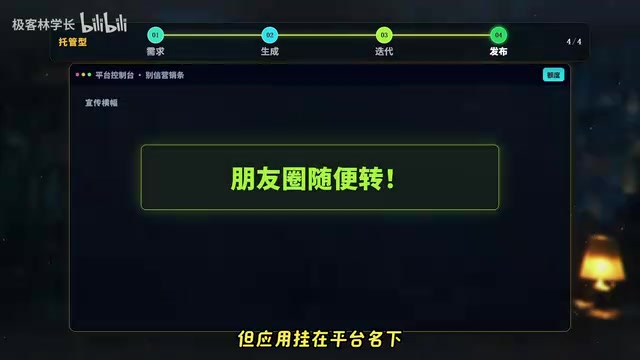
The second mode is publishing as your own officially registered Mini Program. Here, the platform simply helps you submit the code — you still need to have an account that's already verified and filed. In other words, if you need payment capability and independent operation, you still have to handle the credentials yourself.
Most major tech companies now offer this type of managed platform: Baidu's Miaoda, Alibaba's Miao, Tencent Cloud's WeDA, and ByteDance's Coze. They eliminate the work of tech selection, coding, and deployment — speed is the main selling point. But the underlying logic and data live on the platform's servers. You can't fully control it the way you can with the self-hosted route, migrating your project elsewhere is difficult, and deeply custom business logic is hard to implement.
ICP filing (Internet Content Provider filing) is a legal requirement in mainland China for any internet service offered to the public, administered by the Ministry of Industry and Information Technology (MIIT). Before launching a Mini Program, you also need to complete WeChat Mini Program filing, which involves submitting entity credentials on the WeChat Open Platform and linking them to your ICP information. Both filings are mandatory. Review timelines typically range from 5 to 20 business days, so it's advisable to initiate the process in parallel with development rather than waiting until the code is finished. Managed platforms save you from writing code, but when you publish as an independent Mini Program, these filings cannot be done on your behalf — they must be handled by the account holder directly.
How to Choose: It Comes Down to What You Actually Want
Neither route is objectively better — it depends on your goals.

- Long-term operation with deep customization: Go with the self-hosted route. Your code and data are yours, and the ceiling is much higher.
- Fast validation or a side project to test an idea: Go with the managed route. It's quicker and easier, and gets your idea in front of users as fast as possible.
Ultimately, the iron rule bears repeating: if you want an officially registered Mini Program under your own name that can accept payments, ICP filing and an individual business or corporate entity registration are non-negotiable gates. Personal accounts cannot use WeChat Pay.
The value of VibeCoding is that it lets people without a programming background actually build and ship products. But tools are just amplifiers — what truly determines which route is right for you is your vision for the product and your operational expectations. Get clear on that first, then match it to this route map, and the path forward becomes much smoother.
Related articles

From Prompt to Harness: Deconstructing the Four Layers of Agent Engineering
Agent engineering isn't just about writing prompts: from Prompt, Context, and Harness to AgentOS, this four-layer breakdown shows how complex tasks can be checkable, recoverable, and resumable — solving the three core engineering problems of capacity, precision, and continuity.

AI Daily: Google Gemini 4 Delayed, GPT-6.1 Ultra-Fast Edition Released
Google Gemini 4 Argon was delayed at Gemini At Work 2026, limited to internal security testing; OpenAI released GPT-6.1 ultra-fast edition with 8x speed; Anthropic launched Claude Dashboard and Motion. AI agent capabilities are being rapidly rewritten.

Datalab Open-Sources OmniParseBench: 16,288 OCR Tests to Audit Document Parsers
Datalab releases open-source OCR benchmark OmniParseBench with 16,288 test items across 2,937 pages and 92 languages. Pass rates are sliceable by tag, script, or language, making document parser evaluation auditable and reproducible.