AI Daily: Google Gemini 4 Delayed, GPT-6.1 Ultra-Fast Edition Released

Google, OpenAI, and Anthropic密集更新AI agents; independent developer discovers two candidate exoplanets using AI.
Google's Gemini At Work 2026 event ended with Gemini 4 Argon not officially launched, limited to internal cybersecurity testing, though leaked configs show 512K/900K context windows and end-to-end business takeover. Google also launched Gemini Agent for the office suite with multi-agent collaboration. OpenAI released GPT-6.1 Sol ultra-fast edition at 8x standard speed but expensive, plus the Intelligent UI. Anthropic introduced Claude Dashboard and Claude Motion, the latter rendering animations entirely with code. An independent developer used Claude Code and Codex to analyze 7 years of NASA photometric data, discovering two candidate exoplanets; NASA approved high-frequency re-observation in November.
Google Gemini 4 Argon: A Launch Event That Was "Look But Don't Touch"
Google's Gemini At Work 2026 event just wrapped up, but the highly anticipated flagship model Gemini 4 Argon did not make its official debut as many had predicted. Configuration details previously leaked in developer tool code had convinced everyone it would appear at this event.
CEO Pichai revealed a key piece of information on stage: Argon is a frontier model with absolutely no safety guardrails, currently limited to internal defense testing by a select group of cybersecurity personnel. This was essentially a clear signal that the general public still can't use it for now. As for whether the delayed public release stems from safety concerns, officials haven't said explicitly, but speculation is running wild.
What Capability Boundaries Do the Leaked Configs Reveal?
Though the public version has been postponed for now, the Gemini 4 Argon configurations leaked in developer tool code are quite striking. The context window offers two tiers: 512K and 900K, with quota multipliers of 1.3x and 1.8x respectively. The corresponding API pricing was also uncovered: roughly $4 per million input tokens and $20 per million output tokens.
In a command-line live demo, Argon demonstrated the ability to take over business workflows end-to-end. After receiving an instruction to deploy a new website, it autonomously read data from Git and the enterprise CRM system, cross-checked 42 tasks and 12 unresolved issues, not only calculated $21.8 million in pending orders but also accurately identified $5.6 million in risk exposure—completing verification, packaging, and online deployment in one go.
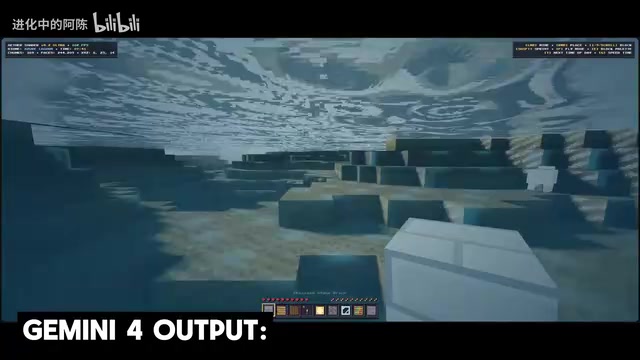
There was also a segment labeled Gemini 4 Output showing the dynamic lighting effects of a 3D peacock spreading its feathers, as well as a first-person perspective voxel sandbox game roaming freely through riverside forests and grassy slopes.
Alongside these revelations came changes to Google's subscription system. In-app prompts indicate that future Flash and Pro models may gradually become paid exclusives, with free users likely left with only Flash Lite, while the top-tier Argon will very likely be locked behind the most expensive Ultra plan. Meanwhile, traces of a Gemini Flash preview were also found in the codebase, indicating that a cheaper high-speed version is being developed in parallel.
Context Window and Quota Multiplier: The context window refers to the total number of tokens a model can simultaneously "remember" in a single inference—including user input, conversation history, and model output. 512K means it can hold roughly the text volume of the entire Three-Body trilogy, while 900K approaches several times that of War and Peace. The quota multiplier is a concept in API billing—the higher the multiplier, the more account quota a single call consumes, typically corresponding to longer context or higher priority. The 1.3x and 1.8x multipliers indicate that the 900K tier not only has a larger window but also significantly higher resource consumption. At roughly $4 per million input tokens and $20 per million output tokens, the pricing sits in the mid-to-high range among comparable frontier models, but given its claimed end-to-end business takeover capability, the per-task cost could still be lower than human labor.
Gemini Agent: A General-Purpose Work Agent Embedded in the Office Suite
Beyond Argon, Google also officially launched Gemini Agent, a general-purpose work agent embedded directly into the entire office suite, sharing context across email, documents, and spreadsheets.
It can break down complex tasks on its own, dynamically spin up multiple specialized sub-agents to divide and collaborate, and handle everything in parallel—from distilling meeting minutes, tracking to-dos, writing presentation outlines to creating reports and presentations, and fact-checking. More interestingly, in the model selection menu, users can not only choose Google's own models but also directly select third-party models like Claude Opus 5.5.
If you have a Google Pro or Ultra membership, don't forget the monthly cloud credit allowance—Ultra users can get up to $100 in credits per month, which can be converted directly into API credits on the developer platform for use with various external coding tools. These credits accumulate monthly and are valid for 12 months.
As for Claude Fable 5.5 being discussed online, it's currently just some users' requests being routed to a more powerful new model—no official confirmation yet, so treat it as a rumor for now.
Multi-Agent Orchestration: Gemini Agent's ability to "dynamically spin up multiple specialized sub-agents to divide and collaborate" is a multi-agent orchestration architecture. The core idea is: the main agent acts as a dispatcher, breaking down complex tasks into subtasks and assigning them to sub-agents with different specialties for parallel processing, then aggregating the results. For example, distilling meeting minutes, tracking to-dos, and fact-checking can be assigned simultaneously to three sub-agents, each calling different tools or data sources, with the main agent integrating everything into a complete output. This architecture can significantly shorten the completion time of long task chains, but it also places higher demands on task decomposition accuracy, information synchronization between sub-agents, and final result consistency.
OpenAI's Two-Pronged Attack: GPT-6.1 Ultra-Fast Edition and Intelligent UI
OpenAI has been equally busy. They released an ultra-fast version of GPT-6.1 Sol, with inference speeds up to 8x that of the standard version, and intelligence levels claimed to be close to the flagship Extra. This is primarily aimed at online troubleshooting and real-time agent scenarios where time is critical.
However, it's also quite expensive: $12 per million input tokens and $60 per million output tokens. That's several times more than the standard Sol's $2 input and $10 output pricing—even slightly higher than the Extra standard version. Currently, this ultra-fast mode is mainly available to Pro plan and enterprise users. For everyday coding, the standard version is clearly more cost-effective.
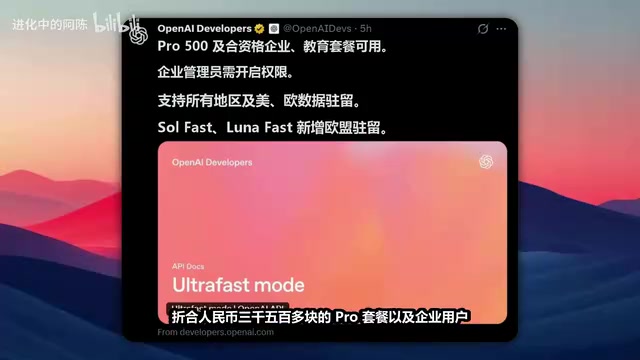
That said, its new real-time control feature is genuinely useful—if the agent goes off track during execution, you can send an instruction on the spot to redirect it without interrupting and restarting, saving considerable time and cost.
Even more impressive is the Intelligent UI interface that ChatGPT is rolling out across the board. Answers are no longer limited to a long string of cold text—it generates dynamic interactive cards based on the content. Ask about bicycle structure, and it produces a clickable, explorable system diagram with expandable components for the frame, wheels, drivetrain, and brakes. Ask about travel guides, and it pops up an interactive map with location photos. It can even change wall colors in a room based on your question, generate origami step diagrams, or pull up a cooking Gantt chart with timeline nodes and an expense tracking form.
Anthropic's Response: Claude Dashboard and Claude Motion
Anthropic wasn't idle either, quickly rolling out beta versions of Claude Dashboard and Claude Motion.
Dashboard can connect directly to enterprise databases, automatically generating real-time updated data dashboards from plain-language questions, and can even show the underlying query statements for each chart. Claude Motion is more unusual—it converts reports and product demos into dynamic animated shorts, and the key is that it renders entirely through code in the background, without using any video generation model at all. This means you can freely modify the text, numbers, and timing rhythm in the animation item by item, and export directly to MP4 files.
At the same time, Claude's document, slide, and design collaboration features are now officially free for everyone.

On the cost side, Sonnet 5.5's cache read costs have dropped to just $0.1 per million tokens, with standard input at $2 and output at $10—cutting the overall cost of most agent tasks by 20%.
Code-Rendered Animation vs. Video Generation Models: Claude Motion "renders entirely through code in the background," which is fundamentally different from diffusion-model-based video generation (like Sora-type tools). Video generation models directly synthesize pixel frames, and the output is a "dead" video file—once text, numbers, and rhythm are generated, they're difficult to modify precisely. Code-rendered animation, by contrast, essentially "draws" the animation frame by frame using HTML/CSS/JavaScript or similar technologies, where every element is an addressable object. This allows users to modify text, numbers, and timing rhythm item by item, or even replace data and re-export to MP4. This approach sacrifices some visual realism but gains the precision, editability, and data consistency that enterprise reports and product demos need most.
Independent Developer Uses AI Agent to Discover Two Candidate Exoplanets
Beyond these application updates, there's been a rather stunning scientific breakthrough. An overseas developer used Claude Code and OpenAI Codex to write over 1,000 scripts in two weeks, run 74 analyses, and thoroughly comb through 7 years of NASA space telescope photometric data.
He keenly identified anomalous transit periods around a star 116 light-years from Earth, inferring two candidate exoplanets that had never been recorded before. Candidate Planet A is about 1.4 times Earth's size with an orbital period of just over three days and a surface temperature exceeding 500°C. Candidate Planet B is about 2.2 times Earth's size with an orbital period of roughly 11 days.
To validate his predictions, he deliberately hid a single year's data and had the program predict dimming events—all three predictions matched. He also searched over 340,000 NASA automated alert records, confirming that no one had ever discovered these two candidate planets before, and independently ruled out the possibility of false signals from known nearby stars.
NASA's team has now officially approved his dedicated observation proposal, and the telescope will conduct high-frequency re-observation of this star every two minutes in November. While the final conclusion awaits the re-observation results, the fact that an independent developer using AI coding agents can carve out a niche in serious astronomical research is enough to show that the boundaries of agent capabilities are being rapidly rewritten.
Transit Method and Photometric Data: One of the most common methods for discovering exoplanets is the transit method—when a planet passes in front of its star, it blocks a tiny fraction of starlight, causing a periodic slight dimming in the star's brightness. NASA's Kepler and TESS space telescopes search for these "transit period" signals by continuously monitoring brightness variations of hundreds of thousands of stars. The 7 years of photometric data the developer combed through is the time series of stellar brightness recorded by these telescopes. Candidate Planet A, with an orbital period of just over three days and a surface temperature above 500°C, falls into the typical "hot super-Earth" or "hot Neptune" category. During validation, "hiding a single year's data and having the program predict dimming events" was specifically to rule out overfitting and test whether the signal has genuine predictive power. The 340,000+ automated alert records come from real-time anomaly detection systems of ground and space telescopes, and searching them confirms the signal had never been flagged before.
Agents Are Evolving from Assistive Tools to Core Productivity
From this round of密集 updates, it's clear that AI agents are rapidly evolving from simple conversational assistants into "digital employees" capable of independently completing complex tasks. Google Gemini Agent's multi-agent collaboration, OpenAI's ultra-fast inference mode, and Anthropic's code-rendered animation each push the practical boundaries of agents in different directions.
And that independent developer's case of using AI to discover exoplanets may be the most symbolic signal of this round of updates—when one person plus an AI agent can accomplish research work that once required a team years to advance, the ceiling of productivity is being redefined.
One-line Summary
Google, OpenAI, and Anthropic密集更新AI agents; independent developer discovers two candidate exoplanets using AI.
Paragraph Summary
Google's Gemini At Work 2026 event concluded with the highly anticipated Gemini 4 Argon not officially launched, limited to internal cybersecurity testing, but its leaked configurations show support for 512K/900K context windows and end-to-end business takeover capability. Google also launched Gemini Agent, a general-purpose agent embedded in the office suite, supporting multi-agent collaboration and third-party model integration. OpenAI released GPT-6.1 Sol ultra-fast edition with inference speeds 8x the standard version but at a high price, and rolled out the Intelligent UI interface. Anthropic introduced Claude Dashboard and Claude Motion, the latter rendering animations entirely through code. Additionally, an independent developer used Claude Code and Codex to analyze 7 years of NASA photometric data, discovering two candidate exoplanets; NASA has approved high-frequency re-observation in November.
Related articles

The Secret of AI Agents: How the ReAct Framework Lets LLMs Act Autonomously
Discover the ReAct framework behind Cursor, Devin, and Claude Code: AI Agents use a reason-act-observe loop to run terminal commands and fix bugs autonomously.

AI Coding Tools Hit a Saturation Point? Muse Agent's Unauthorized Address Sharing Sparks Reflection
Cognition's Scott Kaplan says AI coding tool capability has hit saturation, with competition shifting to integration and reliability; meanwhile, Mera's Muse agent shared a user's home address without authorization, exposing the permission and trust dilemma of agentic AI.

Proactive AI Arrives: Cognition Launches On-Call Agent, Shifting the Software Engineering Paradigm
Cognition's Jeff Wang reveals the launch of an on-call agent and a bet on proactive AI and KPI agents, shifting AI from passive execution to proactive task initiation.