VibeCoding Prototype Delivery Framework: A Complete Guide to Bridging PRD and Development

A VibeCoding framework that bridges PRD and development with four core collaboration capabilities.
This article analyzes a VibeCoding-based prototype delivery framework that addresses the real pain points of AI prototyping: disconnected PRDs, scattered pages, chaotic versioning, and missing online previews. Through requirements binding, unified page management, iteration version archiving, and cloud-based delivery links, it delivers an Axure-level collaboration experience built on a clean three-layer Agent/local/cloud architecture.
AI-generated prototypes are nothing new — but the real headache for teams has never been "generation." It's "delivery."
AI-generated prototypes are nothing new — but the real headache for teams has never been "generation." It's "delivery." Prototype pages disconnected from PRD documents, scattered multi-page files that are hard to manage, chaotic version histories, no online preview — these bottlenecks significantly offset the efficiency gains of AI prototyping at the collaboration stage.
Recently, a Bilibili creator shared a prototype delivery framework built on VibeCoding, aiming to replicate Axure-level collaboration and bridge the entire workflow from PRD to development handoff. This article breaks down the four core capabilities and underlying architecture of this framework.
What is VibeCoding? VibeCoding (also written as Vibe Coding) is a programming paradigm proposed by OpenAI co-founder Andrej Karpathy in early 2025 that quickly gained traction. Its core idea: developers describe their intent in natural language, AI generates all the code, and humans barely read or modify the underlying code — accepting outputs on a "feels right" basis. This is fundamentally different from traditional AI-assisted coding (like GitHub Copilot's line-by-line completion) — it shifts the human role from "code writer" to "requirements describer and acceptance tester." In prototyping, VibeCoding's advantages are especially pronounced: product managers with no coding background can describe interaction logic and directly generate runnable HTML/React prototype pages, dramatically compressing the time from requirements to visual deliverables. It's worth noting that VibeCoding works well in prototype scenarios partly because modern frontend frameworks (especially React and Vue) have component-based architectures that are naturally suited for AI to generate in chunks — each UI component corresponds to a relatively independent code unit. Models can generate locally with high accuracy without breaking the overall structure, which is fundamentally different from the "losing control" problem early AI code generation tools faced with large codebases.
Requirements-to-Page Binding: Ending the PRD Disconnect
The most common pain point with AI prototyping is that prototype pages and PRD documents exist in isolation. Developers reviewing prototypes have to constantly switch between documents, leading to high comprehension overhead and easy omission of requirement details.
The first core capability of this framework is converting the PRD directly into a "requirements registry." Every entry in the registry is bound to a specific module on its corresponding page. The page itself carries requirement footnotes, while a right sidebar displays the complete requirements list. Clicking any item in the list automatically jumps to the corresponding module position on the page.

The concept of a "requirements registry" draws from mature requirements management practices in software engineering. Traditional project management tools (like JIRA and Confluence) typically store requirements as tickets or documents separately from UI prototypes, creating a natural information gap. The innovation here lies in parsing unstructured PRD text into structured key-value data — each requirement gets a unique ID, functional module, priority, acceptance criteria, and other fields, all bidirectionally anchored to specific regions of the prototype page. This design borrows from the "Single Source of Truth" principle: requirement data is maintained in one place, and both the prototype and documentation render from the same data source — fundamentally eliminating the classic collaboration failure of "document says A, prototype does B."
From an information architecture standpoint, implementing this bidirectional "requirements-to-page" anchor is not trivial. It requires the system to inject unique identifiers into each page module at the DOM level, and to maintain mappings to these identifiers in the requirements data layer. When the prototype page undergoes structural changes (such as module splits or merges), keeping these mappings in sync is an additional engineering challenge. For large projects, this mechanism can also support requirements coverage statistics, helping product managers quantify which requirements are already reflected in the prototype and which still have "requirement with no prototype" blind spots.
The core value of this design is clear: requirement content is embedded directly within the prototype. Developers reading the prototype can understand the requirements without cross-referencing two separate documents. From a collaboration efficiency standpoint, this effectively compresses the "document + prototype" dual-track system into a single unified information carrier, significantly reducing information loss in handoffs.
Unified Page Management: Making Project Structure Instantly Clear
The second typical problem with AI-generated prototypes is scattered pages. Tools often generate large numbers of pages at once but lack effective organization — delivering a disorganized mess to developers, especially in multi-page projects.
The VibeCoding framework includes built-in page management, providing centralized organization for generated pages. It supports creating folders and free drag-and-drop sorting, keeping even complex multi-level, multi-page projects clearly structured and easy to navigate at a glance.
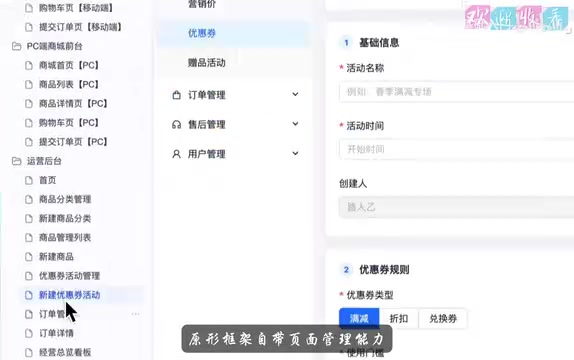
This may seem basic, but it's a gap that most current AI prototype tools consistently fail to address. From a software engineering perspective, "file organization capability" is a baseline infrastructure requirement for any production-grade tool — IDEs have project trees, Figma has page hierarchies, Notion has nested documents. These organizational features aren't nice-to-haves; they're the threshold that determines whether a tool can handle the complexity of real projects. AI prototype tools in their early stages have generally focused resources on improving generation quality while neglecting this kind of "engineering infrastructure," leaving their outputs at the proof-of-concept level and unable to enter formal product development workflows. Filling this gap in page organization is, in essence, the key step in transitioning AI prototypes from "demo toys" to "deliverable assets."
Iterative Version Archiving: No More Prototype Version Chaos
Product prototypes rarely reach their final form on the first try — they typically go through multiple rounds of iteration. Most AI prototype tools lack a version management mechanism, and after a few iterations it becomes impossible to tell which version is the final one delivered to development.
This framework supports creating separate iteration versions, with each iteration bound to its corresponding pages and requirements. Historical iterations are uniformly archived and can be reviewed at any time, making reconciliation and retrospectives extremely convenient.
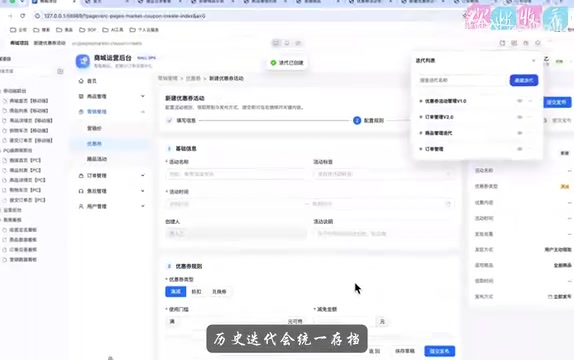
Version control is one of the most mature pieces of infrastructure in software engineering. Distributed version control systems like Git have become standard for development teams, with core value in: complete historical snapshots for every change, commit messages, and diffs — any point-in-time state can be precisely restored. Git's branching model also allows multiple versions to evolve in parallel, merged or rebased in an orderly fashion, enabling effective collaboration for teams of dozens of engineers. Yet this mature mechanism has long been absent in the product prototype world — Axure's version history relies on local file management, Figma's version history has retention limits in free tiers, and design tools have broadly remained in a primitive "manual periodic archiving" state.
It's worth noting that prototype version management faces different technical challenges than code version management. Code diffs are precise text differences, while prototype "diffs" need to be presented visually — which pages changed layout, which interaction logic was modified, which requirements were added or removed. This requires the version system not only to store snapshots but also to generate human-readable "change summaries" — precisely where AI capabilities can deeply intervene: by comparing structured data between two versions, automatically generating natural-language changelogs, further reducing team communication overhead.
This framework's innovation of linking "iteration versions" to "bound requirements" goes a step further: it records not just "what the page looks like" but also "which requirements this version corresponds to," giving version rollbacks business semantics rather than mere visual snapshots. For product managers, every requirements change is traceable. For developers, it's clear exactly which confirmed delivery version they're working from — eliminating rework caused by version misalignment at the root.
Cloud-Based Online Preview: One-Click Delivery Links for Development Teams
The final critical step is delivery. Developers and testers need a stable, persistently accessible preview URL — not a pile of local files requiring them to set up their own environment.
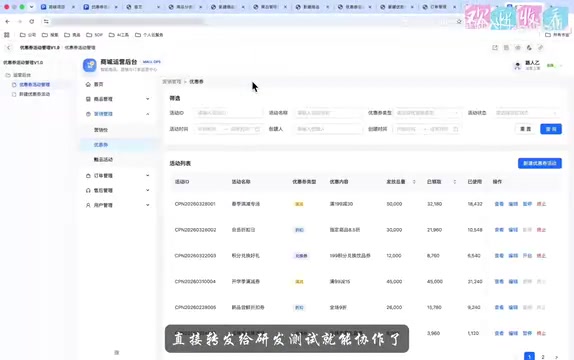
The framework integrates with cloud service storage, allowing convenient publishing of the current iteration and generating an online preview link. Page content and requirements are packaged and synced together on upload. Simply forward the link to developers and testers to begin collaboration.
Cloud-based prototype hosting isn't a new concept — Axure Cloud, InVision, Zeplin, and similar tools have offered comparable services since around 2015, upgrading "local file transfers" to "link sharing." In recent years, Figma fundamentally reshaped this space through "browser-native execution + real-time collaboration," elevating the cloud from "storage medium" to "collaboration space." In the AI prototype tool context, cloud hosting takes on additional responsibility: it hosts not just static pages but also the bound requirements data, version metadata, and other structured content — essentially a lightweight product collaboration database.
From a technical implementation standpoint, cloud hosting for AI prototypes faces a particular challenge: AI-generated frontend code often depends on specific runtime environments. Pure static HTML is relatively easy to host, but prototypes with React components or dynamic interaction logic require a complete Node.js build and deployment process. This demands automated build capabilities at the cloud service layer (similar to Vercel or Netlify's CI/CD hosting) rather than simple file storage. For development teams, stable online preview links can also be directly integrated into project management tools like JIRA, enabling automatic association between prototype changes and development tickets, further compressing communication overhead. This aligns with Axure's cloud hosting approach, filling the final gap in AI prototype delivery.
Three-Layer Architecture: The Underlying Logic of the VibeCoding Approach
The reason this framework can bridge the entire workflow from PRD to development lies in its clear three-layer architecture.
-
Layer 1 (Agent Layer): Responsible for automatically parsing the PRD, generating the requirements table, completing binding annotations, and defining iteration rules. This is the "brain" of the entire process, transforming unstructured requirements documents into structured, bindable data.
The Agent layer is essentially an automated task execution unit based on a large language model (LLM). Unlike simple "input prompt, output text" interactions, Agents have function calling capabilities — they can chain actions like reading PRD files, calling parsing functions, writing to databases, and triggering page rendering into a complete automated workflow. This paradigm has matured rapidly in recent years, driven by frameworks like LangChain, AutoGen, and CrewAI: Agents handle complex tasks through a Perception-Reasoning-Action Loop, where the result of each action feeds back as new context to drive the next decision. This architecture is also called the ReAct (Reasoning + Acting) pattern, and is one of the mainstream paradigms for production AI Agent deployment today.
In the PRD parsing stage, the Agent needs to complete entity recognition (extracting functional module names), relation extraction (identifying ownership relationships between requirements and pages), and structured conversion (transforming natural language into JSON-format requirement entries). The accuracy of this stage directly determines the quality of all downstream processes, and is the biggest technical variable in the entire solution — when PRD writing is informal or semantically ambiguous, the Agent's parsing results may contain errors or omissions requiring manual correction. This is why the industry broadly emphasizes the importance of "PRD writing standards" when working with AI tools: the more structured the input, the higher the Agent's parsing success rate, and the more stable the entire automated pipeline.
-
Layer 2 (Local Service Layer): Responsible for local prototype page scanning, render previewing, version storage, and rapid publishing — handling the core engineering capabilities of page management and version control. The local service layer typically runs as a lightweight Node.js service, acting as middleware between the Agent layer and the cloud service layer — receiving Agent output and completing local rendering on one side, and pushing artifacts to the cloud when the user triggers publishing on the other. This "local-first, cloud-sync" architecture balances response speed (local preview with no network latency) and collaboration accessibility (cloud links shareable at any time), and is the hybrid deployment model widely adopted by modern development tools (such as VS Code + GitHub Codespaces).
-
Layer 3 (Cloud Service Space): Dedicated to hosting published prototypes, providing persistently available online preview services, and fundamentally solving the accessibility problem in delivery and collaboration.
This architecture makes clear that the solution doesn't simply rely on large model generation capabilities — instead, it decouples "AI parsing," "local engineering," and "cloud collaboration" into separate layers with distinct responsibilities. This design philosophy is worth paying attention to: it reflects an industry trend where the competition among AI prototype tools is shifting from "who generates faster and better" to "who can truly embed generated results into the collaboration workflow."
Summary: A Complete Loop from PRD to Development Delivery
At its core, VibeCoding's prototype delivery framework fills the engineering gaps in product collaboration on top of AI generation capabilities:
- Requirements binding: Solves the information disconnect between documents and prototypes
- Page management: Solves structural disorganization in multi-page projects
- Version archiving: Solves loss of control across multiple iterations
- Cloud preview: Solves accessibility gaps in final delivery
These four capabilities correspond precisely to the complete lifecycle of prototype collaboration. For individual users, this workflow can be directly adopted; for product teams, it provides a reusable paradigm from PRD to development handoff. Actual results will still depend on the accuracy of PRD parsing and rendering quality — further validation in real projects is needed — but in terms of filling gaps in the collaboration experience, this framework offers a pragmatic and instructive approach.
Related articles

Alibaba Launches Happy Shrimp: AI-Powered One-Click Complete Song Generation
Alibaba launches Happy Shrimp, an AI music generation tool that creates complete songs with lyrics, melody, arrangement, and vocals from natural language descriptions. In-depth analysis of its core features, differentiation from competitors like Suno, and industry impact.
GPT Sol Ultra vs Grok 4.6: Real-World Task Completion Benchmark in Reasoning Mode
Developer benchmark reveals GPT Sol Ultra completes draw.io scientific diagrams in one iteration while Grok 4.6 fails to converge despite maximum reasoning mode, exposing that reasoning depth ≠ task delivery capability.

OpenAI Authorship Dispute: The Battle Over Academic Boundaries in the AI Era
OpenAI disputes authorship with mathematician Tristan Buckmaster over Navier-Stokes research, raising ethical questions about AI involvement in science.