Vibemate: An Open-Source Tool for Multi-Agent AI Coding Collaboration in a Shared Chat Room
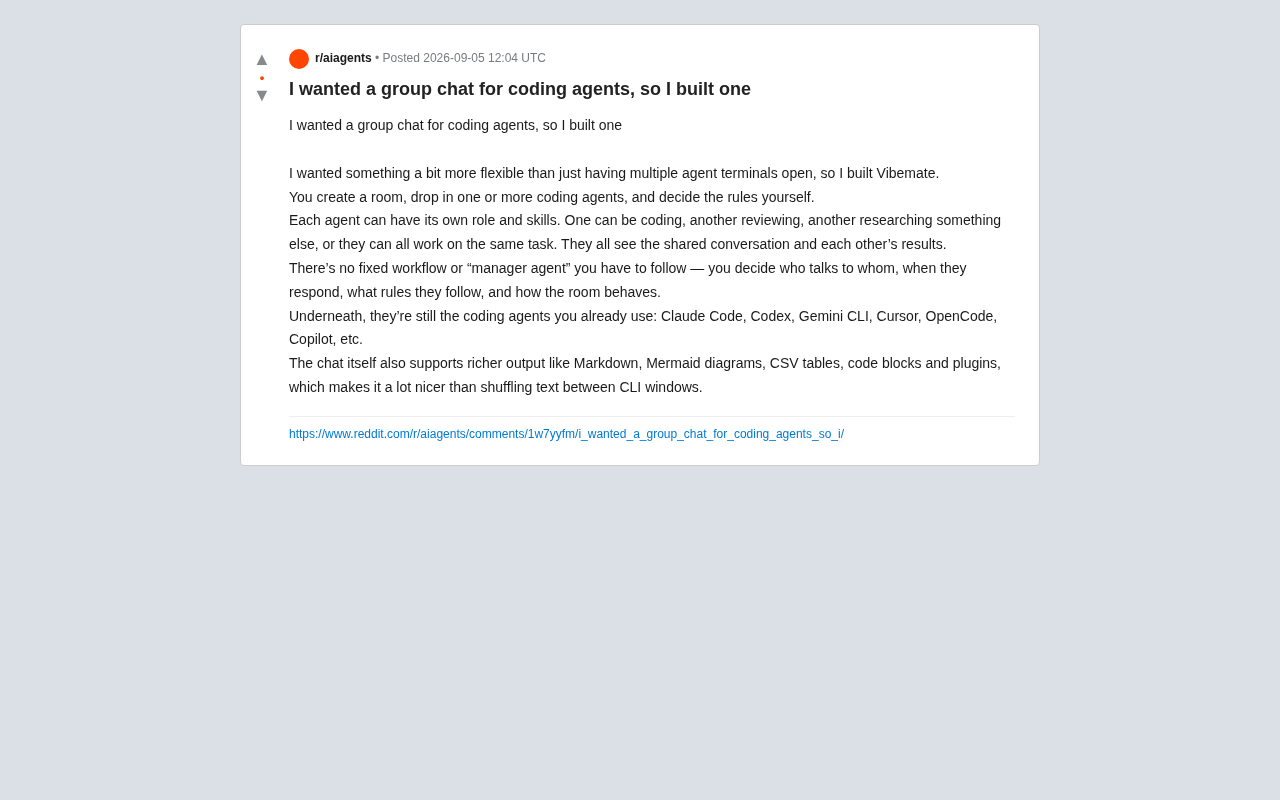
Vibemate unifies Claude Code, Copilot, and other AI coding agents into one shared chat room for collaborative, context-aware programming.
Vibemate is an open-source multi-agent coding collaboration tool that connects AI assistants like Claude Code, Gemini CLI, and GitHub Copilot into a single shared chat room, giving each agent visibility into the others' outputs and eliminating information silos. Unlike orchestration frameworks with fixed hierarchies, Vibemate lets developers freely define roles, interaction rules, and trigger logic. It also supports rich media rendering — including Markdown, Mermaid diagrams, CSV tables, and code highlighting — removing the need to copy text between CLI windows. Positioned as a coordination layer rather than a replacement, it preserves full developer control over existing tools and workflows.
Vibemate: An Open-Source Tool for Multi-Agent AI Coding Collaboration in a Shared Chat Room
In the world of AI-assisted development, engineers often juggle multiple coding assistants to tackle complex tasks. Frustrated by constantly switching between terminal windows, one developer built a tool called Vibemate — enabling multiple coding agents to collaborate inside a single shared chat room.

Breaking Free from the Single-Agent Paradigm
Traditional AI coding assistants operate in isolation, forcing developers to context-switch between tools like Claude Code, Cursor, and GitHub Copilot. Vibemate's core innovation is bringing these independent agents into a shared chat environment where they can see each other's conversations and outputs.
This mirrors how human dev teams actually work — members with different roles communicate through a common channel, sharing context and avoiding information silos. With Vibemate, you can dedicate one agent to writing code, another to code review, a third to technical research, or have multiple agents collaborate on the same problem simultaneously.
Flexible, Fully Customizable Collaboration Rules
Unlike some multi-agent systems that enforce a fixed "manager-worker" hierarchy, Vibemate imposes no preset workflows. Developers have full control over:
- Role assignment: Define specific roles and skill sets for each agent
- Interaction rules: Determine which agents can talk to each other and when responses are triggered
- Work modes: Choose between parallel execution or joint problem-solving
- Room rules: Customize the overall behavior logic of the chat room
This high degree of configurability makes Vibemate adaptable to a wide range of development scenarios — from simple code generation to complex system architecture design.
Rich Visual and Interactive Output
Beyond multi-agent coordination, Vibemate significantly improves the user interface experience. Compared to the plain text output of traditional CLI tools, it supports a variety of rich media formats:
- Markdown rendering: Structured display of documentation and explanations
- Mermaid diagrams: Visualize flowcharts and architecture diagrams directly in the chat window
- CSV tables: Clearly present data comparison results
- Code highlighting: Improve readability of code snippets
- Plugin system: Extend functionality through plugins
These features eliminate the need to copy and paste text between multiple CLI windows, making information presentation far more intuitive and efficient.
Compatible with Your Existing AI Coding Ecosystem
One important detail: Vibemate isn't trying to replace your existing AI coding tools — it acts as a coordination layer on top of them. Under the hood, it still calls the agents you're already using, including Claude Code, Codex, Gemini CLI, Cursor, OpenCode, GitHub Copilot, and other mainstream tools.
This means developers don't need to learn an entirely new agent system. Simply plug in your familiar tools and immediately benefit from multi-agent collaboration.
The Future Direction of Multi-Agent Coding Collaboration
This project reflects an important trend in AI-assisted development: the shift from single-agent to multi-agent collaboration. As large language models continue to grow more capable, a single agent can already handle many coding tasks — but complex projects often benefit from a "virtual team" of specialists working together.
Vibemate offers a lightweight multi-agent orchestration approach that keeps developers in full control of the collaboration process, creating an interesting complement to fully automated agent frameworks. Rather than imposing a specific workflow paradigm, it hands the choices back to the user — a design philosophy well-suited to the diverse realities of real-world development.
For developers looking to experiment with multi-agent programming collaboration, Vibemate is a low-barrier platform worth exploring.
Related articles

Invalid Source Material Notice
The source material provided lacks substantive information and is unrelated to AI/tech topics, making it impossible to produce a complete professional article.

Invalid Source Material: Unable to Generate a Valid AI/Tech Article
This Twitter source material is an irrelevant marketing tweet with no AI or tech content, making it impossible to generate a valid professional article.
Insufficient Source Material: Unable to Generate a Valid Article
The source material was limited to a single broken tweet with no usable content, making it impossible to produce a complete, high-quality article.