Viggle JST-2: A Single Model for Generating 3D Scenes, Characters, and Motion

Viggle releases JST-2, a single model that unifies 3D scene, character, and motion generation, with API and MCP integration.
Viggle released JST-2 on Product Hunt, billed as a "physics-native" world foundation model that attempts to generate 3D scenes, characters, and full-body motion with the same model, emphasizing consistency across a shared world. In terms of functionality, scene generation takes about one second, characters can be generated from images or text with built-in motion, and motion supports text or video driving. Access methods include a free trial in the PINOC browser, an API, and MCP, the latter of which can integrate into agent workflows such as Claude Code—seen by the author as a more promising signal than the trial. The article also notes that the official benchmarks are vendor-organized blind human evaluations lacking third-party reproduction, so the generalizability of the conclusions must be discounted; the real difficulty lies in the consistency among scenes, characters, and motion, not in the quality of individual generation.
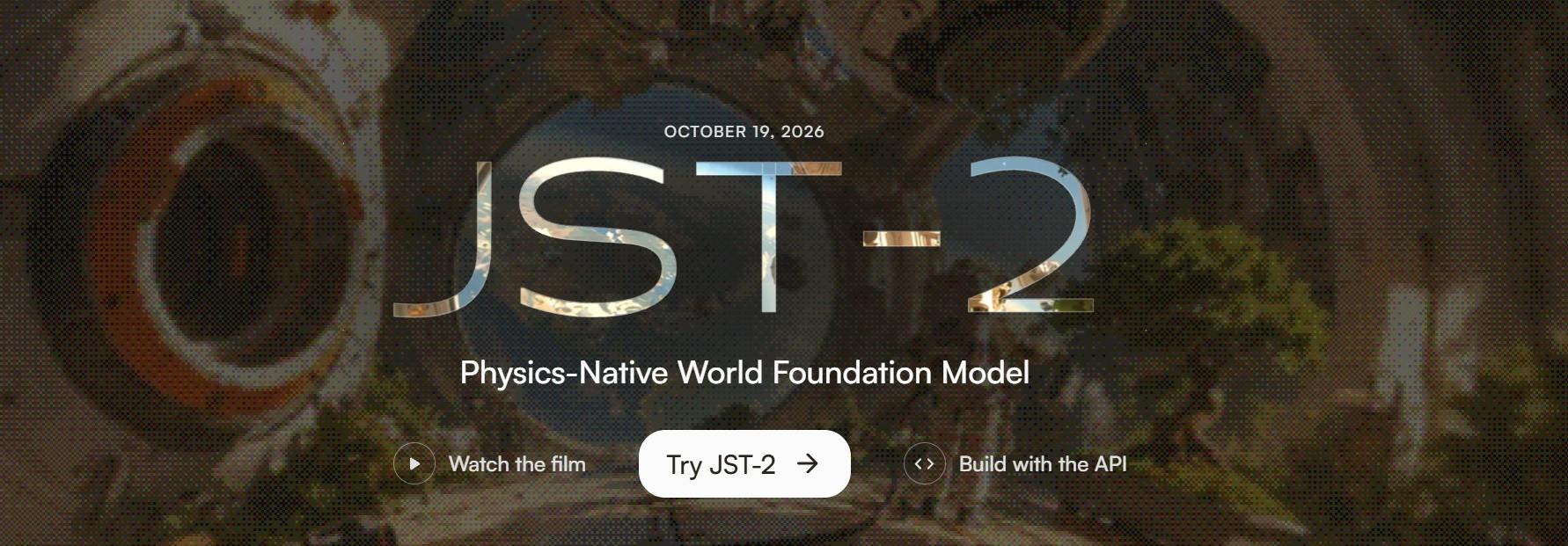
Viggle released JST-2 on Product Hunt, a world foundation model billed as "physics-native" that attempts to unify the generation of 3D scenes, characters, and full-body motion within a single model. This positioning itself is worth unpacking: in the past, these three things were typically assembled from separate pipelines, and the core claim of JST-2 is to place them within one shared world.
One model, three kinds of output
According to the official description, what JST-2 can do breaks down into three parts. Scene generation takes roughly one second; characters can come from an image or a piece of text, with motion built in; and the motion itself can be driven by text or video.
This "one input, multiple outputs" structure points toward an approach closer to a world model—rather than separately rendering scenes and characters, it determines their relationships simultaneously within the same space. The official description calls JST-2 a "physics-native" foundation model, emphasizing precisely this consistency of a shared world.
"World model" is a concept often confused with 3D generation but with a different goal: it usually refers to a model that internally builds a representation of environmental states and their evolution, capable of predicting "if a certain action is taken, what will the world become," rather than merely rendering a single frame. In video generation, robot control, and embodied intelligence, world models are used to support planning and decision-making. JST-2 places scenes, characters, and motion into the same representation space, approaching the generative-side application of this idea, but whether it possesses interactive state prediction and counterfactual reasoning capabilities is not made clear in the official description. Understanding this distinction helps in judging whether "world foundation model" is a capability description or positioning rhetoric.
How to get started: browser, API, and MCP
JST-2 offers several usage paths. The lightest is a free trial in the PINOC browser app, suitable for quickly validating results. For developers there is an API; in addition, MCP is supported, allowing integration into agent workflows such as Claude Code.
MCP support is an easily overlooked but very practical signal: it means JST-2 is not only meant to generate content for people, but is also intended to be called by agents, becoming a generation node in automated pipelines. For teams working on AI applications and AI programming, this path offers more imaginative potential than a pure browser trial.
MCP (Model Context Protocol) is an open protocol proposed by Anthropic in late 2024, designed to let large model applications connect to external tools and data sources in a unified way. It abstracts "tools" as servers that can be dynamically discovered by agents, and clients (such as Claude Code, Claude Desktop, or third-party IDEs) call them through standard interfaces, thereby avoiding writing custom glue code for each model and tool. For generative services, supporting MCP means it can be automatically selected and invoked by agents during task orchestration, without relying on manual operation on a web page. This also explains why the article regards MCP integration as a signal more worth watching than the free trial: it puts JST-2 on the candidate list for automated content production pipelines.
The limits of the benchmarks
The official description notes that the relevant benchmarks are blind human evaluations conducted by Viggle itself. This needs to be viewed honestly: blind human evaluation has its reasonableness for subjective metrics like generation quality, but when organized by the vendor itself and lacking third-party reproduction, the generalizability of the conclusions must be discounted.
In other words, the direction of JST-2's demonstrated capabilities is clear, but the question of "how much better it actually is than similar products" can currently only reference the vendor's own claims.
Blind human evaluation is a common method in generative AI assessment: evaluators do not know which model a sample came from and only score dimensions such as quality and consistency, in order to reduce brand bias. However, the credibility of such evaluations depends heavily on evaluator recruitment, sample size, scoring scale design, and statistical significance testing—details that are often not disclosed. Vendor self-testing also faces the risk of selective presentation—the test set, prompts, and comparison baselines may all be selected in ways favorable to the vendor. Therefore, without third-party reproduction or public benchmarks (such as quantitative metrics on standard 3D scene datasets), vendor claims are better suited as directional reference rather than a basis for cross-product ranking.
What's worth watching
The real difficulty in converging scenes, characters, and motion into a single model lies not in the quality of individual generation, but in the consistency among the three—whether proportions are reasonable after a character is placed into a scene, and whether motion conforms to the scene's physical constraints. JST-2 uses "shared world" to describe this, and the direction is right, but actual performance still requires more independent testing to verify.
For teams focused on 3D content generation and the practical deployment of AI applications, JST-2's API and MCP integration are more worth following up on than the free trial.
Related articles
world2vec: Building Mechanistic World Models with Latent Dynamics Learning
world2vec proposes a reward-free method for learning mechanistic world models via latent dynamics, faithfully reproducing systems over long horizons with at least an order of magnitude fewer parameters than DreamerV3, TD-MPC2, and LeWM, and achieving accurate system identification on 71 attractor benchmarks.

A New KL-DRO Paradigm: Adaptive Scenario Generation Around a Learned Density Model
KL-DRO research proposes centering the KL ball on a learned density model instead of the empirical distribution, with adaptive scenario generation guiding sampling toward the worst case. Experiments show lower cost under distribution shift when records are scarce and the model can extrapolate, with comparable in-distribution cost.

ODE Samplers for Discrete Diffusion Models: Exponential Residual Flows Accelerate Generation
Discrete diffusion models lack deterministic ODE sampling? This article introduces Exponential Residual Flows (ERFs), which introduce continuous residual variables per token to construct piecewise ODEs for deterministic sampling and support consistency distillation acceleration. Superior to prior methods on code and text generation tasks.