Vincentt: Build Web Camera Experiences Fast

Vincentt uses AI coding agents plus an open SDK to simplify building and publishing web camera experiences.
Vincentt is a developer tool launched on Product Hunt, positioned as the fastest way to build and launch camera experiences on the web. It lets developers use AI coding agents like Claude Code and Codex with an open SDK, preview on phone, and publish a shareable link—no app store or headset required. It targets rapid prototyping and lightweight interactive scenarios, but remains early-stage with limited public info.
Camera as the Entry Point: Vincentt Wants to Simplify Web Camera Experience Development
On Product Hunt, a new tool called Vincentt quietly launched with a straightforward tagline: "Bring your ideas to life through the camera." It targets a long-overlooked niche: quickly building and publishing camera interaction experiences on the web.
According to its Product Hunt page, Vincentt positions itself as "the fastest way to build and launch camera experiences on the web." Developers can use their familiar coding agents (such as Claude Code or Codex) alongside its open SDK to develop, preview in real time on their phone, and then publish with one click as a link anyone can open. The entire process requires no app store listing and no headset.
The product received 79 upvotes and 9 comments on Product Hunt, ranking 17th for the day and categorized under Developer Tools, Artificial Intelligence, and Augmented Reality.
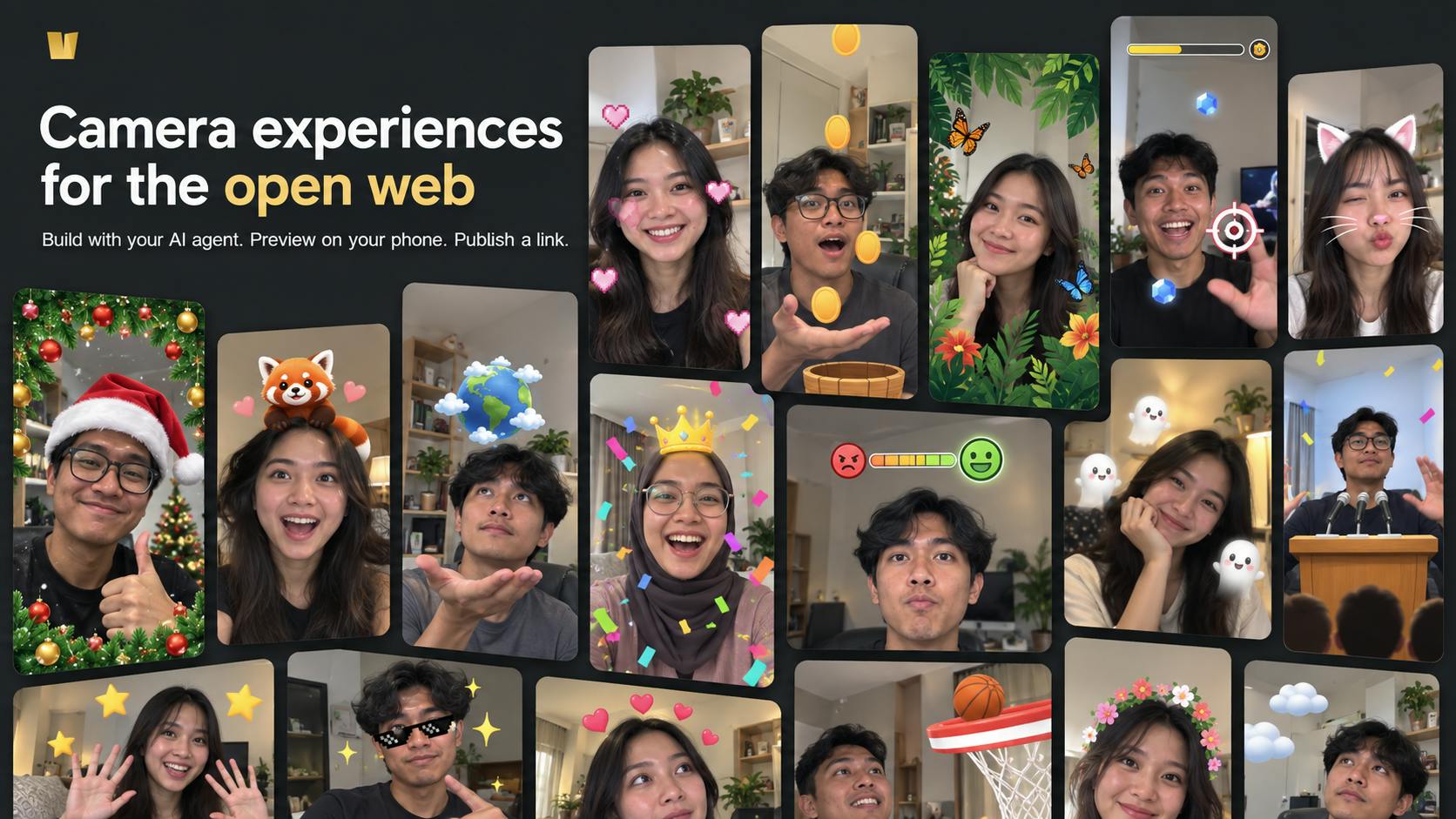
What Problem It Solves: The "Last Mile" of Camera Experiences
Traditionally, implementing camera interactions on the web—whether AR filters, gesture recognition, or real-time video processing—forces developers to deal with cumbersome permission requests, cross-device compatibility debugging, and a long pipeline from development to distribution. If the goal is just a lightweight camera demo or a marketing interaction page, the return on investment for this process is far from ideal.
Vincentt's approach is to compress that pipeline. It doesn't require developers to learn a new framework from scratch; instead, it allows them to use existing AI coding tools to generate code, then connect camera capabilities through the SDK. The phone preview step solves the age-old headache of mobile debugging, while the "publish link" action bypasses the app store review cycle.
For product teams needing to quickly validate ideas, creative developers building interactive marketing, or indie developers who just want to experiment with camera features, this lightweight path has real appeal.
The tech stack behind web camera interactions: Calling the camera in a browser relies on the W3C-specified MediaDevices.getUserMedia() API, which requests camera and microphone permissions and returns a media stream. Once you have the video stream, developers typically need to combine WebGL or WebGPU for real-time rendering, use WebAssembly to run computer vision models (such as MediaPipe or TensorFlow.js), and handle low-latency transmission via WebRTC. This pipeline involves coordination across multiple browser APIs, and given the behavioral differences between iOS Safari, Android Chrome, and desktop browsers in permission prompts, autoplay policies, and front/rear camera switching, cross-device compatibility debugging often consumes significant time. Vincentt aims to encapsulate exactly this layer of complexity.
Open SDK + AI Coding Agents: A Subtle Shift in Development Paradigm
One notable design choice in Vincentt is its embrace of AI coding agents. The page explicitly mentions that you can build with Claude Code or Codex, meaning developers don't need to hand-write large amounts of boilerplate code—instead, they describe requirements in natural language and let AI generate code that integrates with the Vincentt SDK.
This model lowers the barrier to camera-related development, but it also depends on the accuracy of AI-generated code and the quality of the SDK's documentation. Currently, public information doesn't show the SDK's specific API design or code examples, so whether the actual experience is as smooth as described still requires hands-on verification by developers.
Judging from its category tags "Artificial Intelligence" and "Augmented Reality," Vincentt clearly wants to ride both the AI and AR technology waves, but its core value leans more toward a development efficiency tool rather than some entirely new AR experience.
The model of combining AI coding agents with SDKs: Tools like Claude Code and Codex are essentially agents that generate and modify code through natural language instructions—they can read project files, execute commands, and iterate on changes. When such tools are used alongside a domain-specific SDK, the quality of the SDK's documentation and the intuitiveness of its API design directly determine the accuracy of AI-generated code—because AI primarily infers how to call the API based on documentation and type definitions. This is also the common challenge of the "AI coding + vertical SDK" format: SDKs need to be optimized for machine readability (clear types, examples, error messages), otherwise generated results can easily go wrong on details like permissions and async timing. Vincentt hasn't disclosed its API design, so the actual experience in this regard remains unknown.
The Cost and Opportunity of Lightweight Publishing
"No app store, no headset" is the selling point Vincentt emphasizes. Indeed, app store review processes and headset adoption rates have long been obstacles to scaling AR products. A shareable web link can theoretically reach any device with a browser and camera.
But this path has inherent limitations. Web-based camera experiences can't match native apps or dedicated hardware in performance, permission management, or sensor precision. For immersive, heavy-duty AR scenarios, Vincentt may not be the right choice; but for rapid prototyping, social sharing, and light interactions, its convenience advantage is clear.
The data of 79 upvotes and 9 comments shows it has attracted some attention, but hasn't yet sparked explosive discussion. As a developer tool, its long-term value depends on SDK stability, community ecosystem building, and whether it can attract enough developers to create interesting camera experiences with it.
The capability boundary between web and native AR: Web-based camera experiences are limited in several ways. In performance, JavaScript and WebGL rendering pipelines struggle to match the frame rates and power efficiency of native Metal/Vulkan. In sensors, the web typically can only access the camera feed, while native apps can leverage LiDAR, IMU, gyroscopes, and more for precise spatial tracking. In permissions, browsers may require re-authorization each session, and iOS imposes stricter restrictions on autoplay and camera access. As a result, standards like WebXR, while already supporting some AR capabilities, still lag behind headsets or native ARKit/ARCore in precision and stability. Lightweight, distributable web solutions are better suited for low-immersion scenarios.
A Direction Worth Watching
Vincentt represents an emerging category of tools: combining AI coding capabilities with domain-specific SDKs to let developers enter previously technical fields at lower cost. Camera interaction is one such field—it involves multiple layers of complexity including computer vision, real-time rendering, and device adaptation.
If Vincentt can make this path work, it could become a quick entry point for web camera experiences. But it's still in its early stages with limited public information, and the actual development experience and final output quality await verification from more developers. For teams looking for lightweight camera interaction solutions, it's worth keeping an eye on.
One-line Summary
Vincentt uses AI coding agents plus an open SDK to simplify building and publishing web camera experiences.
Paragraph Summary
Vincentt is a developer tool launched on Product Hunt, positioned as "the fastest way to build and launch camera experiences on the web." It lets developers write code using AI coding agents like Claude Code and Codex alongside an open SDK, preview in real time on their phone, and publish with one click as a shareable link—no app store listing or headset required. It aims to compress the high costs of traditional web camera development caused by permission requests, cross-device debugging, and distribution pipelines, offering real value for rapid prototyping, interactive marketing, and lightweight demo scenarios. The product currently has 79 upvotes and 9 comments, ranking 17th, and is still early-stage—its SDK stability and community ecosystem will determine its long-term value.
Related articles

How Big Can Stars Really Get? The Physical Limits of the Largest Stars
Red supergiants are the largest stars by volume, with radii up to 2,000 times the Sun, engulfing the inner solar system. But there is no precise upper limit on stellar size—models predict up to 15,000 solar radii. The most massive blue stars are far smaller than red supergiants—biggest and heaviest are two different things.

Apple HomeView Smart Display Full Feature Breakdown: Wall-Mount or Desktop, $299
Apple launches HomeView, a $299 smart display with wall-mount and desktop options, 12MP camera for facial recognition, smart home control, music playback, and recipe step-by-step cooking. Full breakdown of watch faces, apps, privacy, and cooking integration.

Where Did the Promised New Studio Go? Craft Computing Answers After Five Years
Craft Computing's host responds to viewer questions: the new studio promised five years ago was shelved as construction costs soared from $30,000 to $75,000, and was replaced by a 168-square-foot garage conversion.