Vintage Violence: An Absurdist Crime Thriller Built for the Phone-Addicted

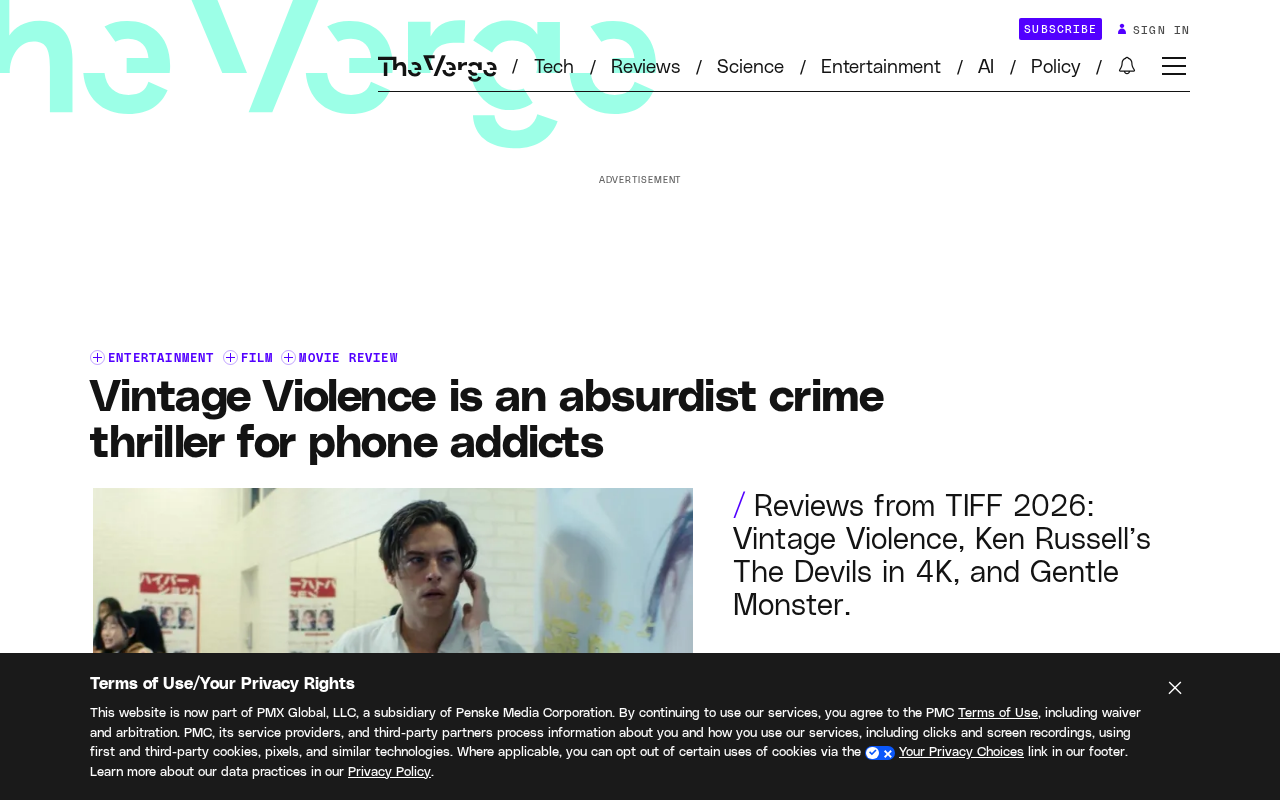
Vintage Violence is an absurdist crime thriller for phone addicts and one of the boldest screenlife experiments to date.
Vintage Violence continues the growing trend of filmmakers weaving smartphones, livestreams, and instant messaging into cinematic storytelling — and pushes it toward a more extreme, stylized extreme. Positioned as an absurdist crime thriller "made for phone addicts," the film treats the fragmented, screen-dominated texture of modern life as its core aesthetic rather than mere backdrop. The "absurdist" label suggests it forgoes realistic logic in favor of exaggeration and dark comedy to portray our near-pathological dependence on devices. Described as the "most chaotic" entry in the subgenre, that chaos appears to be a deliberate stylistic choice. Key details on plot and creative team remain limited pending wider release.
Many films have attempted to seamlessly weave modern technology — text messages, live streams, social media notifications — into their storytelling. These experiments are especially prevalent in genre cinema, such as Deadstream, a horror film built around the conceit of a Twitch-style livestream. Based on available materials, Vintage Violence may be the most chaotic and audacious attempt yet: an absurdist crime thriller centered entirely on phone culture and screen dependency.
Note: This article is based on a brief promotional synopsis. Original source material is limited, and the following discussion focuses primarily on the key points that have been established.
When Technology Becomes the Narrative Itself
For the past decade, filmmakers have been exploring how to bring smartphones, instant messaging, and online streaming to the big screen. It's no easy task — text messages slapped in a corner of the frame can disrupt the viewing experience, but when handled well, they can create an entirely new kind of immersion and realism.
Deadstream is one of the more inventive examples, using the Twitch livestream format to build its horror atmosphere, making the audience feel as though they're watching a real-time video spiral out of control. Films like this demonstrate that screen culture itself can function as a narrative language — not just a prop.
This creative trend is sometimes called the "screenlife film," pioneered most notably by Searching (2018), produced by Russian filmmaker Timur Bekmambetov — a film told entirely through the perspective of computer desktops and phone screens, establishing a complete visual grammar of its own. The Unfriended series applied the same format to horror, proving that the screen interface itself can generate psychological dread. These precedents show that "screen-native storytelling" is not a gimmick but a legitimate cinematic language with a growing body of successful examples. Its core logic is straightforward: notification banners, read-but-unanswered message bubbles, and suddenly dropped connections are inherently laden with suspense and anxiety, capable of triggering modern emotional memory in the audience at minimal cost.
Where Vintage Violence Fits In
Based on the original synopsis, Vintage Violence is positioned as an absurdist crime thriller "made for phone addicts." It appears to deliberately transform the fragmented, screen-dominated texture of modern life into the film's core aesthetic identity.
The label "absurdist" is worth noting. It suggests the film likely isn't pursuing a grounded, realistic crime narrative logic, but instead uses exaggeration, disorientation, and even dark comedy to portray the near-pathological dependency people have on their devices. According to the source material, this is described as the "most chaotic" entry in this subgenre — and that chaos is very likely a deliberate stylistic choice rather than a flaw.
Absurdism as a philosophical and aesthetic tradition traces back to thinkers like Camus, with its central tension being the human desire for meaning set against the inherent meaninglessness of the world. Translated into film style, the absurdist crime thriller is not an unfamiliar combination: the Coen Brothers' Fargo and No Country for Old Men both use absurdism to dissolve the moral order of conventional crime narratives. Applying this sensibility to phone addiction suggests the film likely has no interest in delivering a preachy critique of digital dependency. Instead, by amplifying its absurdity — people unable to put down their phones even in extreme circumstances — it generates a tension that is simultaneously funny and deeply unsettling.
The Potential of Combining Phone Culture with Genre Film
Merging phone addiction, a defining contemporary social phenomenon, with the crime thriller genre is inherently provocative. Virtually every modern viewer can relate to the feeling of being unable to put down their phone, giving the film a natural emotional entry point.
From an industry perspective, this kind of screen-native storytelling is emerging as a direction indie filmmakers are actively exploring. Production costs are relatively manageable, while the familiar digital interfaces still offer novelty and experimental potential. If Vintage Violence can find the right balance between absurdism and suspense, it could become a notable work in this niche.
That said, given the very limited information currently available, key details — including specific plot, creative team, and distribution — remain unclear. The actual quality of the finished film will ultimately require a viewing to assess.
Takeaway
Vintage Violence represents yet another filmmaker effort to integrate digital life into cinematic storytelling. Wrapped in the shell of an absurdist crime thriller, it trains its lens on the universal phenomenon of phone addiction. For audiences interested in the intersection of technology and popular culture, the value of films like this lies not only in the story itself, but in how they reflect and amplify our increasingly entangled relationship with screens.
Related articles

Databricks Genie: The AI Analytics Assistant That Tripled a Marketing Team's Data Usage
Databricks' AI analytics assistant Genie tripled marketing team data usage. Discover how this conversational NL2SQL tool lowers the data access barrier and what it means for enterprise AI adoption.

How The Oregon Trail Became a Cultural Icon for Generations
How The Oregon Trail grew from educational software into a multigenerational cultural icon — through classrooms, "You have died of dysentery," and shared childhood memories.

Health Benefits Platform Thatch Hits $1B Valuation as Healthcare Costs Surge
Thatch raises $108M and hits a $1B valuation, backed by a16z, Index Ventures, and General Catalyst, as surging U.S. healthcare costs drive demand for flexible benefits platforms.