ViRA Breakthrough for Ultra-High-Resolution Visual Agents: CrossRPO Teaches AI to 'Read Images' Instead of 'Guess Images'

CrossRPO uses contrast-set training to force visual agents to read evidence from ultra-high-resolution images rather than rely on common-sense guessing.
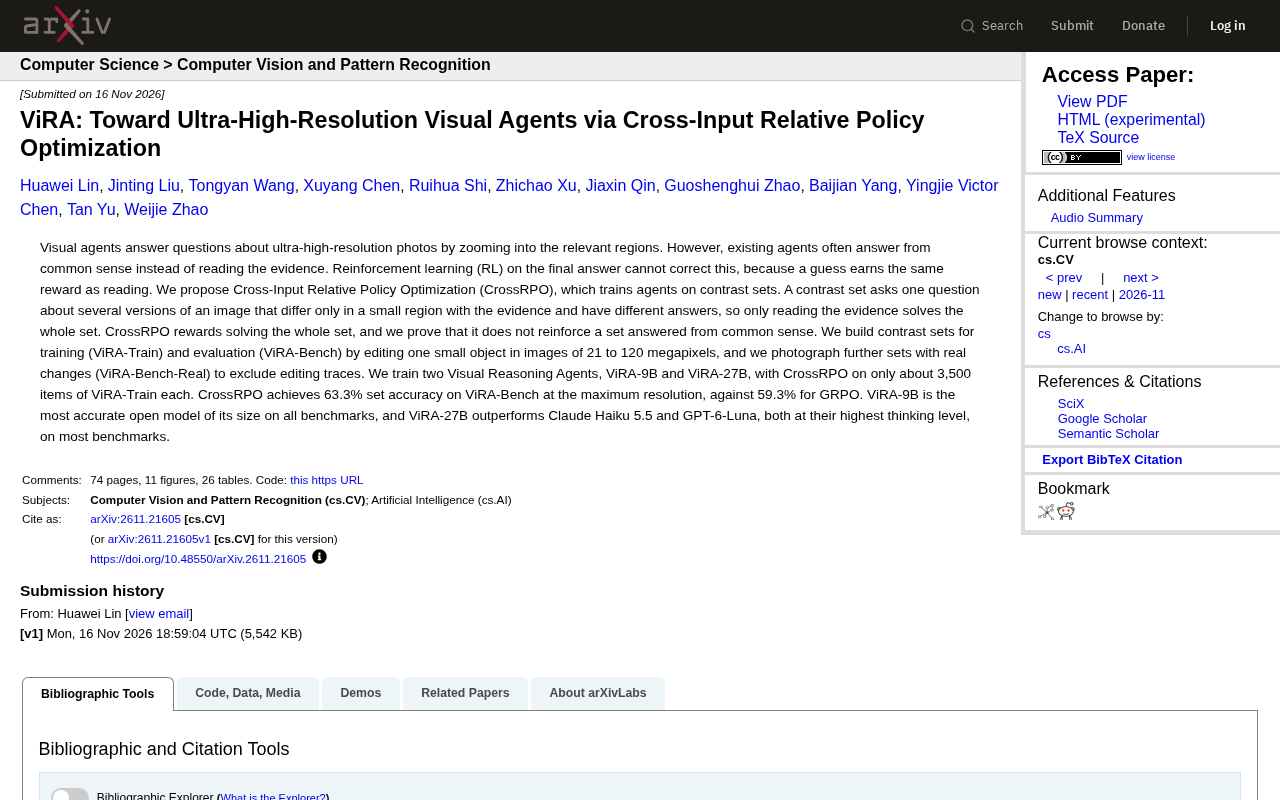
To address agents relying on common-sense guessing instead of reading evidence in ultra-high-resolution visual question answering, researchers propose CrossRPO. It constructs contrast sets with multiple image versions differing only in the evidence region and rewards solving the entire set, forcing fine-grained visual localization. ViRA-9B and ViRA-27B were trained; CrossRPO achieves 63.3% set accuracy versus GRPO's 59.3%, and ViRA-27B surpasses Claude Haiku 5.5 and GPT-6-Luna on most benchmarks.
Visual agents processing ultra-high-resolution images typically need to zoom into relevant regions to answer questions. However, existing agents often rely on common sense rather than actually reading evidence from the image. To address this pain point, researchers propose Cross-Input Relative Policy Optimization (CrossRPO), which trains agents with contrast sets and significantly improves the accuracy of ultra-high-resolution visual reasoning.
Problem Background: Why Do Agents 'Guess' Instead of 'Read'?
Ultra-high-resolution images (e.g., 21 to 120 megapixels) contain rich details, but when answering questions, agents often skip zooming in and directly give answers based on common sense or the overall semantics of the image. This 'guessing' behavior is difficult to correct in traditional reinforcement learning (RL), because when only the final answer is rewarded, a correctly guessed answer receives the same reward as an answer that truly reads the evidence. This means the model has no incentive to learn how to locate and interpret key regions.
According to the paper, existing agents commonly exhibit 'answering the wrong question' behavior when responding to ultra-high-resolution image questions—they may give plausible answers unrelated to the image evidence. This flaw is especially prominent in scenarios requiring fine visual discrimination, such as identifying tiny objects, reading blurry text, or judging subtle differences.
Foundations of Reinforcement Learning and Policy Optimization
Reinforcement learning (RL) uses reward signals to guide agents in learning policies, enabling them to take actions in an environment that maximize cumulative reward. In visual question answering tasks, an agent's 'actions' include deciding whether to zoom into an image region, which region to select, and how to interpret visual evidence. Traditional RL methods such as GRPO (Group Relative Policy Optimization) optimize policies by comparing a group of candidate answers relatively, but their rewards are based only on the correctness of the final answer. When the model guesses the answer correctly based on common sense, it receives the same reward as an answer that truly reads the evidence, so the policy gradient cannot distinguish between 'guessing' and 'reading.' This problem of sparse and non-discriminative rewards is the fundamental reason why visual reasoning agents struggle to learn fine-grained visual localization.
CrossRPO: Using Contrast Sets to Force the Model to 'Read Evidence'
To solve the above problem, researchers propose Cross-Input Relative Policy Optimization (CrossRPO). Its core idea is to construct 'contrast sets': for the same question, provide multiple image versions that differ only in a small region (the region containing the evidence), with different answers. Therefore, only by truly reading the evidence can the entire contrast set be solved; relying on common sense or guessing cannot correctly answer multiple versions at the same time.
CrossRPO's reward mechanism is designed to reward solving the entire contrast set rather than a single question. The paper proves that this reward method does not reinforce sets answered solely by common sense. In other words, the model must learn to focus on subtle differences in images to obtain rewards. This training approach forces the agent to develop fine-grained visual localization and evidence extraction capabilities.
To support training and evaluation, researchers constructed ViRA-Train and ViRA-Bench. These datasets are generated by editing a small object in 21 to 120 megapixel images, ensuring that the differences between contrast sets lie only in the evidence region. In addition, they captured real-world image sets with actual changes (ViRA-Bench-Real) to eliminate interference from editing artifacts and verify the model's generalization ability in real scenarios.
Contrastive Learning and Contrast Set Construction
The core idea of contrastive learning is to learn discriminative representations by comparing similarities and differences between samples. In CrossRPO, contrast sets are not used for representation learning but as a means of constructing training signals: for the same question, generate multiple image versions with subtle differences only in the evidence region and assign different answers. The model must identify these subtle differences to correctly answer all samples in the set simultaneously. This design transforms 'whether evidence is read' into a verifiable discriminative task, making the reward signal discriminative. The construction of contrast sets relies on local editing of ultra-high-resolution images, ensuring that differences exist only in the evidence region, thereby preventing the model from taking shortcuts using other visual cues.
Experimental Validation: Performance of ViRA-9B and ViRA-27B
Researchers used CrossRPO to train two visual reasoning agents on approximately 3,500 ViRA-Train samples: ViRA-9B and ViRA-27B. At maximum resolution, CrossRPO achieved 63.3% set accuracy on ViRA-Bench, compared with 59.3% for the baseline method GRPO. This improvement indicates that CrossRPO can effectively guide the model to focus on evidence regions.
ViRA-9B achieved the highest accuracy among open models of comparable scale and performed well on all benchmarks. ViRA-27B surpassed Claude Haiku 5.5 and GPT-6-Luna (both at their highest thinking levels) on most benchmarks. These results show that the CrossRPO method not only improves the model's reasoning ability on ultra-high-resolution images but also makes smaller-scale models competitive.
Set Accuracy Metric
Set accuracy is the core metric in CrossRPO training and evaluation, defined as the proportion of contrast sets in which the model correctly answers all questions simultaneously. Unlike traditional single-question accuracy, set accuracy requires the model to give correct answers on multiple image versions that differ only in the evidence region, so it can effectively distinguish between 'truly reading evidence' and 'guessing based on common sense.' For example, if a contrast set contains three image versions, the model must answer all correctly to be counted as correct. This metric directly reflects the model's ability to localize and interpret evidence regions, avoiding the inflation of single-question accuracy due to guessing. In experiments, CrossRPO achieved 63.3% set accuracy, significantly higher than GRPO's 59.3%, indicating that it indeed improves evidence-reading ability.
Significance and Outlook: A New Paradigm for Ultra-High-Resolution Visual Reasoning
The proposal of ViRA and CrossRPO provides a new approach for training ultra-high-resolution visual agents. Through contrast sets and relative rewards, the model is forced to learn to 'read images' rather than 'guess images,' which is expected to advance applications in visual question answering, document analysis, medical imaging, and other fields. In the future, researchers may need to further explore how to reduce the construction cost of contrast sets and how to extend the method to more complex reasoning tasks.
Overall, this study reveals the limitations of traditional reinforcement learning in visual reasoning and provides a verifiable solution. As ultra-high-resolution images become more widespread, visual agents capable of accurately reading evidence will become increasingly important.
One-line Summary
CrossRPO uses contrast-set training to force visual agents to read evidence from ultra-high-resolution images rather than rely on common-sense guessing.
Paragraph Summary
To address the problem that agents in ultra-high-resolution visual question answering rely on common-sense guessing rather than reading evidence, researchers propose CrossRPO. The method constructs contrast sets: for the same question, it provides multiple image versions with subtle differences only in the evidence region and different answers, and rewards the model for solving the entire set rather than a single question. This forces the model to focus on subtle image differences and develop fine-grained visual localization capabilities. Researchers constructed ViRA-Train, ViRA-Bench, and ViRA-Bench-Real datasets and trained ViRA-9B and ViRA-27B agents. On ViRA-Bench, CrossRPO achieved 63.3% set accuracy, outperforming GRPO's 59.3%. ViRA-27B surpassed Claude Haiku 5.5 and GPT-6-Luna on most benchmarks. This work reveals the limitations of traditional RL in visual reasoning and provides a new paradigm for training ultra-high-resolution visual agents.
Related articles

Prompt Engineering for Beginners: From Writing Prompts to Engineering Thinking
Starting from the essence and four functions of prompts, this article systematically explains the six-step process, four success criteria, learning value, and practical limitations of prompt engineering to help you build a complete understanding.

Anthropic Launches Nasdaq IPO: AI Giant's Listing and Risk Disclosures
Anthropic officially launches its Nasdaq IPO under ticker ANT, with market valuation expected to potentially exceed SpaceX's record. The prospectus devotes nearly 100 pages to AI risks, while first-half revenue grew over 14x but net losses widened sharply, reigniting the AI bubble debate.

Rust cURL Clone Uses 4,832 unsafe Blocks—Is the Memory Safety Myth Broken?
A Rust cURL clone uses 4,832 unsafe keywords, challenging Rust's memory safety narrative. We analyze what unsafe really means, compare Fil-C, and examine rewrite motives.